
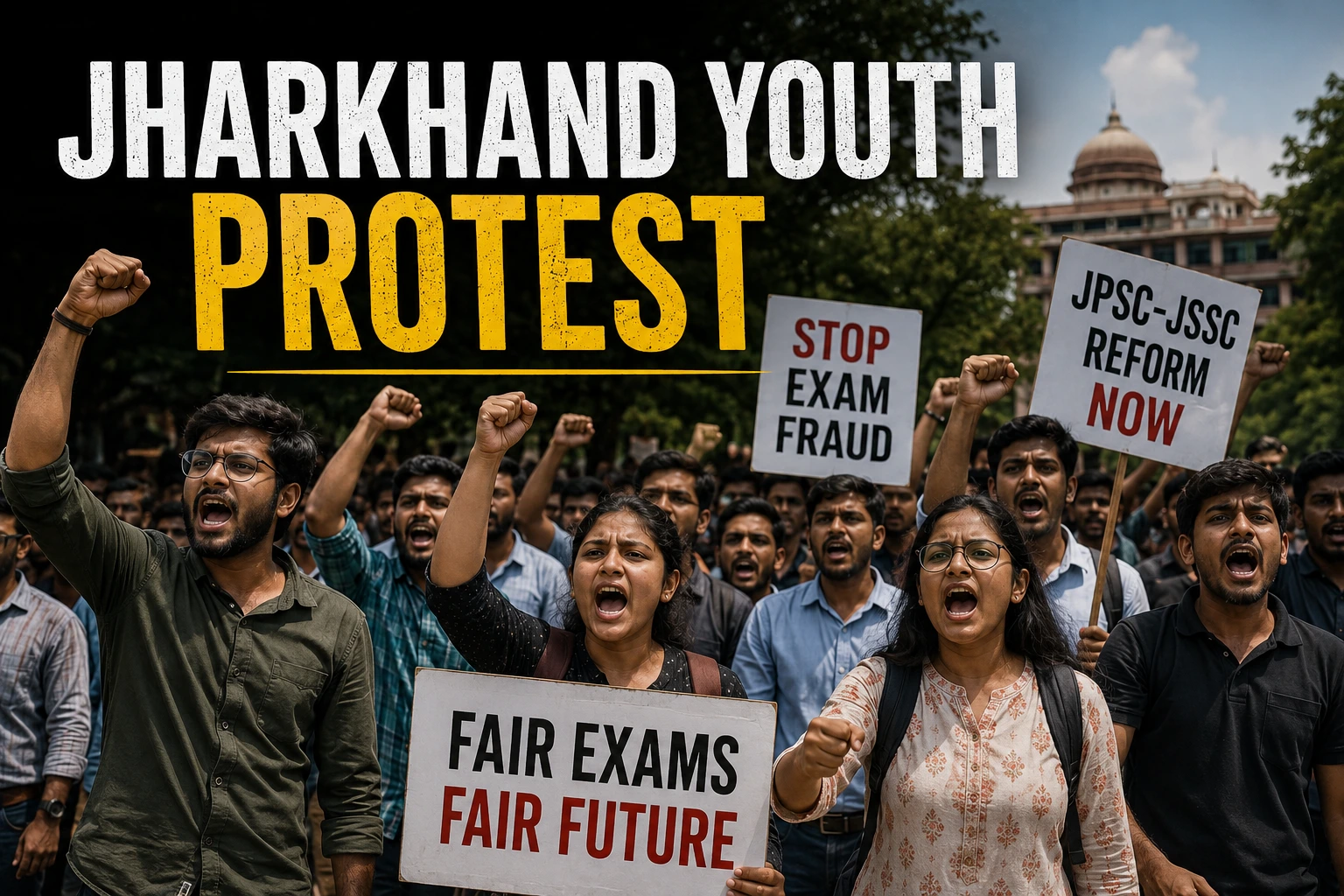
For many young people in Jharkhand, government recruitment is no longer just about clearing an examination. It has become a question of whether the system can be trusted at all.
Students and job aspirants have been protesting across Ranchi over alleged irregularities in examinations conducted by the Jharkhand Public Service Commission (JPSC) and the Jharkhand Staff Selection Commission (JSSC). Their complaints range from delays and disputed answer keys to alleged OMR-related irregularities, withheld cut-offs and demands for independent investigation. The protests have intensified as a CID investigation into alleged recruitment irregularities has resulted in arrests.
What is the protest about?
At the centre of the agitation are candidates who say they have spent years preparing for government examinations, only to find themselves caught in recruitment processes they believe lack transparency.
One of the protesters, Riya Tulika Pingua, told The Quint that she had prepared for UPSC and JPSC despite her family struggling to afford coaching. Her question — what to tell her parents when they ask why she is still unemployed — captures the frustration driving the movement.
The protesters are demanding a recruitment system in which examination dates, answer keys, results and cut-offs are released transparently and candidates have a clear mechanism to challenge mistakes.
Why are JPSC and JSSC under pressure?
JPSC and JSSC conduct recruitment examinations for different government posts in Jharkhand.
The current agitation involves allegations against several recruitment processes rather than one single examination. Protesters have raised concerns about:
OMR sheet and evaluation-related irregularities
Disputed answer keys
Changes in candidates' scores
Delays in examinations and results
Non-release of cut-offs
Alleged manipulation and fraud
Long gaps between recruitment notifications.
These are allegations made by protesters and candidates; they should not be treated as established facts unless confirmed through investigations or judicial findings.
The answer-key controversy
For some candidates, the dispute became personal after the publication of answer keys.
Brahmanand Kumar, a JSSC-CGL Technical examination candidate, alleged that several answers were initially marked incorrectly. After candidates raised objections, some answers were corrected, but he claimed other discrepancies remained.
He also alleged that the examination portal subsequently showed changes in scores, causing him to fall below the qualifying threshold.
Whether individual claims are ultimately proved is for the relevant authorities to establish. But such complaints have contributed to a larger loss of confidence among aspirants.
A recruitment system that moves slowly
Another major issue is the shortage of recruitment opportunities themselves.
Vikram Kumar, an engineering graduate and JPSC Assistant Engineer aspirant, told The Quint that the examination for the post has reportedly been conducted only three times — in 2007, 2013 and 2019.
He claimed that no fresh recruitment notification for engineering graduates had been issued since 2019 and that 539 positions remained vacant. He also pointed to the mismatch between the number of engineering graduates entering the job market and the number of government positions advertised.
For young people who have spent years preparing for government employment, every delayed notification effectively means another year of uncertainty.
Why are government jobs so important in Jharkhand?
For many families, a government job represents more than a monthly salary.
It offers stability, social security and, particularly in economically weaker households, a route to financial independence.
That is why an examination delay or an allegation of irregularity can have consequences far beyond the examination hall.
A candidate may spend several years preparing for one examination. If that process is delayed, cancelled or challenged, the candidate loses not just an attempt but potentially years of productive time.
This is one reason the current protests have attracted support from students who are not themselves JPSC or JSSC aspirants.
Why has the protest intensified now?
The agitation gained further momentum after investigations into alleged irregularities led to arrests.
According to The Quint, 19 people had been arrested in connection with the CID investigations at the time of its report. For protesting candidates, those arrests reinforced their belief that their complaints should be investigated seriously.
The protests have included hunger strikes, demonstrations and planned marches.
Some protesters have continued their fasts despite deteriorating health, while others have gathered at the Jaipal Singh Munda Stadium in Ranchi.
What are the protesters demanding?
The JPSC-JSSC Reform Manch has listed 21 demands.
Among the major demands are:
Cancellation of certain disputed examinations
Protesters want several examinations they consider compromised to be cancelled and conducted afresh.
Independent investigation
They have demanded a CBI investigation into alleged fraud and irregularities.
Transparent recruitment
They want clear examination procedures, answer keys, results and cut-offs.
Accountability
They want officials and others responsible for proven irregularities to face action.
What has the Hemant Soren government said?
Chief Minister Hemant Soren has said that the government is open to dialogue with the protesters.
The state has constituted an 11-member committee of ministers and officials to hold talks with the students. The protesters, meanwhile, have formed an eight-member delegation.
However, talks alone have not ended the agitation.
The protesters say they want concrete action on their demands rather than assurances.
Why does this matter beyond Jharkhand?
Jharkhand's recruitment crisis reflects a much larger problem faced by India's young job seekers.
Across the country, competitive government examinations have become extremely high-stakes because the number of applicants can far exceed the number of available posts.
That makes trust in the examination system just as important as the number of jobs being advertised.
If candidates believe that an answer key can change unexpectedly, results can be delayed indefinitely or recruitment can be challenged years later, the incentive to keep preparing starts to collapse.
The problem then becomes bigger than unemployment.
It becomes a crisis of institutional credibility.
The bigger picture
The Jharkhand protests are ultimately about three things: jobs, fairness and time.
Young people are willing to study for years for a government position. What they are demanding in return is a recruitment process they can trust.
The government may be able to end a protest through negotiations, but restoring confidence will require more than a meeting.
It will require transparent examinations, timely recruitment, credible investigations into genuine irregularities and clear accountability wherever wrongdoing is established.
Because for a young person who has spent years preparing for a government job, the question is no longer simply “Will I get selected?”
It is increasingly:
“Can I trust the process by which someone gets selected?”