
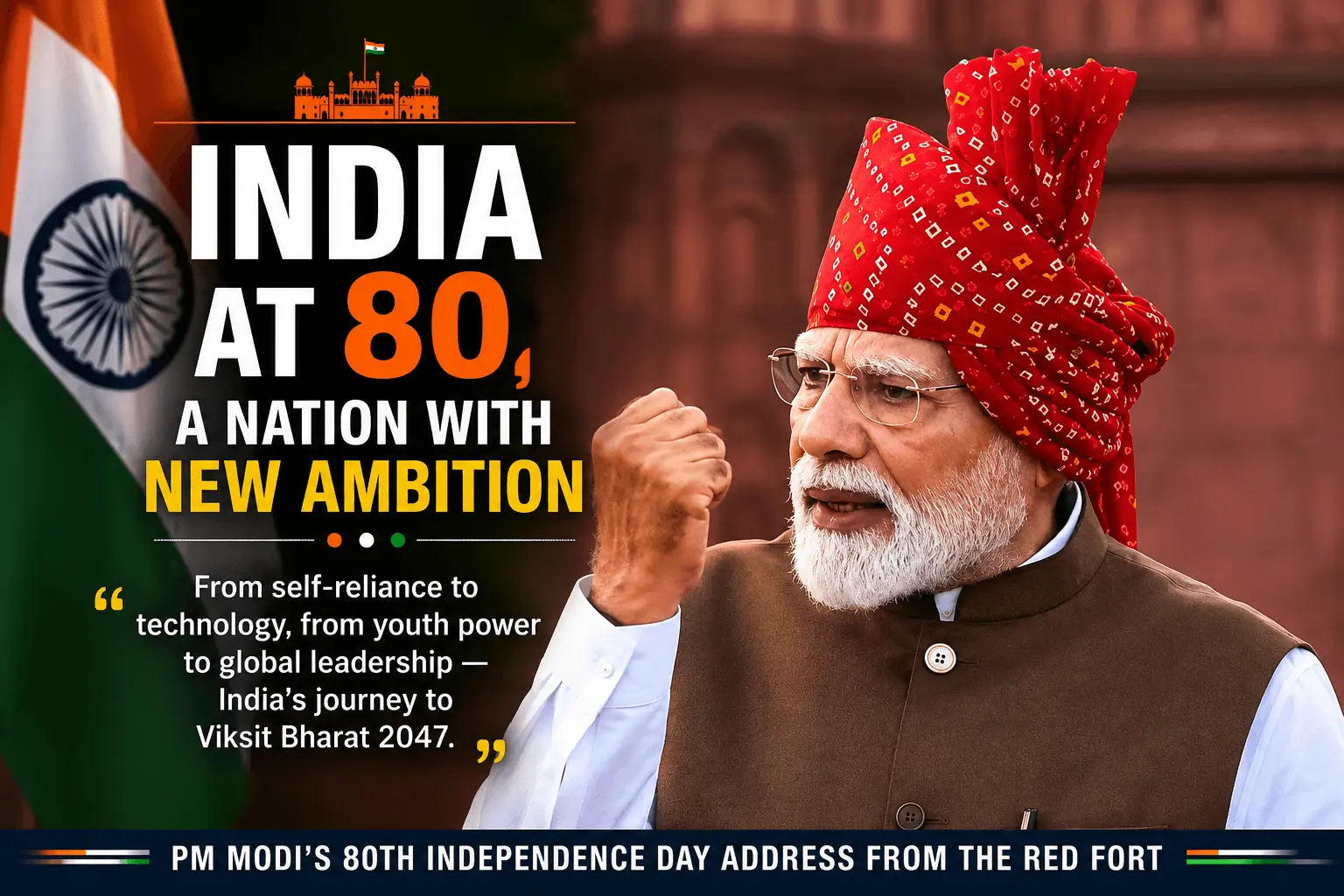
On India's 80th Independence Day, Prime Minister Narendra Modi outlined a seven-point development agenda, announced new programmes for young Indians and stressed self-reliance in manufacturing, technology, energy and defence.
India marked its 80th Independence Day on August 15 with Prime Minister Narendra Modi leading the national celebrations from the Red Fort in New Delhi. In his address, Modi focused heavily on India's journey towards Viksit Bharat by 2047, arguing that the country's future growth will depend on self-reliance, manufacturing, technology, energy security and the ambitions of its young population. The Editorial Team of Behind The Headlines reports that this year's speech was less about a single headline announcement and more about laying out a broad development roadmap, with the Prime Minister presenting seven areas of focus under what he called “Shakti ki Sapt Dhara.”
What happened at the Red Fort?
The Independence Day ceremony began with the traditional national celebrations at the Red Fort, including the flag hoisting, Guard of Honour and a 21-gun salute, followed by the Prime Minister's address to the nation. One of the notable features this year was the rendering of Vande Mataram as part of the official Red Fort celebrations, coinciding with the 150th anniversary of the National Song. Modi described the occasion as historic
.
The Prime Minister also paid tribute to India's freedom fighters and expressed solidarity with families affected by recent floods and landslides in different parts of the country. (
But the central theme of the speech was India's next phase of development.
Why is 2047 so important?
India will complete 100 years of independence in 2047.
The government has therefore set the goal of transforming India into a developed country by then, commonly referred to as Viksit Bharat 2047.
Modi said India must think beyond incremental progress and set bigger goals. He argued that larger ambitions create greater capabilities and urged citizens to move away from what he described as an earlier mindset of “hoti hai”, “chalti hai”, “ho jaega” and “dekha jaega”.
The broader message was that India's next 21 years should be about moving from economic growth to becoming a country with greater technological, industrial and strategic independence.
What is 'Shakti ki Sapt Dhara'?
One of the major elements of the speech was the announcement of a seven-point development framework.
Modi described these seven areas as “Shakti ki Sapt Dhara”:
Manufacturing
Agriculture and food processing
Technology and innovation
Gati Shakti and connectivity
Raksha Shakti and defence
Green and blue economy
India's soft power
The government sees these sectors as interconnected pillars of India's future growth.
The manufacturing focus, for example, was linked not only to producing goods in India but also to making Indian products globally competitive in terms of cost, quality and scale.
Why did manufacturing get so much attention?
Self-reliance was one of the strongest themes in the speech.
Modi said India cannot remain dependent on other countries and must strengthen its domestic capabilities. He linked this to the broader Atmanirbhar Bharat, Make in India and “Vocal for Local” approach.
The Prime Minister also urged Indian manufacturers and MSMEs to take advantage of new trade opportunities created by India's recent trade agreements.
The underlying objective is to make India not merely a large consumer market but a major global manufacturing and supply-chain hub.
That means producing more components domestically, improving product quality and competing globally rather than relying heavily on imported inputs.
Why did Modi focus on young Indians?
Youth emerged as another major theme.
During the speech, Modi announced an AI training programme aimed at training one crore young Indians within a year. He also announced free online coaching for young people.
The focus reflects a larger challenge for India.
A young population can become a major economic advantage if it has the skills required for the jobs of the future. But technology is also changing the nature of employment, particularly in areas such as artificial intelligence, software, manufacturing and digital services.
The government's message is therefore increasingly moving from simply creating jobs to creating a workforce capable of competing in an AI-driven global economy.
Why was AI mentioned prominently?
Artificial intelligence has become a strategic economic issue worldwide.
For India, the opportunity is particularly large because the country already has a substantial technology workforce and a large digital economy.
Training one crore young people in AI is intended to expand that talent pool.
But the larger challenge will be converting training into actual employment, entrepreneurship and productivity.
The announcement therefore matters not only because of its scale but because it reflects how the government sees AI as a core component of India's economic future.
What did Modi say about energy security?
Energy independence was another major part of the address.
Modi spoke about nuclear power, alternative energy and domestic exploration.
He said India has set a target of 200 GW of nuclear energy and is setting up five new nuclear reactors. He also highlighted progress in fast breeder nuclear technology, describing it as an important step towards greater self-reliance in nuclear fuel.
The Prime Minister also said India had opened up offshore areas that had previously been restricted for oil and natural-gas exploration.
The message is straightforward: a rapidly growing economy cannot remain excessively dependent on imported energy.
What is the significance of critical minerals and semiconductors?
Modern economies depend on technologies that require materials and components such as semiconductors and critical minerals.
These are essential for everything from smartphones and electric vehicles to defence systems and artificial intelligence infrastructure.
Modi therefore connected India's self-reliance agenda with semiconductor manufacturing and critical-mineral security.
The objective is to reduce vulnerabilities caused by dependence on foreign supply chains.
This has become increasingly important as geopolitical tensions have made countries more conscious of the risks associated with concentrated global supply chains.
What did Modi say about defence?
Defence manufacturing was included among the government's broader development priorities.
Under Raksha Shakti, Modi highlighted next-generation defence technologies, including drones and supersonic technologies.
He also pointed to the expansion of India's domestic defence production.
According to figures cited in the speech, defence production has increased nearly fourfold over the past 12 years. Modi also highlighted growth in electronics manufacturing and other industrial sectors.
The broader objective is to reduce India's dependence on imported military equipment while creating a domestic defence industry capable of exporting technology and products.
What does the government mean by the green and blue economy?
The sixth pillar of the seven-point framework focuses on India's natural resources and environmental opportunities.
The green economy includes areas such as renewable energy and sustainable technologies.
The blue economy covers India's oceans, coastal resources, marine industries and related economic activity.
India's large coastline and maritime position give the blue economy particular strategic importance, while the country's growing energy demand makes the transition towards cleaner energy increasingly important.
What role does soft power play?
The final pillar is India's soft power.
Modi highlighted areas such as Yoga, Ayurveda, holistic health, creative industries and tourism.
The idea is that India's influence does not come only from its economy or military.
Its culture, traditions and knowledge systems can also contribute to India's global image and economic opportunities.
Tourism and cultural industries can additionally generate employment while strengthening India's international presence.
What economic progress did Modi highlight?
The Prime Minister used the speech to point to changes across several sectors over the last 12 years.
He said defence production has increased nearly four times, Khadi and village-industry production nearly five times and electronics manufacturing nearly seven times. He also cited a major rise in mobile-phone production and digital transactions.
Modi argued that India had moved from being counted among the “Fragile Five” economies to becoming one of the world's major and fastest-growing economies.
These claims form part of the government's broader argument that India's economic trajectory has changed significantly over the past decade.
What is the bigger message of the 2026 speech?
The 80th Independence Day address can essentially be read as a roadmap built around self-reliance and scale.
India wants to manufacture more.
It wants to train more people in emerging technologies.
It wants greater control over energy and critical resources.
It wants to strengthen domestic defence production.
And it wants to use its demographic and cultural advantages to build a larger global economic presence.
The challenge, however, lies in implementation.
Announcing targets is easier than building the factories, training the workforce, creating jobs, attracting investment and ensuring that growth reaches different sections of society.
That is where the next phase of the Viksit Bharat agenda will be tested.
The road to 2047
India now has 21 years to reach the 2047 target.
The government's argument is that the country has already built significant momentum and now needs to move faster.
The focus on youth, AI, manufacturing, energy, defence and connectivity suggests that New Delhi sees the coming decades as a competition not only between economies but also between technologies, supply chains and national capabilities.
The Independence Day message therefore went beyond celebrating India's past.
It was largely about defining what India wants to become next.
The question now is not whether India can dream of becoming Viksit Bharat by 2047.
It is whether the country can turn these ambitions into measurable outcomes over the next two decades.