
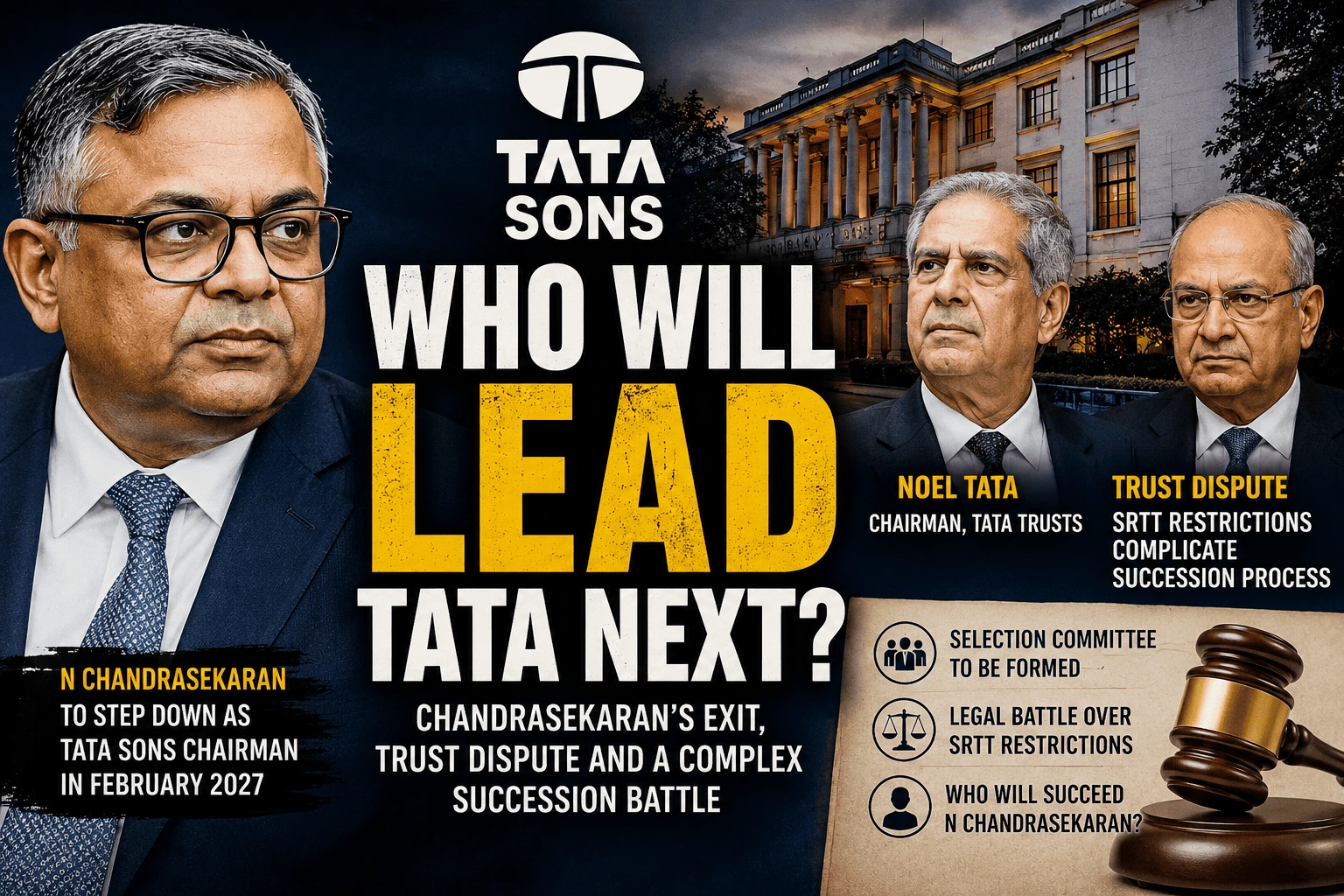
N Chandrasekaran will step down as Tata Sons chairman in February 2027, but the search for his successor has hit an unexpected hurdle: restrictions on the Sir Ratan Tata Trust could affect the very process meant to choose the next chairman.
N Chandrasekaran has decided not to seek another term as chairman of Tata Sons, bringing an end to his decade-long leadership of the Tata Group's holding company. His current term ends on February 20, 2027, giving the group several months to find his successor. But what initially appeared to be a routine leadership transition has quickly turned into a complicated governance issue involving Tata Trusts, the Sir Ratan Tata Trust (SRTT), the Sir Dorabji Tata Trust (SDTT) and restrictions imposed by the Maharashtra Charity Commissioner.
The Editorial Team of Behind The Headlines reports that the immediate concern is not simply who will replace Chandrasekaran, but whether the Tata Trusts can legally participate in all the decisions required to select his successor. SRTT is currently restricted from participating in certain key decisions, creating a problem because the principal Tata Trusts normally have to work together on important Tata Sons matters, including the formation of the committee that will recommend the next chairman.
What happened to Chandrasekaran?
Chandrasekaran informed Tata Trusts nominee directors that he would not seek reappointment when his current term ends in February 2027.
His decision came after a board-level disagreement over his proposed continuation. According to reports, the Tata Sons board had not reached unanimous support for his reappointment. Chandrasekaran subsequently decided that he would not seek another term rather than continue amid a lack of complete board backing.
This was significant because Tata Trusts had previously backed Chandrasekaran for another five-year term.
His departure therefore does not look like a conventional retirement planned years in advance. It comes after months of disagreements within the group's governance structure, particularly over the direction of Tata Sons and some of its businesses.
Who is Chandrasekaran and why does his exit matter?
Chandrasekaran became chairman of Tata Sons in 2017, succeeding Cyrus Mistry.
He had spent decades within the Tata Group and previously headed Tata Consultancy Services. During his tenure as Tata Sons chairman, the group expanded aggressively across areas including technology, automobiles, aviation, electronics and infrastructure.
The Tata Group also returned to aviation through the acquisition and rebuilding of Air India, while Tata Electronics expanded its ambitions in semiconductor manufacturing.
His departure therefore comes at a particularly important point for the conglomerate.
The next chairman will inherit a group with large ongoing investments, ambitious expansion plans and several businesses requiring significant capital and strategic oversight.
That makes succession much more than a change in title.
So, what is the problem with Tata Trusts?
This is where the story becomes complicated.
The Tata Trusts are central to the ownership and governance structure of Tata Sons. Two of the principal trusts are the Sir Dorabji Tata Trust (SDTT) and the Sir Ratan Tata Trust (SRTT).
The succession process requires the creation of a five-member Selection Committee under the Tata Sons Articles of Association. The committee will recommend a candidate to become the next chairman. SDTT has already passed a resolution to begin the process of setting up this committee.
But SRTT is currently facing restrictions imposed by the Maharashtra Charity Commissioner.
Those restrictions have prevented SRTT from participating in certain trustee-level decisions.
And that creates a problem.
According to reports, SRTT and SDTT need to jointly nominate members to the committee that will select Chandrasekaran's successor. If SRTT cannot participate, the normal process becomes difficult.
Why is SRTT restricted?
The restrictions are connected to an ongoing dispute involving the governance and composition of SRTT.
The Maharashtra Charity Commissioner had directed that SRTT could not participate in certain meetings and decisions while related issues were being examined.
The dispute has created a wider governance complication for Tata Trusts.
As a result, Tata Trusts has reportedly been considering urgent legal measures to restore SRTT's ability to participate in key decisions.
The legal step is important because the succession timeline cannot simply remain open indefinitely.
Tata Sons has an Annual General Meeting scheduled for August 18, and the inability of the two principal trusts to jointly nominate representatives has already complicated preparations for the meeting.
Why does the AGM matter?
An AGM is a routine corporate event, but this year's Tata Sons AGM comes at an unusually sensitive time.
The question is whether the required representatives can be nominated under the current restrictions.
Reports indicate that SDTT has said it cannot jointly nominate a representative with SRTT while the restrictions remain in place. Tata Sons may nevertheless proceed with the AGM, although questions over quorum and representation could complicate proceedings.
That means a legal dispute involving a charitable trust is now potentially affecting the governance of one of India's largest business groups.
Does this mean Tata Sons cannot find a new chairman?
Not necessarily.
The succession process has already begun.
SDTT has formally resolved to initiate the process of establishing the Selection Committee, which will recommend Chandrasekaran's replacement. Tata Trusts has also said it respects Chandrasekaran's decision and wants a smooth and timely leadership transition.
The problem is that the process may not be able to move forward normally until the SRTT issue is resolved.
This is why Tata Trusts is reportedly exploring legal options.
The objective would be to restore SRTT's participation sufficiently for the group to complete the succession process without creating another governance dispute.
Who could replace Chandrasekaran?
No successor has been officially announced.
Several names may be discussed internally and in the media, but the final decision will depend on the formal selection process.
One name that has begun circulating is T.V. Narendran, managing director and CEO of Tata Steel. Reports have described him as one of the possible contenders, although there is no confirmation that he has been selected or even formally nominated.
Other possibilities could include an internal Tata executive or an external candidate.
The selection committee is expected to play a central role in determining the eventual choice.
That makes the committee itself one of the most important pieces of the current succession puzzle.
Why is Noel Tata important in all this?
Another major figure in the unfolding story is Noel Tata, chairman of Tata Trusts and a nominee director on the Tata Sons board.
Following Ratan Tata's death in 2024, Noel Tata became chairman of Tata Trusts and subsequently took a more prominent position in the group's governance structure.
He now has an important role in the succession process because Tata Trusts controls the holding company and therefore has significant influence over the future leadership of Tata Sons.
There have also been reports of disagreements between Noel Tata and Chandrasekaran over certain businesses and strategic decisions.
However, those reports should not automatically be interpreted as evidence of a personal dispute. The broader issue appears to involve differences over governance, business performance and the future direction of Tata Sons.
Is this another Tata Group power struggle?
The comparison is difficult to avoid.
The Tata Group has experienced major boardroom conflicts in the past, most notably the removal of Cyrus Mistry as Tata Sons chairman in 2016.
The current situation is different in several respects.
Chandrasekaran is not being abruptly removed from office. He is expected to continue as chairman until the end of his current term in February 2027.
The concern this time is about how the next chairman will be selected and whether disagreements within the ownership structure could influence that process.
That distinction is important.
What happens next?
There are effectively three parallel processes now underway.
1. Find Chandrasekaran's successor
The Selection Committee must eventually identify and recommend a candidate for the Tata Sons chairmanship.
2. Resolve the SRTT restrictions
Tata Trusts may seek legal relief so that SRTT can participate in the decisions required for the succession process.
3. Manage the transition
Chandrasekaran is expected to remain in position until February 20, 2027, giving the group time to identify a successor and ensure an orderly handover.
Why does this matter for the Tata Group?
Tata Sons is not just another company.
It sits at the centre of a sprawling group whose businesses include TCS, Tata Motors, Tata Steel, Titan, Tata Consumer Products, Tata Power and Air India, among others.
The chairman therefore plays an important role in setting the overall strategic direction of the group.
The next chairman will inherit several major decisions, including the group's capital allocation, expansion plans, aviation strategy, technology investments and the future structure of Tata Sons itself.
There is also the unresolved question of whether Tata Sons should eventually be listed publicly, an issue that has reportedly generated differences within the group's leadership structure.
The bigger picture
The most important point is that Chandrasekaran's exit is only the beginning of the story.
The Tata Group now has to manage a leadership transition while simultaneously dealing with an ownership and governance dispute involving one of its principal trusts.
The group has time.
Chandrasekaran is not leaving immediately, and a selection committee is already being planned.
But the succession process needs the Tata Trusts' governance structure to function smoothly.
That is why the SRTT restriction has become so important.
If the legal issue is resolved quickly, the Tata Group can proceed with what should ultimately be a structured leadership transition.
If it remains unresolved, the succession process could become entangled in another round of internal governance disputes.
For now, the central question is not simply:
“Who will replace N Chandrasekaran?”
It is:
“Can the Tata Group resolve its own governance dispute before choosing the person who will lead it into its next chapter?”