
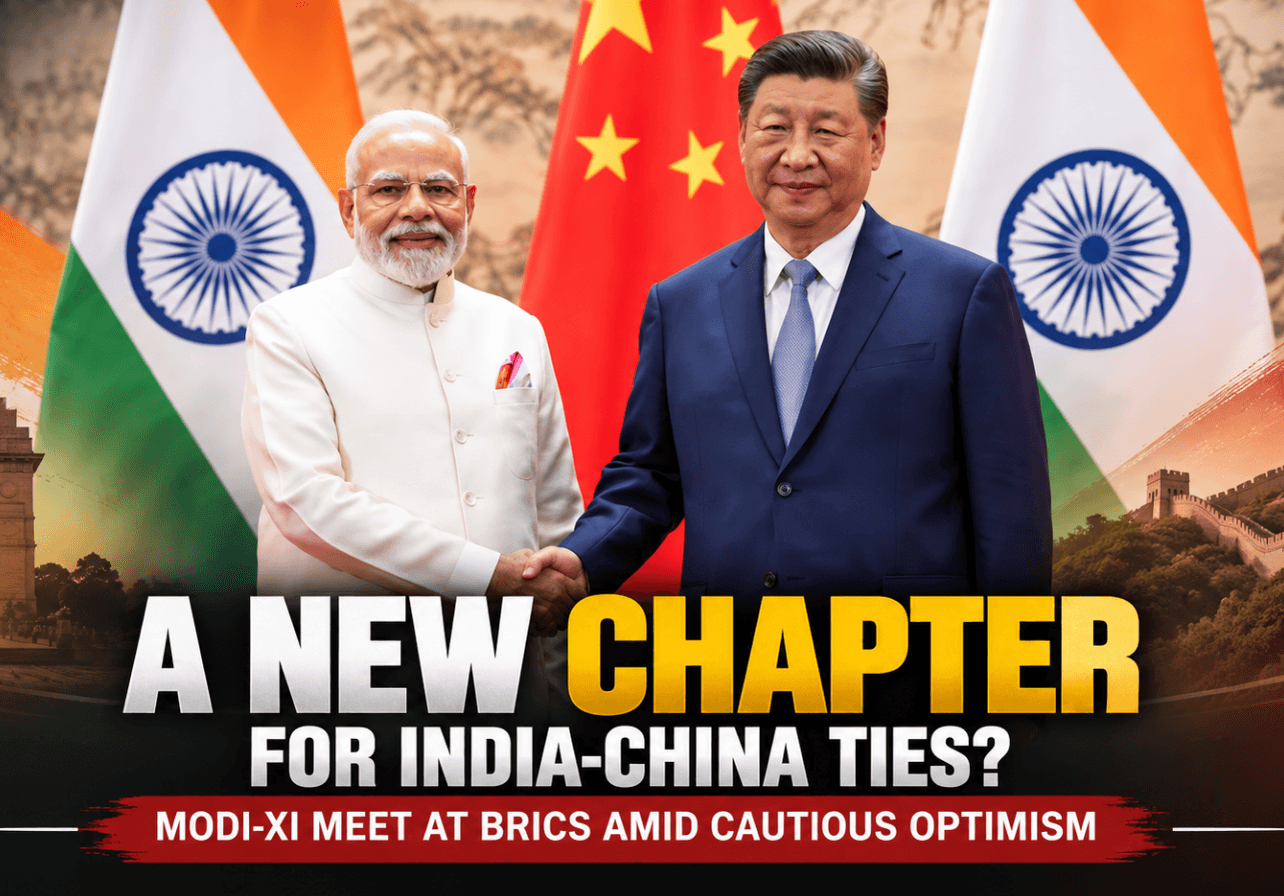
Xi Jinping’s expected visit to New Delhi for the BRICS Summit comes as India and China try to move beyond the tensions of 2020. But the relationship still carries a deep trust deficit.
India-China relations are entering a potentially important phase as Chinese President Xi Jinping is expected to visit New Delhi for the BRICS Summit on September 12-13, his first visit to India in seven years. A meeting with Prime Minister Narendra Modi could become one of the most closely watched events on the summit's sidelines.
The Editorial Team of Behind The Headlines reports that the significance of the possible Modi-Xi meeting goes beyond diplomatic optics. Both countries have taken steps towards stabilising relations after the 2020 border crisis, but major disagreements over the Line of Actual Control, trade imbalance, investment and strategic trust remain unresolved.
From Galwan to cautious engagement
India-China relations deteriorated sharply after the 2020 Galwan Valley clash, in which 20 Indian soldiers and four Chinese soldiers were officially reported killed.
For several years, political and economic engagement remained constrained.
The situation began changing after the two sides reached an agreement in October 2024 on patrolling arrangements in eastern Ladakh. Modi and Xi subsequently met in Kazan on the sidelines of the BRICS Summit, marking their first formal bilateral meeting in nearly five years.
Since then, both sides have gradually reopened channels of communication.
India and China have also worked towards restoring direct flights, facilitating visas and restarting the Kailash Mansarovar Yatra. Modi and Xi have repeatedly emphasised that differences should not become disputes.
But normalisation remains incomplete.
Why the BRICS meeting matters
The BRICS platform gives India and China a relatively comfortable diplomatic setting.
Unlike a purely bilateral summit, both countries can discuss global issues while simultaneously using the sidelines for sensitive bilateral conversations.
India is hosting the 18th BRICS Summit under the theme “Building for Resilience, Innovation, Cooperation and Sustainability.”
The expanded BRICS now has 11 full members, including India, China, Russia, Brazil, South Africa, Egypt, Ethiopia, Indonesia, Iran, Saudi Arabia and the UAE.
For New Delhi, the summit is also an opportunity to demonstrate that India can lead a diverse Global South grouping despite major differences among its members.
The border remains the biggest test
Any improvement in India-China relations ultimately depends on stability along the border.
Disengagement has reduced the immediate risk of confrontation, but the larger boundary dispute has not been resolved.
This means India is likely to remain cautious about describing the current phase as a complete “reset”.
The objective is more practical: prevent another crisis while gradually rebuilding confidence.
Recent diplomatic engagement has included Special Representatives talks on the boundary question. India and China have also discussed broader measures to maintain peace along the LAC.
A Modi-Xi meeting could therefore be important if the two leaders provide further political direction to these negotiations.
Trade is another difficult conversation
Economic relations present a paradox.
India and China are major trading partners, but their relationship is heavily imbalanced in China's favour.
Bilateral trade has reached record levels even as political mistrust remains high. At the same time, Indian policymakers continue to scrutinise Chinese investments and technology participation in sensitive sectors.
Some restrictions on Chinese investment were eased earlier this year, particularly in areas such as electronics, capital goods and solar manufacturing. Yet several Chinese companies remain cautious about expanding their footprint in India.
This creates a complicated situation.
India needs Chinese components and manufacturing capabilities in several sectors, while simultaneously wanting to reduce excessive dependence on China.
Beijing, meanwhile, wants greater access to the Indian market but remains wary of India's regulatory environment.
The trust deficit has not disappeared
The biggest obstacle may therefore not be trade or even the border.
It is trust.
India continues to view China's military posture and strategic partnerships, particularly with Pakistan, through a security lens.
China, meanwhile, closely watches India's growing partnerships with the United States, Japan, Australia and other Indo-Pacific powers.
Both countries say they should view each other as development partners rather than rivals.
But turning that principle into reality will require sustained action.
A senior Indian strategic analyst has described the relationship as one where trust remains limited and rebuilding it will require considerable effort.
India does not want a confrontation — but it also does not want dependence
New Delhi's approach appears increasingly pragmatic.
India is not seeking confrontation with China, but neither is it prepared to sacrifice its strategic interests to improve relations.
This is why the current approach can best be described as competitive coexistence.
India and China can cooperate on climate change, global trade, development financing, BRICS and multilateral reform while competing in technology, manufacturing, regional influence and security.
The two countries do not have to become friends to prevent their rivalry from becoming another military crisis.
What could come out of the Modi-Xi meeting?
A dramatic breakthrough on the boundary dispute would be difficult.
But smaller outcomes could be significant.
The two leaders could provide political direction for:
Further stabilisation along the LAC
Expansion of direct air connectivity
Easier business and travel visas
Greater economic engagement
Reduction of trade barriers
Cooperation on critical supply chains
Continued diplomatic dialogue on the boundary question
Even an agreement to keep communication channels open could have strategic value.
BRICS is bigger than India-China
There is another reason the Modi-Xi interaction matters.
BRICS itself is becoming more complicated as it expands.
The grouping now includes countries with sharply different positions on the US, Russia-Ukraine war, West Asia and global economic governance.
India is trying to focus the summit on practical areas where consensus is easier — resilience, food and energy security, health, technology, sustainability and development.
Experts have warned that India's ability to produce a meaningful joint declaration will itself be a test of its diplomatic leadership.
If Modi and Xi manage to demonstrate that two major rivals can cooperate within the same multilateral framework, it could strengthen India's broader BRICS message.
The road ahead
Xi's visit should not be interpreted as proof that India-China tensions are over.
Similarly, a successful Modi-Xi meeting would not automatically resolve the border dispute or eliminate India's concerns about Chinese economic and military activity.
What it could do is create political space for the next stage of engagement.
For India, the ideal outcome is not an unconditional reset.
It is a relationship in which competition continues but confrontation becomes less likely.
For China, improved relations with India could provide greater stability in Asia and help expand economic opportunities.
And for the wider region, a stable India-China relationship would reduce one of the biggest potential sources of strategic instability.
The real test of the Modi-Xi meeting will not be the handshake. It will be what happens after it.
If the two sides can convert diplomatic warmth into progress on the border, trade and people-to-people ties, the BRICS Summit could mark a meaningful step forward.
If not, the meeting may remain another symbol of a relationship that is improving — but only cautiously.