
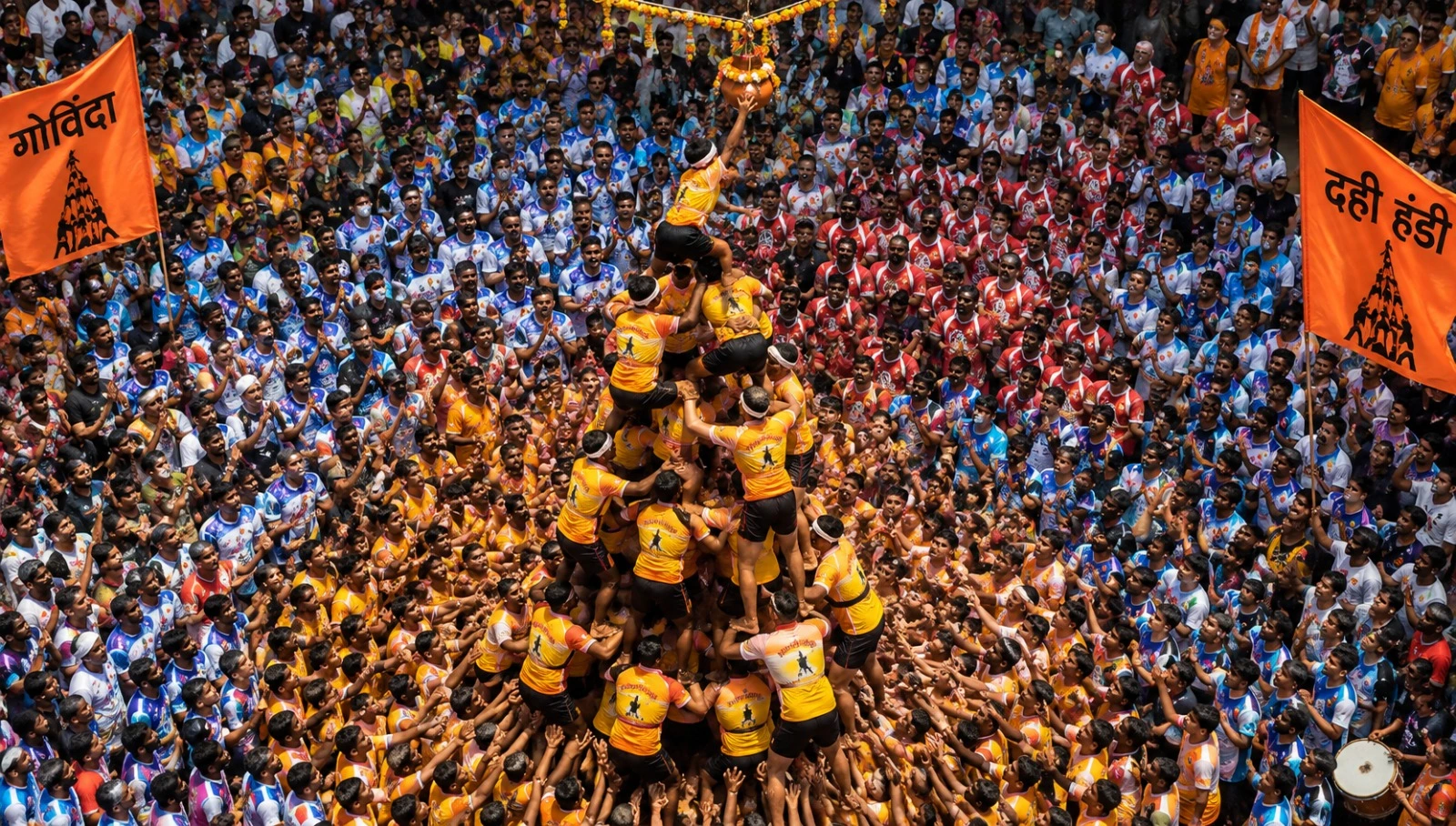
From neighbourhood lanes and modest clay pots to towering human pyramids, celebrity-filled stages and lakh-rupee prizes, Mumbai’s Dahi Handi has changed dramatically — yet its core spirit of teamwork, celebration and community remains intact.
Every year around Janmashtami, Mumbai changes its rhythm.
Drums become louder, streets become more crowded and groups of young men — and increasingly women and children — gather in matching outfits, preparing for one of the city's most recognisable spectacles: Dahi Handi.
At first glance, it is simply the act of breaking a pot filled with curd and other offerings suspended high above the ground. But in Mumbai, the tradition has evolved into something much bigger.
It is religion, sport, entertainment, community celebration and, increasingly, a form of public spectacle rolled into one.
The Editorial Team of Behind The Headlines reports that the festival's ability to constantly reinvent itself may be the biggest reason it continues to connect with different generations.
From a neighbourhood tradition to a citywide spectacle
Dahi Handi is associated with the childhood stories of Lord Krishna, who is traditionally depicted as stealing butter and curd with his friends.
The human pyramid represents that playful attempt to reach the pot.
In Maharashtra, particularly Mumbai, Thane and Pune, the tradition became deeply embedded in local culture. Govinda teams, or mandals, train together and compete to reach increasingly difficult heights. The festival is officially described as a celebration of teamwork, perseverance, devotion and coordination.
For older generations of Mumbaikars, however, the memory of Dahi Handi is often much simpler.
A pot hanging between buildings.
Children and teenagers gathering in the street.
Neighbours cheering from balconies.
A small local mandal attempting to break the handi.
There were fewer sponsors, fewer cameras and far less emphasis on prize money.
The celebration was primarily about the neighbourhood.
Then Mumbai made Dahi Handi bigger
Over the years, Dahi Handi began moving beyond the lanes.
Political leaders, local organisers and community groups started turning individual celebrations into large public events.
Fashion shows, music performances, Bollywood appearances and large cash prizes gradually became part of some major celebrations.
The result was a festival that could attract thousands of spectators.
For some, this represented commercialisation.
For others, it was simply the natural evolution of a living tradition.
The transformation also introduced ideas from outside India. One notable example was the interaction between Mumbai's Govinda teams and Castellers, the traditional human-tower groups of Catalonia, Spain.
The comparison was fascinating because two cultures separated by thousands of kilometres had developed strikingly similar forms of collective physical performance.
Why young people continue to participate
The festival's biggest strength is perhaps its ability to make young people feel that they are part of something larger than themselves.
A human pyramid cannot be built by one person.
Every participant has a role.
The people at the bottom provide stability.
Those in the middle carry weight and maintain balance.
The climbers depend on everyone beneath them.
And the person at the top has only a few seconds to complete the task.
That makes Dahi Handi a physical demonstration of trust.
One mistake can bring down the entire structure.
The Maharashtra Tourism Department describes the tradition as a demonstration of strength, coordination, teamwork and resilience.
For young participants, these values can be as important as the religious symbolism.
The festival has also become competitive
Modern Dahi Handi is not simply about breaking a pot.
Large events can involve substantial prize money, sponsorships, music, celebrity appearances and professional-level Govinda teams.
The height of the handi has become a challenge in itself.
Teams train for weeks and sometimes months.
Physical conditioning, balance and coordination have become increasingly important.
That competitive character has helped keep the festival relevant to younger audiences accustomed to sporting competitions and social-media spectacles.
A successful pyramid is now photographed, filmed and shared within minutes.
The festival therefore exists simultaneously on the street and on the smartphone screen.
But the risks are real
The evolution has also brought an uncomfortable question:
How far should competition go in a religious celebration?
Human pyramids are inherently risky.
Participants can fall from significant heights, while spectators and structures around the event can create additional dangers.
This year's celebrations in Mumbai highlighted that risk in tragic fashion.
A seven-year-old boy died in Malad after a brick column collapsed during a Dahi Handi celebration, while dozens of Govindas were treated for injuries across the city. Another participant died in Navi Mumbai after a human pyramid collapsed.
These incidents have once again brought safety to the centre of the Dahi Handi conversation.
The challenge for organisers is to preserve the excitement without allowing competition to overwhelm basic safety.
The festival keeps changing
Perhaps the most interesting thing about Mumbai's Dahi Handi is that there is no single version of it.
There are massive events with professional teams.
There are small neighbourhood celebrations.
There are traditional mandals that have been participating for decades.
And there are communities experimenting with completely different ways of celebrating.
In Maharashtra's Raigad district, for example, one village has maintained a distinctive Dahi Handi tradition involving participants jumping into a well rather than forming the conventional human pyramid. The practice has been described as more than a century old and offers a different way of preserving the festival while reducing some of the risks associated with tall pyramids.
That diversity says something important about the festival.
Traditions survive not because they remain frozen.
They survive because communities find new ways to keep them meaningful.
More than religion
Dahi Handi is unquestionably connected to Krishna and Janmashtami.
But Mumbai's version has developed an identity that extends beyond the religious ritual.
It brings together residents, spectators, musicians, athletes, organisers, businesses and political groups.
The streets become temporary community spaces.
People who may not know one another personally cheer for the same Govinda team.
For a few hours, neighbourhood identities become stronger.
That social dimension is one reason the festival continues to resonate even with people who may participate more for community and cultural reasons than religious ones.
A festival that refuses to belong to one generation
For someone in their 50s or 60s, Dahi Handi may bring back memories of watching Govindas in a neighbourhood lane.
For someone in their 30s, it may recall the era when Mumbai's major celebrations became increasingly glamorous.
For today's teenagers, it is equally a sporting challenge, a cultural event and social-media content.
The festival has managed to accommodate all three.
That is rare.
Many traditional celebrations struggle to remain relevant as younger generations develop different interests.
Dahi Handi has done almost the opposite.
It has adopted music, entertainment, competition, sponsorship and technology without completely losing its traditional identity.
The sound that connects generations
There is another reason Dahi Handi remains instantly recognisable.
The moment the drums start and the crowd begins shouting “Govinda Ala Re!”, generations seem to converge.
The famous song associated with the festival dates back to the 1963 film Bluff Master! and was sung by Mohammed Rafi.
That detail itself reflects the layered cultural history surrounding the celebration.
A song performed by a Muslim singer became closely associated with a Hindu festival and continues to evoke the same excitement decades later.
It is a reminder that popular culture often creates connections that are much more complex than religious or social labels.
What will Dahi Handi look like in the future?
The festival is unlikely to return to the modest celebrations of decades ago.
There will probably be bigger events, more sophisticated training, more sponsorships and even greater social-media visibility.
But there is also likely to be increasing pressure for safety.
The future of Dahi Handi may therefore depend on finding a balance between tradition and spectacle.
The human pyramid will remain.
The music will remain.
The cheering crowds will remain.
But organisers will have to make sure that the pursuit of height, money and publicity does not overshadow the reason the festival began in the first place.
Dahi Handi has changed with Mumbai — from a neighbourhood ritual to a citywide spectacle. Yet at its heart, it remains about people trusting one another enough to climb higher together.
And perhaps that is why, despite all the changes, it still belongs to every generation.