
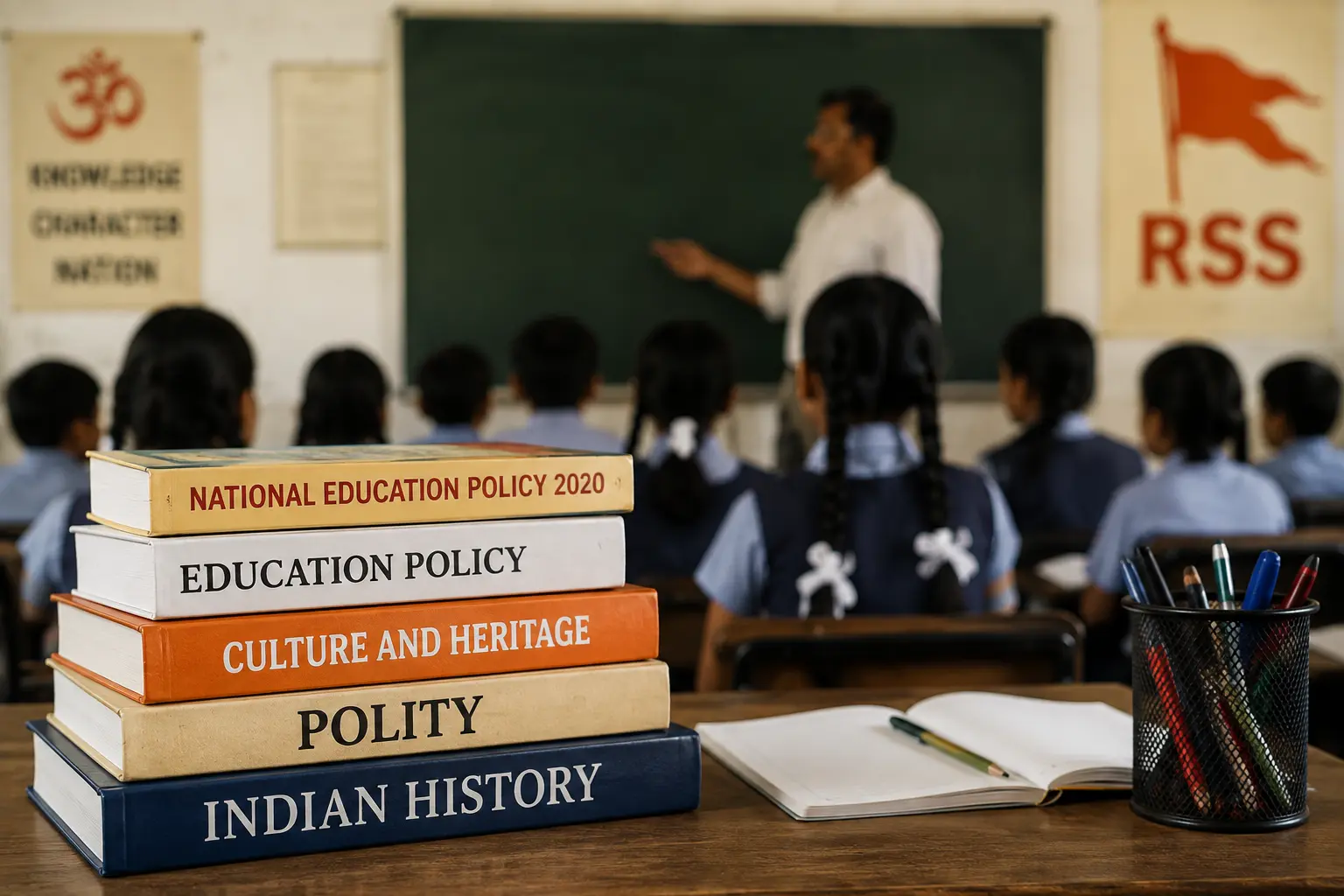
India's education system has once again become the subject of political debate after Leader of the Opposition Rahul Gandhi alleged in Parliament that the Rashtriya Swayamsevak Sangh (RSS) exercises significant influence over education policy. The remarks came during discussions on student protests, examination reforms and broader issues concerning the country's education system, triggering sharp responses from the ruling Bharatiya Janata Party (BJP).
What Triggered the Debate?
The discussion gained momentum during the Monsoon Session of Parliament, where Rahul Gandhi argued that the resignation of the Union Education Minister would not by itself change the functioning of the education system. He claimed that the RSS, rather than individual ministers, plays a central role in shaping educational policy and institutions. His remarks led to protests by treasury benches, and parts of his speech were objected to during the Lok Sabha proceedings.
The BJP rejected the allegations, describing them as politically motivated and defending the government's education reforms, including the implementation of the National Education Policy (NEP) 2020. Government leaders maintained that policy decisions are taken through constitutional and institutional processes.
Why Is the RSS Linked to Education?
The RSS is a socio-cultural organisation founded in 1925 and has a network of affiliated organisations working in different sectors, including education. Among the best-known is Vidya Bharati, which operates one of India's largest private school networks with thousands of schools across the country. The RSS ecosystem also includes student organisations such as the Akhil Bharatiya Vidyarthi Parishad (ABVP), which is active in universities and student elections.
Supporters describe these organisations as promoting Indian cultural values, character-building and national development. Critics, however, have argued that their educational approach reflects a particular ideological perspective, especially in debates over history, culture and curriculum.
Why Has Education Become a Political Issue?
Education has increasingly become a subject of political contestation in recent years. Debates have centred on curriculum revisions, textbook content, examination reforms, language policy and the implementation of the National Education Policy.
Several NCERT textbook revisions have drawn public attention, with some historical references being removed or modified. These changes have been defended by education authorities as part of curriculum rationalisation, while Opposition parties and some academics have questioned whether they alter historical context or reflect ideological preferences.
The issue has also gained prominence following nationwide discussions on examination integrity after paper leak controversies and student protests, bringing broader questions about governance and educational institutions into public debate.
What Are the Different Political Positions?
The Congress and several Opposition parties have argued that educational institutions should remain free from ideological influence and have called for greater institutional autonomy. Rahul Gandhi has repeatedly stated that India's education system should be rebuilt to focus on students and academic integrity while alleging ideological interference in policymaking.
The BJP has rejected these allegations, stating that reforms under the NEP are intended to modernise education, improve learning outcomes and strengthen Indian knowledge systems. The government has also argued that the Opposition is politicising education rather than engaging constructively on reforms.
What Happens Next?
The debate over education is expected to remain an important political issue as Parliament continues discussions on examination reforms, curriculum, and institutional governance. Implementation of the National Education Policy, curriculum updates and reforms to public examinations are likely to remain under public and political scrutiny.
While political parties continue to disagree over the role of ideology in education, future developments will largely depend on government policy decisions, judicial oversight where applicable, and ongoing parliamentary debate.