
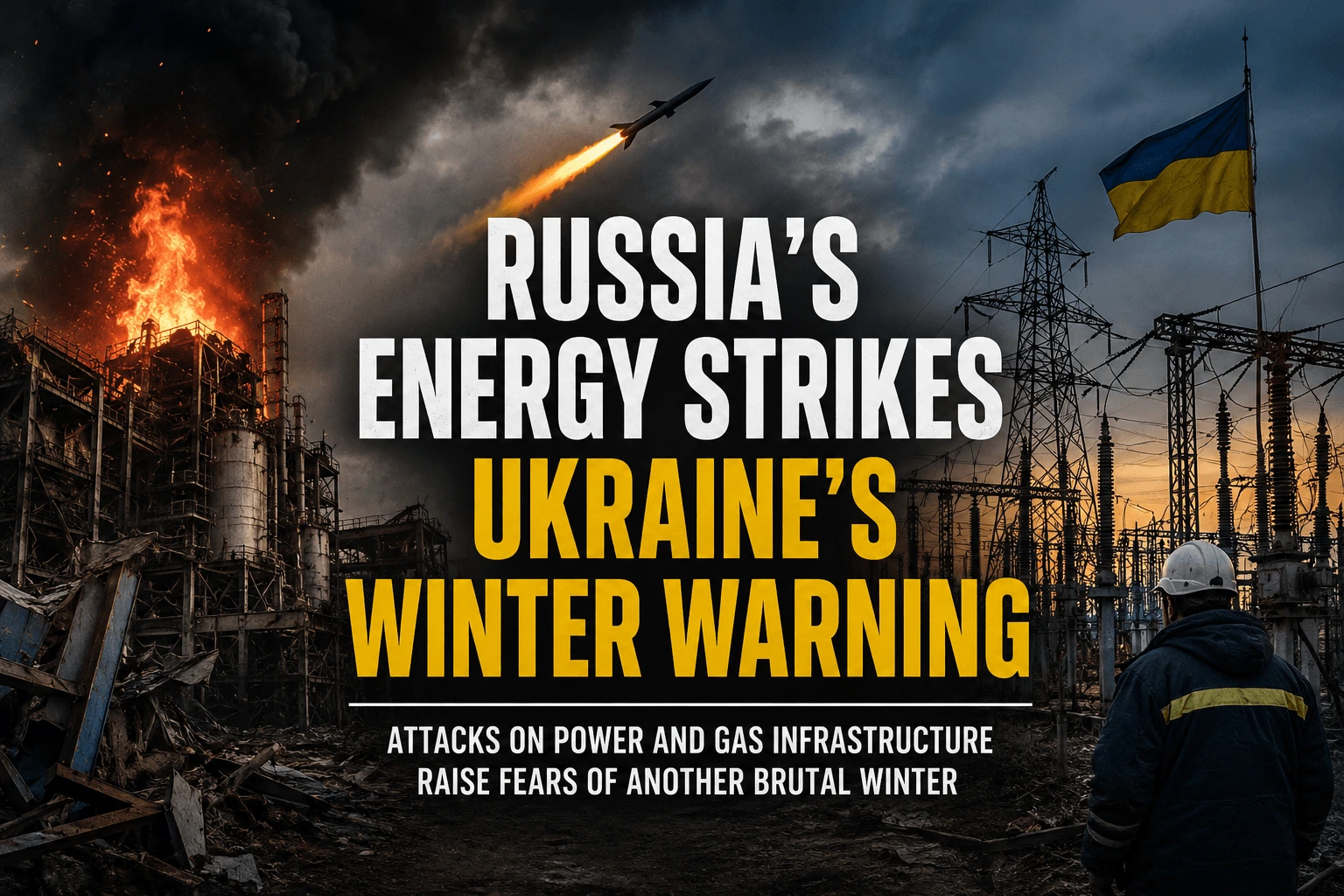
Repeated attacks on Ukraine’s oil and gas infrastructure are raising fears that Moscow could again target the country’s energy system before winter, threatening electricity, heating and fuel supplies.
Russia’s latest attacks on Ukraine’s energy infrastructure have revived fears of another difficult winter for millions of Ukrainians. Ukraine’s state energy company Naftogaz said Russian forces attacked its facilities 13 times in the week leading up to August 17, with several strikes causing serious damage to equipment and production capacity. Naftogaz said its facilities have been targeted almost 300 times since the beginning of 2026.
The Editorial Team of Behind The Headlines reports that the significance of the latest strikes goes beyond the immediate physical damage. Ukraine is entering another winter with parts of its energy infrastructure already weakened after years of Russian attacks. The concern in Kyiv is that Moscow could deliberately intensify attacks before temperatures fall, making it harder for the country to provide electricity, heating and gas to homes, hospitals and businesses. Ukrainian officials have described the strategy as an attempt to “weaponise winter.”
What happened?
Russian drones and missiles repeatedly struck facilities belonging to Naftogaz across several Ukrainian regions during the past week.
Naftogaz said one of its assets was hit multiple times, while critical equipment and production infrastructure suffered substantial damage. The company reported no employee casualties from those attacks.
The latest strikes follow a broader pattern.
Russia has increasingly targeted Ukraine’s energy infrastructure during the war, including power plants, gas production facilities, transmission networks and heating infrastructure.
The objective, according to Ukrainian officials and independent assessments, is not simply to destroy individual facilities. Damaging enough parts of the energy system can create wider disruptions because electricity, heating, water supply, communications and industrial activity all depend on reliable energy.
Why is winter making the attacks more serious?
Ukraine can manage some electricity disruptions more easily during warmer months.
Winter is different.
Temperatures can fall below freezing, while households depend heavily on electricity and centralised heating systems.
If power generation or gas supplies are disrupted, the consequences can quickly extend beyond people losing electricity.
Heating systems may stop working.
Water systems can be affected.
Hospitals and public services may have to depend on generators.
Businesses can face repeated shutdowns.
And damaged infrastructure becomes harder to repair during severe weather.
A UN human-rights assessment found that Russian attacks between October 2025 and March 2026 struck combined heat and power plants at least 74 times across nine Ukrainian regions and Kyiv. Kyiv's three major heating plants alone were hit at least 40 times during that period.
That experience is shaping Ukraine's fears for the coming winter.
Is Russia deliberately targeting Ukraine’s energy system?
Energy infrastructure has been a major target throughout the war.
The pattern has changed over time.
Earlier attacks concentrated heavily on electricity transmission infrastructure, including substations and transformers. More recent campaigns have also targeted power-generation facilities, natural-gas production and heating infrastructure.
A 2026 analysis by the Foundation for Strategic Research noted that Russia intensified attacks on critical infrastructure from August 2025 and increasingly targeted thermal and hydropower plants, gas facilities and even repair crews.
That matters because repeatedly damaging the same system can make restoration progressively more difficult.
A power plant can potentially be repaired after one attack.
But if another strike hits the same facility before repairs are complete, the recovery process can be pushed back again.
Why is Naftogaz particularly important?
Naftogaz is Ukraine's state-owned energy company and plays a central role in the country's natural-gas system.
Its operations include gas production and energy-related infrastructure that is critical to maintaining supplies.
That makes its facilities strategically important.
The latest attacks therefore raise concerns about Ukraine's ability to maintain sufficient domestic production ahead of the heating season.
The problem is not simply whether a single facility is destroyed.
It is whether enough production capacity remains operational to meet demand when households and businesses need substantially more energy.
Has Ukraine faced this problem before?
Yes—and the consequences have been severe.
Russia launched major waves of attacks against Ukraine's energy system during previous winters, causing large-scale blackouts and disrupting heating supplies.
The International Energy Agency has previously warned that attacks on power infrastructure can have cascading effects because electricity is essential to almost every part of modern life.
During the winter of 2025-26, the pressure was particularly intense.
UN human-rights monitors reported that attacks damaged or destroyed key components of Ukraine's energy system in at least 17 regions and Kyiv.
The coming winter therefore begins with Ukraine already having experience of prolonged energy disruption.
Why can't Ukraine simply protect all its power plants?
This is one of the biggest challenges facing Kyiv.
Ukraine has strengthened its air-defence network and built layers of protection around critical infrastructure.
But the country has a huge amount of territory and a large number of energy facilities.
Protecting every power plant, gas facility, substation and transmission line around the clock is extremely difficult.
Russia can also use different types of weapons, including drones and missiles, forcing Ukraine to spread its air-defence resources across multiple locations.
Ukraine has repeatedly asked its Western allies for additional air-defence systems, particularly US-made Patriot interceptors.
President Volodymyr Zelenskyy said recently that Ukraine needs more Patriot systems to protect civilians and critical infrastructure through the winter. Reuters reported that Zelenskyy argued even a relatively small share of US Patriot stocks could significantly improve Ukraine's ability to defend against Russian ballistic missiles.
Why are gas supplies becoming a major concern?
Gas is particularly important during winter because it is used for heating as well as industrial activity.
Ukraine has underground gas storage facilities and can import gas from European markets, but repeated attacks on domestic production increase the amount the country may need to purchase from abroad.
A European Union document earlier this year said attacks had reduced Ukrainian gas production capacity and created additional requirements for imported gas to ensure adequate supplies during the heating season.
That creates another problem: money.
Replacing destroyed equipment and purchasing additional gas simultaneously puts pressure on Ukraine's finances.
Could Ukraine avoid another major energy crisis?
Yes.
Ukraine has spent years adapting to Russian attacks.
It has expanded backup power generation, decentralised parts of its energy system, increased imports from Europe and strengthened emergency repair capabilities.
The country has also learned how to restore damaged infrastructure quickly.
But resilience does not mean immunity.
A sufficiently large or sustained attack campaign could still create major shortages.
That is why Ukrainian authorities are preparing for the winter months well in advance.
Is Russia also facing energy attacks?
Yes.
The energy war is not one-sided.
Ukraine has increasingly used long-range drones to strike Russian oil refineries and energy infrastructure.
In August alone, Ukrainian attacks have hit several Russian oil facilities, including the Gazprom Neftekhim Salavat complex in Bashkortostan, roughly 1,300 kilometres from Ukraine. AP reported that the strike caused a fire at the refinery, while Ukraine has said its campaign against Russian oil infrastructure is intended to put pressure on Moscow.
That creates a dangerous cycle.
Russia attacks Ukrainian energy infrastructure.
Ukraine attacks Russian oil and energy facilities.
Both sides attempt to damage the other's ability to sustain the war.
The difference is that Ukraine's energy system directly affects the daily survival of a population facing winter conditions, while Russia's oil sector is also central to its economy and military financing.
Why is the coming winter being called a warning?
Because the latest attacks are occurring months before the coldest period begins.
That gives Russia an opportunity to damage infrastructure before Ukraine enters its peak heating season.
The repeated strikes on Naftogaz facilities are therefore being viewed in Kyiv as an early warning rather than an isolated episode.
If the attacks continue at the current pace—or intensify—Ukraine could enter winter with less available production capacity and a greater dependence on imported energy.
The timing is what makes the situation particularly worrying.
What could happen to ordinary Ukrainians?
The worst-case scenario would not necessarily mean the entire country losing electricity.
More likely, different regions could experience scheduled or emergency power cuts.
Heating could be interrupted in areas where infrastructure is heavily damaged.
Households may need alternative heating and power sources.
Hospitals and essential services could increasingly depend on backup generators.
Businesses could face interruptions, while factories may have to reduce production.
For people living close to the front lines, the consequences could be even more severe.
The challenge is therefore not only military.
It is humanitarian.
What does this mean for Europe?
Ukraine's energy problems can also affect its European neighbours.
Ukraine is connected to the European electricity network, allowing it to import electricity when domestic production falls.
European countries can also help supply gas.
But Ukraine's energy deficit increases the demand on European markets and requires additional financial and logistical support.
The longer the war continues, the more important European assistance becomes for maintaining Ukraine's energy resilience.
What happens next?
The coming months will be crucial.
Ukraine will attempt to repair damaged facilities, build backup capacity, increase gas reserves and strengthen air defence around critical infrastructure.
Russia, meanwhile, could continue using drones and missiles against energy targets.
The key question is whether Ukraine can repair and replace infrastructure faster than Russia can destroy it.
That is essentially the energy battle taking place behind the larger war.
The bigger picture
The latest strikes do not mean that Ukraine is certain to face another nationwide blackout this winter.
But they do show why Kyiv is already preparing for a difficult heating season.
The war has increasingly moved beyond the battlefield. Power plants, gas facilities, refineries and electricity networks have become strategic targets because damaging them can affect an entire country's ability to function.
For Russia, energy infrastructure offers a way to exert pressure without having to capture territory.
For Ukraine, protecting that infrastructure has become a matter of national resilience.
And as winter approaches, the question is becoming increasingly urgent:
Can Ukraine keep its lights and heating on faster than Russia can knock them out?