
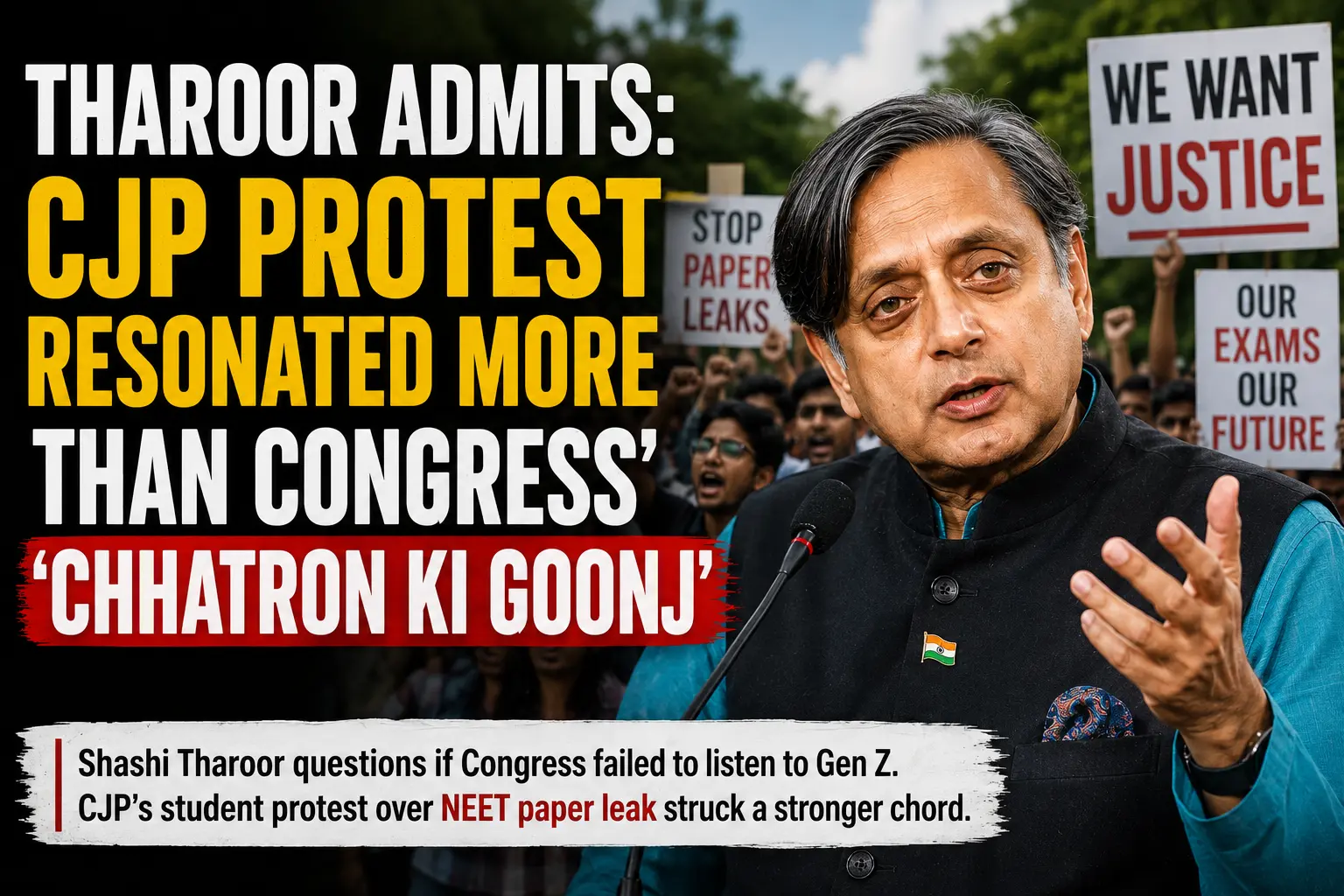
The CJP student protest connected with young people more strongly than Congress’s campaign on similar issues.
Congress leader Shashi Tharoor has acknowledged that the Cockroach Janta Party (CJP) protest over the NEET-UG 2026 paper-leak issue resonated more strongly with young people than Congress’s own “Chhatron Ki Goonj” campaign. Speaking about the contrasting response, Tharoor questioned whether Congress had failed to listen closely enough to Gen Z and understand what young Indians were feeling. The Editorial Team of Behind The Headlines reports that his remarks come as the CJP movement has drawn significant attention through sustained protests and youth mobilisation.
The comparison is significant because Congress had already been raising concerns over examination irregularities and paper leaks through its student-focused outreach. Rahul Gandhi’s “Chhatron Ki Goonj” campaign was designed to bring student concerns, including examination problems and unemployment, into the political debate. At the same time, the CJP began its NEET-UG protest on June 20 and gradually turned the issue into a wider youth campaign, with climate activist Sonam Wangchuk later joining the protest and going on hunger strike. Tharoor has previously supported the protesters and said student grievances deserved to be heard in Parliament.
Tharoor’s admission points to a larger challenge for Congress: raising an issue is not necessarily the same as connecting with the people affected by it. The CJP protest used a more informal and youth-oriented style, while Congress approached many of the same concerns through a conventional political campaign. The difference in response has now prompted questions about whether established parties understand how Gen Z organises, communicates and chooses the issues it wants to fight for. For Congress, the immediate lesson may be that young voters are not simply looking for politicians to speak on their problems — they want to feel that political leaders are listening to them.