
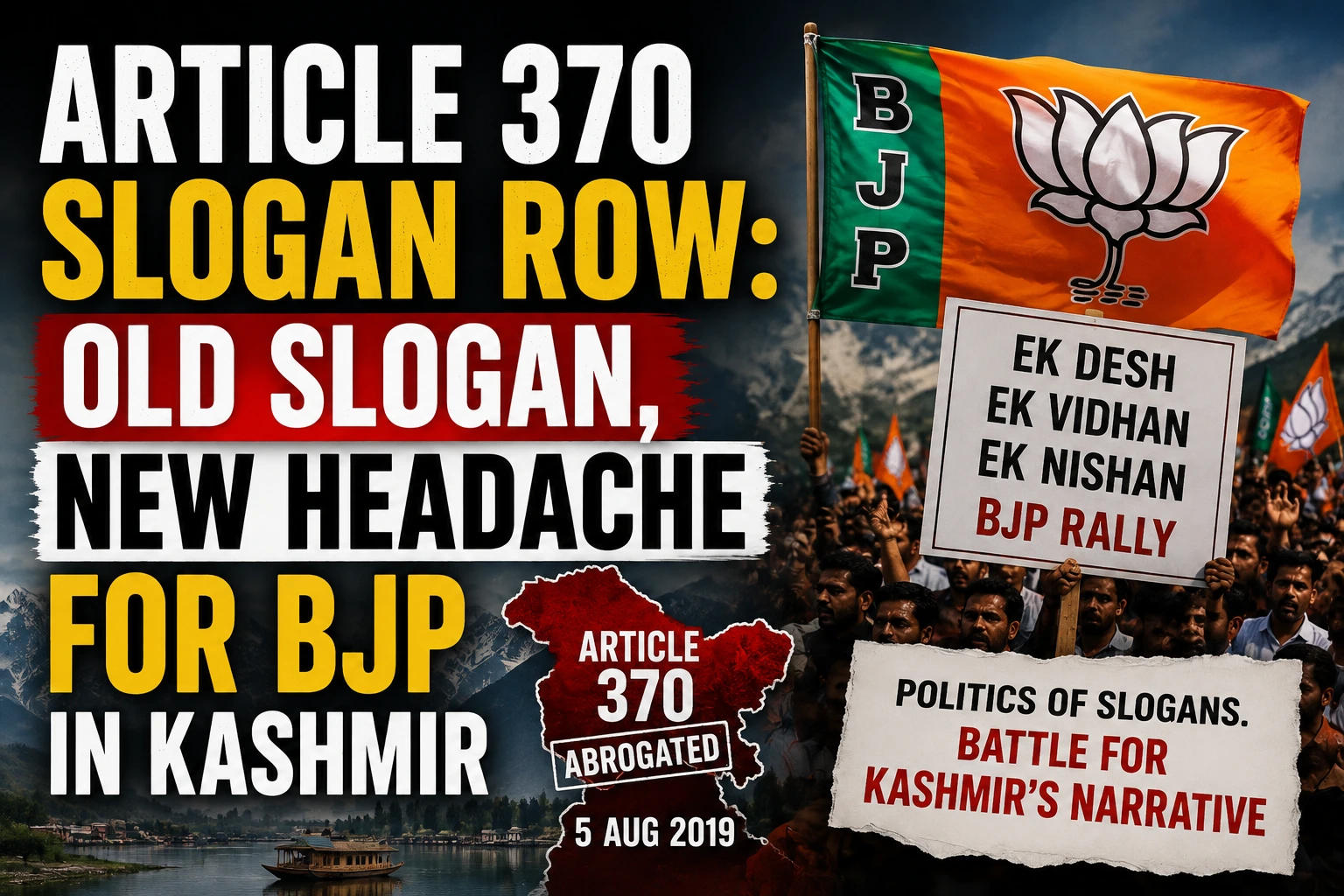
A BJP rally to mark seven years of Article 370’s abrogation has triggered an unexpected political controversy in Jammu and Kashmir.
The BJP organised events on August 5 to celebrate the 2019 constitutional changes, but a slogan raised at one of its rallies — a modified version of a decades-old slogan associated with the National Conference’s political history — has created an awkward situation for the party. What was meant to underline the BJP’s Kashmir narrative instead opened up questions about the party’s own messaging, the history of Article 370 and the changing politics of Jammu and Kashmir. The Editorial Team of Behind The Headlines reports that the controversy comes at a particularly sensitive moment, with the region marking seven years since Article 370 was made inoperative and Jammu and Kashmir was reorganised into two Union Territories.
What happened at the BJP rally?
The BJP had planned celebrations across Jammu and Kashmir to mark the seventh anniversary of the August 5, 2019 decision. For the BJP, the anniversary is a political milestone: the party had opposed Article 370 for decades and had made its removal one of its core ideological commitments.
But the slogan controversy changed the tone.
The political history of Article 370 is unusually complicated. Different political movements in Jammu and Kashmir used slogans around autonomy, integration and special status, often reflecting sharply different ideas of what the region's relationship with the Union should look like.
The BJP's own historical slogan was famously associated with Syama Prasad Mookerjee and the Jana Sangh: “Ek desh mein do vidhan, do pradhan, do nishaan nahi chalega” — arguing against having separate constitutional arrangements, a separate head of state and a separate flag for Jammu and Kashmir.
The National Conference, meanwhile, built much of its political identity around Jammu and Kashmir's autonomy and special constitutional position. The party repeatedly defended Article 370 and later demanded restoration of greater autonomy.
That is why the latest slogan row is politically significant: the BJP is now trying to project the post-2019 Kashmir story as one of integration and development, while its opponents continue to frame August 5 as the beginning of the region's political disempowerment.
Why is a slogan such a big deal?
In Kashmir politics, slogans are rarely just slogans.
They carry decades of political memory.
For the BJP, Article 370 represented what it described as an obstacle to complete constitutional integration. For the National Conference and other regional parties, Article 370 became a symbol of Jammu and Kashmir's distinct political identity and its relationship with New Delhi.
The political meaning of the slogan therefore depends on who is saying it, where it is being said and what message it is intended to convey.
The current controversy is particularly uncomfortable for the BJP because the party has spent years presenting itself as the political force that ended the Article 370 era.
Now, seven years after that decision, a slogan linked to the old Kashmir political vocabulary has resurfaced at a BJP event — giving its opponents an opportunity to question whether the party's message in Kashmir is as clear as it claims.
What exactly happened in 2019?
On August 5, 2019, the Union government announced major constitutional changes concerning Jammu and Kashmir.
The government used Constitutional Order 272 and a resolution in Parliament to make most provisions of Article 370 inoperative. Parliament also passed the Jammu and Kashmir Reorganisation Act, 2019, which divided the erstwhile state into two Union Territories:
Jammu and Kashmir, with a legislative assembly
Ladakh, without a legislative assembly
The Supreme Court subsequently upheld the constitutional changes in December 2023, while also directing that elections be held and statehood be restored to Jammu and Kashmir at the earliest.
For the BJP, this fulfilled a decades-old ideological promise.
For the National Conference, PDP and several other regional political forces, it represented the loss of the constitutional arrangement that had defined Jammu and Kashmir's special position.
That disagreement has not disappeared seven years later.
Why does the BJP celebrate August 5?
The BJP's opposition to Article 370 predates the modern BJP itself.
The party traces its ideological roots on the Kashmir question to Syama Prasad Mookerjee, founder of the Bharatiya Jana Sangh.
Mookerjee opposed the special constitutional arrangements for Jammu and Kashmir and launched a political movement demanding greater integration with India. He entered Jammu and Kashmir in 1953 despite restrictions and was arrested. He died in custody in Srinagar that June. The BJP has subsequently treated his death and political campaign as an important part of its Kashmir narrative.
For decades, the BJP and its predecessor organisations demanded the removal of Article 370.
The 2019 decision therefore became much more than a government policy announcement for the party.
It was presented as the fulfilment of a long-standing ideological commitment.
Why does the National Conference still talk about Article 370?
The National Conference has a very different historical relationship with Article 370.
The party was founded in 1932 and became the dominant political force in Jammu and Kashmir under Sheikh Abdullah.
Its political programme historically focused on greater autonomy and protecting the region's distinctive constitutional position.
Even after Article 370 was removed, the party continued to demand its restoration.
The issue was also part of the National Conference's political messaging during the 2024 Assembly elections. The party won 42 seats and formed the government with Omar Abdullah as Chief Minister.
Omar Abdullah has, however, also acknowledged the difficulty of rebuilding a political platform around Article 370 after the Supreme Court's 2023 verdict.
The party's challenge is therefore unusual: it has to represent the anger surrounding the 2019 decision while operating within the constitutional reality created after 2019.
What has changed in Kashmir since 2019?
This is where the political debate becomes more complicated.
The BJP argues that the removal of Article 370 has brought greater integration, investment, infrastructure development and improved security.
Prime Minister Narendra Modi has repeatedly described the post-2019 period as a transformation of Jammu and Kashmir and Ladakh. The government has highlighted infrastructure, tourism and investment as evidence of change.
But opposition parties argue that economic development cannot substitute for political rights and statehood.
They point to the fact that Jammu and Kashmir remains a Union Territory rather than a full-fledged state.
The issue of statehood has therefore become increasingly important.
In 2024, the BJP itself promised restoration of statehood, while the National Conference and Congress made it a central political demand.
Why is statehood now more politically important than Article 370?
This may be the biggest change in Kashmir politics.
For years, the central political argument was:
Article 370 — should it stay or go?
That question was effectively settled by the 2019 decision and the Supreme Court's subsequent judgment.
The political question today is increasingly:
When will Jammu and Kashmir get its statehood back?
Omar Abdullah's government has repeatedly raised the issue.
The National Conference has argued that voters in the 2024 Assembly elections gave it a mandate that included the restoration of statehood.
The BJP has also promised statehood, but the continuing delay has allowed regional parties to argue that the Centre has not fulfilled its commitment.
That creates an unusual political situation.
The BJP can claim victory on Article 370, but it still has to answer questions about statehood.
Why did opposition parties mark August 5 as a 'Black Day'?
For the National Conference, PDP and Congress, August 5 represents the loss of Jammu and Kashmir's special constitutional status.
On August 5, 2026, these parties organised protests and marked the seventh anniversary as a “black day”, although authorities restricted large gatherings and curtailed planned demonstrations.
Omar Abdullah has said that the political and emotional wounds created by the 2019 decision have not disappeared.
This demonstrates how differently the same date is remembered.
For the BJP:
August 5 = integration and fulfilment of a historic promise.
For the regional opposition:
August 5 = loss of autonomy, political power and statehood.
That difference explains why the date remains politically explosive.
So why has the slogan controversy hurt the BJP?
Because it has shifted attention away from the BJP's preferred message.
The BJP wanted the seventh anniversary to be about:
development + integration + security + post-370 transformation.
Instead, the slogan controversy has pushed the conversation back towards:
Article 370 + Kashmir's political identity + historical slogans + autonomy.
That is precisely the territory where the National Conference has historically had a stronger political vocabulary.
The irony is that the BJP's biggest political achievement in Kashmir was supposed to close the Article 370 chapter.
Yet seven years later, Article 370 remains one of the most powerful political subjects in the region.
Is Article 370 really coming back?
Politically, the National Conference continues to demand restoration of the pre-2019 constitutional position.
But legally and constitutionally, the situation is very different from what it was before August 2019.
In December 2023, the Supreme Court upheld the Union government's action relating to Article 370. It also said the President's power under Article 370(3) could be exercised after the dissolution of the state's Constituent Assembly, rejecting the argument that the provision had become permanently immune from change.
Therefore, restoring Article 370 is not simply a matter of passing a resolution in the Jammu and Kashmir Assembly.
That is why the political debate has increasingly shifted towards statehood and democratic representation.
The bigger political battle
The slogan controversy is ultimately about something much larger than words painted on a banner.
It reflects the unfinished political battle over Kashmir's post-2019 identity.
The BJP wants voters to judge the last seven years through the lens of development, security, tourism and integration.
The National Conference wants voters to judge the period through the lens of autonomy, statehood, political representation and what it describes as the loss of constitutional guarantees.
Both narratives are now competing for space in the same Jammu and Kashmir.
And that is why an old slogan can still create a political storm seven years after Article 370 was removed.
The question is no longer simply whether Article 370 was right or wrong. The bigger question is what kind of political relationship Jammu and Kashmir will have with New Delhi in the years ahead — and whether the restoration of full statehood can become the next major chapter in that relationship.