
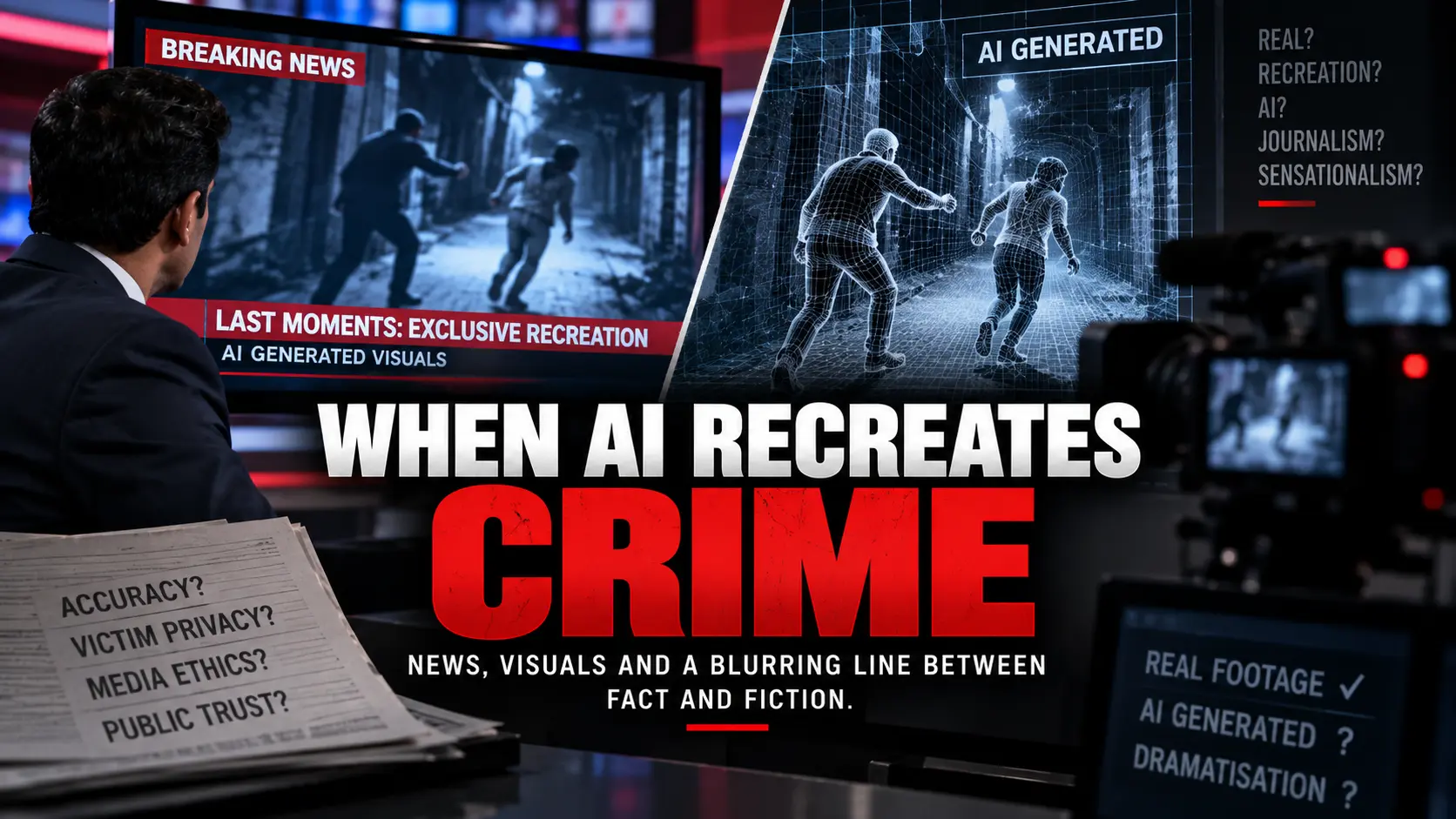
Indian TV news channels are increasingly using generative AI to recreate crimes, raising questions about accuracy, ethics, victim privacy and sensationalism.
A disturbing new trend is emerging in television news: instead of showing only verified photographs, CCTV footage or locations connected to a crime, some broadcasters are using generative AI to create realistic-looking versions of events that were never actually recorded.
The Editorial Team of Behind The Headlines reports that the issue came into focus after a television broadcast used AI-generated visuals to recreate the final moments of Manipuri musician Chongtham Vikram Singh, who was killed in a mob attack in Delhi. The digitally created sequence showed an avatar resembling the victim being chased and assaulted. The blood and violent imagery were synthetically generated.
When an imagined scene looks like real footage
The central problem with AI crime recreations is simple: the event may be real, but the images showing how it happened may not be.
A newsroom can use a prompt to generate a person, location, lighting, movement and sequence of events. The resulting video can look sufficiently realistic for viewers to interpret it as an actual reconstruction based on evidence.
But unless every visual detail is independently established, the AI is effectively filling gaps in the evidence with generated content.
That creates a difficult distinction for television viewers:
What actually happened?
What was captured on camera?
And what has simply been imagined by an AI system?
A small “AI-generated” label may technically provide disclosure, but the placement and prominence of such disclaimers become important when the rest of the presentation resembles conventional news footage.
Crime reporting was already becoming dramatic
The use of AI has not created sensational crime television from scratch.
Indian television news has used dramatizations, 3D graphics, actors, models and recreated crime scenes for years. High-profile cases have frequently been presented through elaborate visual reconstructions designed to help audiences understand the sequence of events.
The difference now is speed and realism.
Generative AI can potentially create a complete crime sequence without actors, locations, costumes or lengthy production. A producer can describe a scenario and generate multiple visual versions within a short period.
That makes a previously expensive television technique much easier to reproduce.
The concern is that the easier it becomes to manufacture dramatic imagery, the greater the temptation to use it even when it adds little factual value.
The victim becomes part of the spectacle
There is another dimension that goes beyond accuracy.
A crime is not simply an event for viewers. It is someone's death, injury or trauma.
In the Delhi case examined by the fact-checking investigation, the victim's family reportedly sought space following the broadcast, while a public figure issued a legal notice seeking removal of the AI-generated depiction and an apology. The broadcaster had not publicly addressed the criticism at the time of the report.
For families, watching an AI recreation of a loved one's final moments can create a completely different form of distress. The footage isn't a recording of what happened, yet it can visually become the dominant version of the event in the public imagination.
That raises an important ethical question:
Does a news organisation have the right to invent the visual details of someone's death simply because the technology allows it?
AI can make uncertainty look certain
This is perhaps the biggest journalistic problem.
Traditional reporting has an important limitation: if there is no footage of an event, journalists have to explain that there is no footage.
AI removes that visual limitation.
A broadcaster can show a person entering a building, running down stairs, being attacked or falling—even when nobody recorded those exact moments.
But AI does not know what actually happened unless those details are supplied from verified evidence. It can generate plausible details that were never established.
That means an AI reconstruction can unintentionally convert uncertainty into apparent certainty.
Experts quoted in the investigation argued that generative AI gives producers unusually precise control over framing, visual intensity, gestures and other elements that can influence audience engagement.
India's existing broadcast rules already address graphic violence
The debate is not happening in a regulatory vacuum.
The Ministry of Information and Broadcasting issued an advisory in January 2023 reminding private television channels to follow the Programme Code under the Cable Television Networks (Regulation) Act, 1995. The advisory listed multiple examples involving disturbing images of injured or dead people, assaults and graphic violence.
The examples included footage showing a man dragging a dead body, assaults on children, graphic images of a deceased singer and other incidents involving physical violence.
The Press Council of India's journalistic norms also call for restraint and caution in crime reporting and advise avoiding intrusion into moments of personal grief except where there is a genuine public-interest justification.
The new challenge is that AI-generated footage may not be real footage at all.
It can therefore fall into a grey area between reporting, illustration and dramatization.
The missing AI rulebook
Another problem is the absence of clearly visible, standardised newsroom policies governing when generative AI can be used.
Technology policy researcher Prateek Waghre told the investigation that few newsrooms have publicly articulated comprehensive policies explaining where they use generative AI, where they prohibit it and what oversight mechanisms exist.
That leaves several questions unanswered:
Should AI-generated crime recreations ever be used?
Should they be permitted only when clearly labelled?
Should faces of victims never be recreated?
Should graphic violence be prohibited even when AI-generated?
Who verifies that an AI reconstruction does not invent critical facts?
Should families have a say when a deceased person is digitally recreated?
How prominently should an AI disclaimer appear?
These are editorial-policy questions as much as technology questions.
The real issue is not AI alone
Generative AI is only the latest tool in a much older competition for audience attention.
Television news has long relied on dramatic graphics, breaking-news music, dramatic studio designs and crime reconstructions.
AI simply makes the process faster, cheaper and potentially more realistic.
The deeper question is therefore about the purpose of journalism.
A map can explain where a crime happened. CCTV can establish what was actually captured. Photographs can introduce the victim. Court documents can establish the allegations. Witness accounts can explain what was reported.
An AI-generated murder scene may make the story more visually compelling—but it can also introduce details that journalism cannot independently establish.
When the facts are incomplete, the responsible newsroom response may sometimes be to show the limits of what is known rather than visually filling those gaps.
As generative AI becomes increasingly common in news production, the distinction between documenting an event and manufacturing an image of it will become increasingly important.