
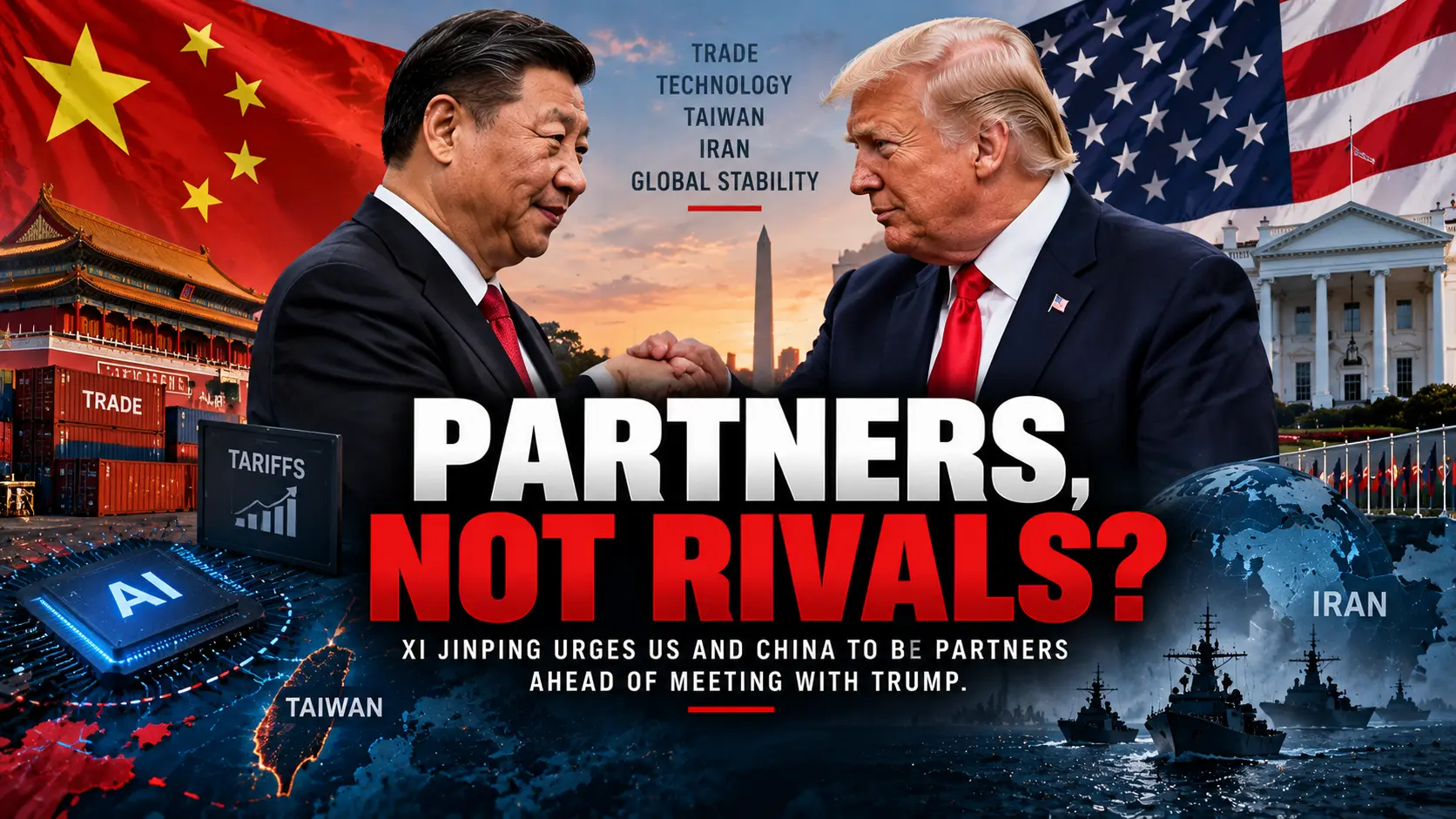
Xi Jinping has called for a more stable US-China relationship ahead of his talks with Donald Trump, with trade, technology, Taiwan and global conflicts on the agenda.
Chinese President Xi Jinping arrived in Washington on September 23 for a three-day state visit and urged the United States and China to treat each other as partners rather than rivals. His message came hours before his scheduled meeting with US President Donald Trump at the White House on September 24.
The Editorial Team of Behind The Headlines reports that Xi's remarks come at a sensitive point in the relationship between the world's two largest economies. While Washington and Beijing have taken steps to stabilise trade ties, major disagreements remain over tariffs, advanced technology, Taiwan, critical minerals and China's relationship with Iran.
Xi's message before meeting Trump
In his written statement after arriving in the US, Xi said the interests of the two countries were deeply connected and argued that China's national development goals and Trump's “America First” agenda could coexist.
He called for a relationship built around cooperation, controlled competition, manageable differences and peaceful coexistence. Xi also said he was confident that the two countries could find an appropriate way to interact in the new era.
The message is significant because Beijing and Washington remain strategic competitors even as both governments seek to prevent their economic relationship from deteriorating into another major trade confrontation.
Trump gives Xi a rare welcome
Trump personally received Xi and his wife Peng Liyuan at Joint Base Andrews after their arrival.
The US president's decision to meet the Chinese leader at the airport was an unusual diplomatic gesture. Xi's visit is the first Chinese presidential state visit to Washington in more than a decade, according to the White House.
A formal state arrival ceremony was scheduled at the White House on September 24, followed by bilateral discussions and a state dinner. The visit runs through September 25.
Trade remains the immediate priority
Trade is expected to be one of the most important issues on the Trump-Xi agenda.
The two countries have been operating under a trade truce designed to prevent another sharp escalation in tariffs and export restrictions. Recent preparatory negotiations have focused on extending that arrangement and addressing disputes involving rare earths, technology and market access.
China's position in the global rare-earth supply chain gives Beijing significant leverage because these materials are important for electronics, electric vehicles, defence equipment and other advanced industries.
Washington, meanwhile, continues to seek greater access for American products and businesses in China while maintaining restrictions involving sensitive technologies.
The White House said the two governments had already agreed in May to work towards a “constructive relationship of strategic stability” and establish mechanisms for managing bilateral trade and investment.
Technology is another major fault line
Artificial intelligence and advanced semiconductors are becoming increasingly important in the US-China relationship.
Both countries are competing for leadership in AI while also discussing the risks created by the technology. Preparatory talks have included the possibility of a dedicated US-China AI dialogue covering shared risks and national-security concerns.
At the same time, Washington continues to restrict China's access to some advanced technologies, while Beijing is trying to strengthen domestic alternatives.
This creates a difficult balance: the two countries may cooperate on specific AI risks while continuing to compete aggressively over the technology itself.
Taiwan remains a major disagreement
Taiwan is likely to be among the most sensitive subjects during the meeting.
China considers Taiwan part of its territory and opposes US military support for the island. Washington does not maintain formal diplomatic relations with Taiwan but remains its principal international security partner and arms supplier.
Xi has previously described the Taiwan issue as central to US-China relations. Chinese officials have repeatedly urged Washington to respect Beijing's position, while the US has continued to maintain its existing approach toward Taiwan.
The issue therefore remains separate from the trade discussions and could limit how far the broader relationship can improve.
Iran adds another layer
The war involving Iran is also part of the wider diplomatic background.
China maintains close economic ties with Iran and is a major buyer of Iranian oil. Washington has been seeking greater pressure on Tehran, while Beijing has shown limited willingness to align its Iran policy with US objectives.
That means the Trump-Xi meeting extends beyond bilateral economics. The two leaders are also discussing how their countries deal with major international crises.
What Xi's message actually means
Xi's call for partnership does not mean that the strategic rivalry between Washington and Beijing has ended.
The two countries continue to compete in trade, technology, military power and geopolitical influence. Analysts also note that the current improvement in relations is heavily dependent on agreements between the two leaders and could remain vulnerable to disagreements over Taiwan, technology controls and economic policy.
What Xi is proposing is a framework in which competition continues but does not automatically become confrontation.
For Trump, the immediate challenge is to secure economic and strategic gains while keeping the relationship stable. For Xi, the priority is maintaining access to major markets and technology while protecting China's strategic interests.
The September 24 meeting will therefore test whether the two sides can turn their recent efforts at stabilisation into a more durable framework for managing competition.