
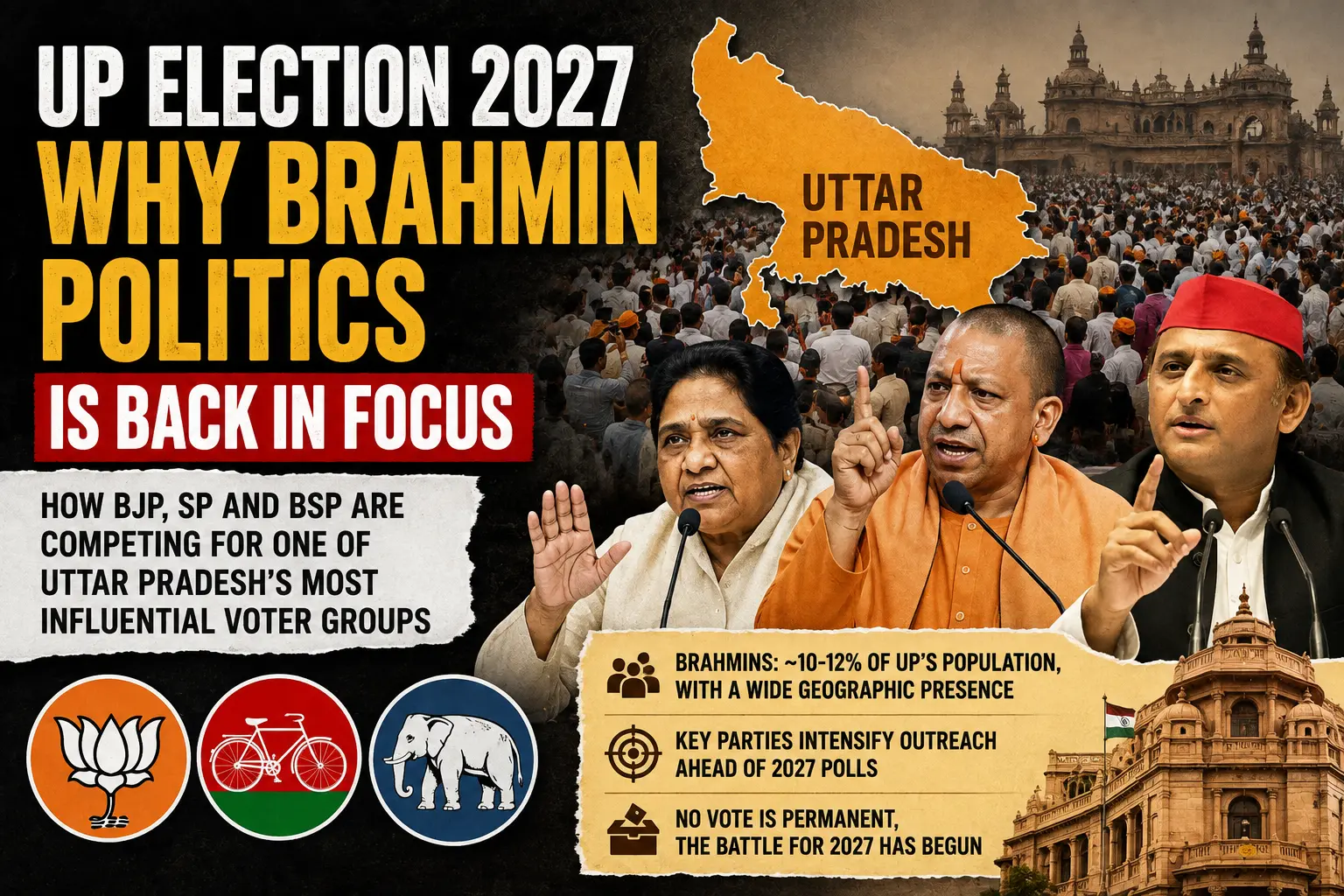
As political parties prepare for the 2027 Uttar Pradesh Assembly elections, the Brahmin community has once again emerged as a key focus of electoral strategy. Long regarded as an influential voting bloc in the state, Brahmins have traditionally played an important role in shaping political outcomes. Recent outreach efforts by the Bharatiya Janata Party (BJP), the Samajwadi Party (SP) and the Bahujan Samaj Party (BSP) indicate that competition for this segment of voters is expected to intensify in the months ahead.
Why Are Brahmin Votes Considered Important?
Although Brahmins constitute a relatively small share of Uttar Pradesh's population—estimated at around 10–12%—their influence extends across many constituencies due to their geographic spread and political participation. Over the past decade, the BJP has enjoyed significant support from the community, particularly during the 2014, 2017, 2019 and 2022 elections, contributing to the party's broader social coalition.
However, political observers note that no community's voting pattern remains fixed. As the next Assembly election approaches, several parties are seeking to broaden their appeal among Brahmin voters through organisational outreach, public meetings and community engagement.
Why Has the Issue Gained Attention Now?
The renewed focus follows a series of political meetings and outreach programmes organised by different parties in Uttar Pradesh. The Samajwadi Party has stepped up engagement through its Brahmin Sabha and community events, while the BSP has also revived efforts to reconnect with Brahmin leaders, recalling its earlier social coalition strategy. The BJP, meanwhile, has continued strengthening its organisational network and outreach across social groups as part of its preparations for the 2027 elections.
These developments have led to wider discussion about whether traditional voting patterns could shift or whether established political alignments will remain intact.
What Are the Main Issues Being Raised?
Political discussions surrounding Brahmin outreach have centred on representation, leadership, participation in government, and community engagement. Opposition parties have argued that the BJP needs to do more to address concerns raised by sections of the community and have attempted to position themselves as alternative political platforms.
The BJP, on its part, has continued to emphasise its governance record, welfare initiatives and organisational expansion, while rejecting claims that it is losing support among any particular social group. Party leaders have also intensified grassroots mobilisation ahead of the Assembly polls.
How Are Opposition Parties Responding?
The Samajwadi Party has increased interactions with Brahmin organisations and community representatives as part of its broader electoral strategy. The BSP has similarly renewed its outreach, seeking to rebuild social alliances that were central to its electoral success in previous years. These efforts suggest that both parties view Brahmin voters as an important constituency in what is expected to be a closely contested election.
What Does This Mean for the BJP?
The BJP continues to remain a dominant political force in Uttar Pradesh, but the party is also working to reinforce support across different social groups through regular organisational meetings and targeted outreach. Analysts note that maintaining a broad social coalition will remain a key objective as the 2027 elections draw closer.
Whether the current political engagement translates into electoral change will depend on candidate selection, local issues, governance, alliances and campaigning over the coming months.
What Happens Next?
With the Uttar Pradesh Assembly elections expected in 2027, political activity is likely to intensify. Parties are expected to continue community outreach, organisational expansion and public engagement as they seek to consolidate support across caste and regional groups. While Brahmin voters remain an important part of the electoral landscape, the eventual outcome will depend on the broader political dynamics that unfold before polling.