
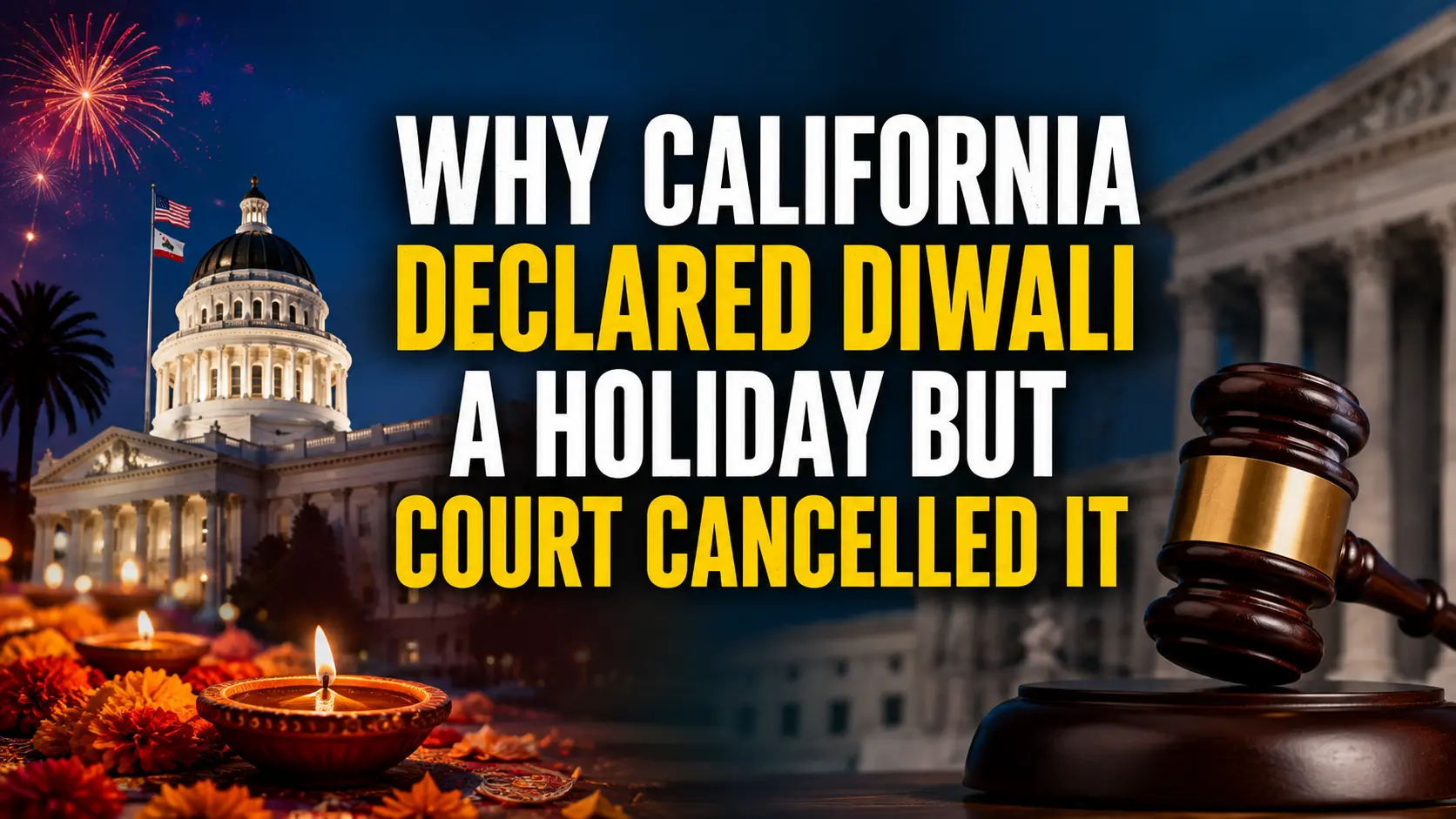
California made history by becoming the third U.S. state to officially recognise Diwali as a state holiday. For the state's nearly one million Indian Americans, it was seen as a milestone that acknowledged their cultural and religious contributions.
But less than a year later, the celebration ran into legal trouble.
A California court has temporarily blocked the law after a taxpayer group challenged it, arguing that the legislation gave preferential treatment to one religion and violated constitutional principles separating religion and government.
How Did Diwali Become a State Holiday?
In October 2025, California Governor Gavin Newsom signed Assembly Bill (AB) 268, introduced by Assembly member Ash Kalra, making Diwali an official state holiday from 2026 onwards.
The legislation aimed to:
Allow eligible California state employees to observe Diwali using paid leave.
Permit public schools and community colleges to close for Diwali if approved locally.
Encourage educational institutions to recognise and teach the cultural significance of the festival.
California became only the third U.S. state, after Pennsylvania and Connecticut, to officially recognise Diwali.
What Changed?
Soon after the law was passed, the San Francisco Taxpayers Association filed a legal challenge in Sacramento County Superior Court.
The group argued that:
The law effectively endorsed one religion.
It violated the Establishment Clause of the U.S. Constitution, which prevents government endorsement of religion.
Implementing the holiday could impose additional costs on taxpayers through employee leave and potential school closures.
A judge later ruled against parts of the legislation, preventing the Diwali holiday from taking effect in its current form.
Did the Court Ban Diwali?
No.
This is one of the biggest misconceptions.
The court did not prohibit Diwali celebrations.
Instead, it found legal issues with how the law was framed—particularly its references to the religious significance of Diwali.
The ruling does not stop people, communities, businesses or temples from celebrating the festival. It only affects the state's official recognition under the existing legislation.
Why Did the Judge Object?
According to court filings and legal arguments, the concern was not the festival itself but the wording of the law.
The taxpayer group argued that:
Official recognition could be interpreted as government preference for one religious tradition.
If Diwali received special recognition, followers of other minority religions might expect similar treatment.
The legislation should have been framed in a more secular manner.
The court agreed that the current wording raised constitutional concerns, though it left open the possibility of lawmakers rewriting the legislation.
Why Was Diwali Recognition Considered Important?
Supporters say California has the largest Indian American population in the United States, and Diwali is celebrated not only by Hindus but also by Sikhs, Jains and many Buddhists.
They argued that recognising Diwali was comparable to recognising other culturally significant holidays and reflected California's diversity rather than government promotion of religion.
What Happens Next?
The court's decision does not permanently end California's Diwali holiday.
Lawmakers can:
Amend the wording of the legislation.
Remove language that emphasises religious significance.
Introduce a revised version focused on cultural recognition and workplace flexibility.
If a revised law addresses the constitutional concerns identified by the court, Diwali could still become an officially recognised state holiday in California in the future.
The Bigger Picture
The case reflects a broader constitutional debate in the United States: how governments can recognise the traditions of diverse communities while maintaining religious neutrality.
For many Indian Americans, the issue is about equal cultural recognition in one of the world's most diverse states. For opponents, it is about ensuring the government does not appear to endorse a particular faith.
The final outcome may shape how other U.S. states approach recognition of religious and cultural festivals in the years ahead.