
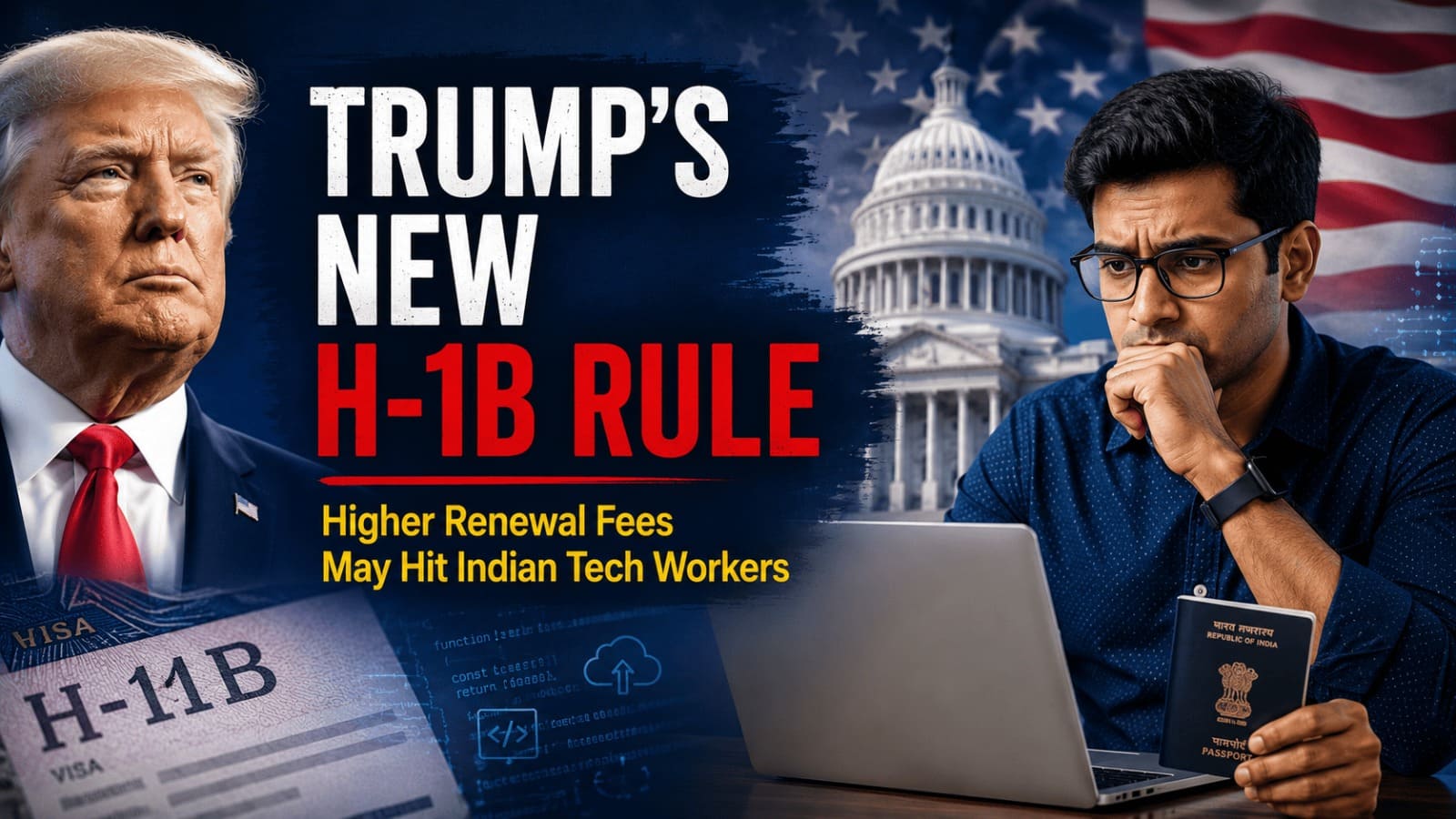
For thousands of Indian professionals working in the United States, renewing an H-1B visa has long been a routine administrative process. But that could soon become significantly more expensive.
The Trump administration is planning to expand an existing immigration fee so that it also applies to H-1B and L-1 visa renewal petitions, not just new applications or job changes. While the fee would technically be paid by employers, experts believe the move could make companies more hesitant to retain or hire foreign workers, particularly Indians who form the largest share of H-1B visa holders.
What Is Changing?
Under current rules, certain large U.S. employers must pay an additional $4,000 for qualifying H-1B petitions and $4,500 for L-1 petitions when hiring a new worker or sponsoring someone changing employers.
The proposed rule would extend the same fee to visa renewals (extensions of stay). That means employers could face the additional charge every time they renew an employee's visa—not just when they first hire them.
Who Will Be Affected?
The proposal primarily targets companies that:
Have 50 or more employees in the U.S.
Have more than half of their workforce on H-1B or L-1 visas
These are typically IT consulting firms and technology outsourcing companies that rely heavily on skilled foreign professionals.
Why Are Indians Most Affected?
India accounts for the overwhelming majority of H-1B professionals in the United States.
Every year, thousands of Indian software engineers, AI specialists, cloud architects, cybersecurity experts and data scientists work for companies such as Microsoft, Google, Amazon, Meta, Apple, Deloitte, Cognizant, Infosys, TCS, Wipro and Accenture through the H-1B programme.
Since many of these professionals remain in the U.S. for several years while renewing their visas periodically, the new proposal could substantially increase the long-term cost of employing them.
Will Employees Have to Pay?
Officially, NO.
U.S. immigration law generally requires employers—not employees—to bear H-1B petition filing costs.
However, immigration experts warn that higher employer costs could still indirectly affect workers through:
Slower salary growth.
Reduced hiring.
Delayed visa renewals.
Greater preference for local hiring.
Increased offshoring of jobs to countries like India.
Why Is Trump Doing This?
The proposal aligns with Donald Trump's long-standing "America First" immigration policy.
His administration argues that companies relying heavily on foreign workers should contribute more toward immigration-related systems and biometric security. The additional fee stems from the 9/11 Response and Biometric Entry-Exit Fee, originally introduced to help fund border security and immigration infrastructure.
Supporters say the measure discourages excessive dependence on temporary foreign workers and encourages companies to hire more Americans.
Critics, however, argue that the policy raises costs without solving underlying skill shortages in the technology sector.
How Could It Affect Tech Companies?
For companies with hundreds or thousands of H-1B employees, renewal costs could rise sharply.
Large employers may respond by:
Hiring fewer foreign workers.
Increasing automation.
Expanding engineering centres in India.
Passing higher immigration costs into business planning.
Industry analysts say firms with a large H-1B workforce would feel the biggest financial impact if the proposal becomes law.
What Does It Mean for Indian Students?
Indian students planning to build careers in the U.S. may face greater uncertainty.
Companies could become more selective in sponsoring H-1B visas if the overall cost of employing foreign workers rises. This may increase competition for sponsorship, particularly for fresh graduates transitioning from student visas to work visas.
Is the Rule Already in Effect?
Not yet.
The proposal has appeared in the U.S. Department of Homeland Security's regulatory agenda and is expected to move through the rule-making process before implementation. Until a final rule is issued, the current renewal fee structure remains unchanged.
The Bigger Picture
The proposed fee is part of a broader effort by the Trump administration to tighten employment-based immigration while encouraging companies to hire more domestic workers.
For India, the implications are significant. The country supplies the largest pool of skilled H-1B professionals to the U.S., making any policy change in this programme closely watched by technology companies, students and professionals alike.
If implemented, the proposal may not stop companies from hiring Indian talent, but it could make retaining that talent more expensive—potentially reshaping hiring decisions across the global technology industry.