
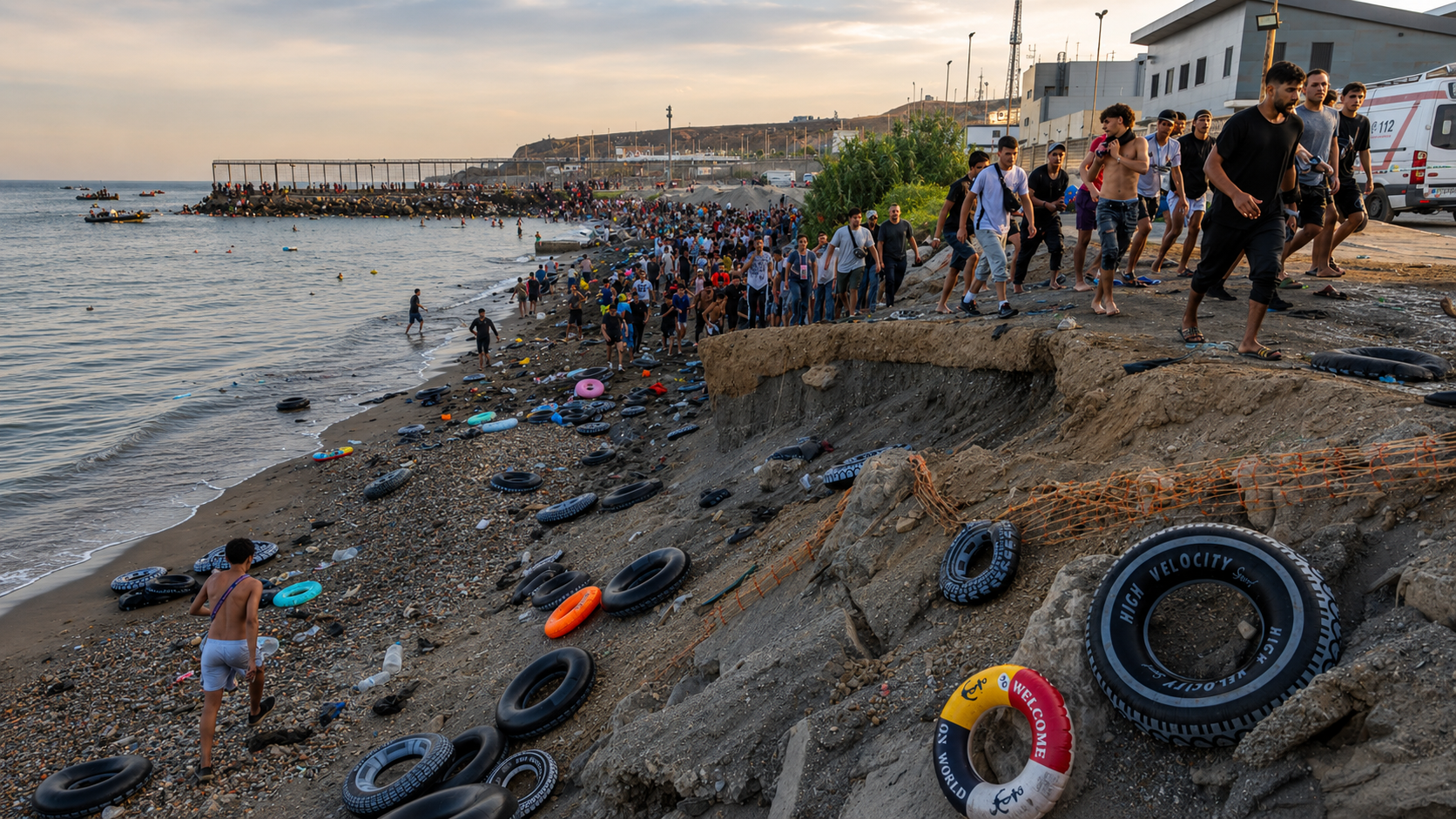
The border between Morocco and Spain has once again become the focus of international attention after thousands of migrants gathered near the Spanish enclave of Ceuta, with many attempting to cross into European territory by land and sea. The surge has placed pressure on border authorities, prompted emergency security measures, and renewed debate over migration management across the European Union.
What Has Happened?
In late July 2026, large groups of migrants assembled near the Moroccan town of Fnideq, adjacent to the Spanish enclave of Ceuta. Many attempted to reach Spanish territory by swimming around coastal breakwaters, walking along the shoreline, or approaching border crossings. Spanish authorities deployed additional police and military personnel after local facilities struggled to cope with the sudden influx. Reports also confirmed multiple fatalities during the crossings, highlighting the humanitarian risks associated with irregular migration routes.
Why Ceuta Matters
Ceuta is an autonomous Spanish city located on the northern coast of Africa. Along with Melilla, it represents one of the European Union's only land borders with Africa. While Spain has administered Ceuta for centuries, Morocco continues to claim sovereignty over both Ceuta and Melilla, making the area strategically and politically sensitive.
Because Ceuta forms part of Spain—and therefore the European Union—many migrants view it as a potential gateway to Europe. The city is protected by extensive border fencing, surveillance systems, and maritime patrols designed to prevent irregular crossings.
Background to the Migration Route
The Morocco–Spain border has experienced periodic migration surges over the past two decades. A similar large-scale crossing occurred in 2021 when thousands entered Ceuta within a short period, prompting Spain to deploy security forces and rapidly return many arrivals. In 2022, another major incident at the Melilla border crossing resulted in dozens of migrant deaths, leading to international scrutiny of border management practices.
The current developments demonstrate that Ceuta remains one of the most sensitive migration routes connecting Africa and Europe.
Current Response
Spain has reinforced security around Ceuta by deploying additional police and military personnel while working with Moroccan authorities to restore order and strengthen border controls. Reports indicate that both governments have discussed mechanisms for returning migrants who entered irregularly and preventing further mass crossings. Spanish Prime Minister Pedro Sánchez is also expected to visit Ceuta following the latest developments.
Humanitarian Concerns
The recent events have highlighted the dangers faced by migrants attempting to reach Europe through maritime and border crossings. Many undertake dangerous journeys by swimming or using makeshift flotation devices, exposing themselves to significant risks. Confirmed fatalities during the latest crossings have renewed calls for stronger humanitarian protection alongside effective border management.
What Happens Next?
Spanish authorities are expected to continue reinforcing border security while coordinating closely with Morocco on migration management. European policymakers are also likely to examine the broader implications for the EU's migration framework, particularly regarding external border protection, asylum procedures, and cooperation with neighbouring countries. The situation remains fluid as authorities monitor further attempts to reach Ceuta and assess humanitarian needs.