
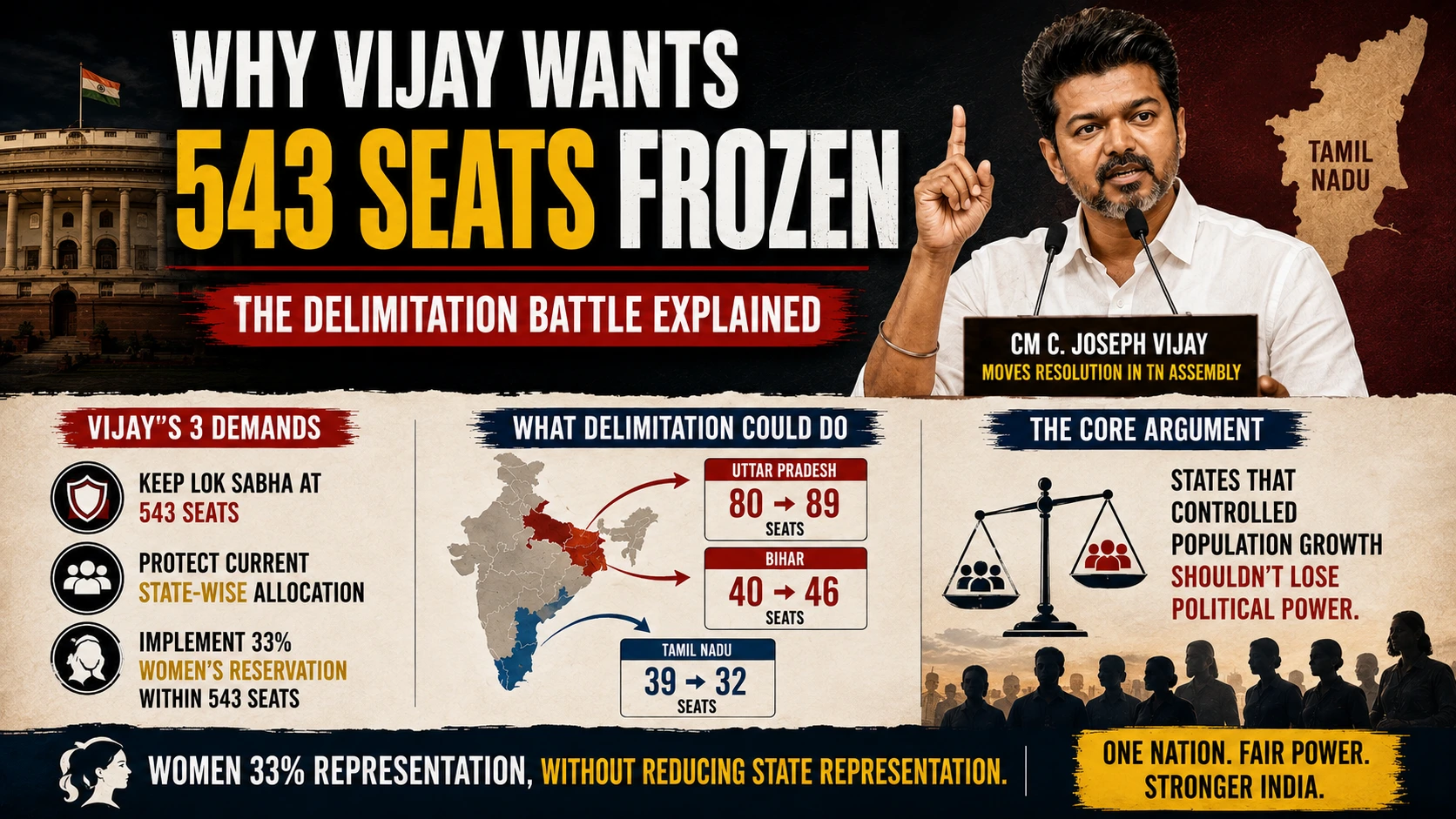
Tamil Nadu Chief Minister C. Joseph Vijay wants the Lok Sabha to retain its existing 543 seats while implementing 33% reservation for women within the same structure. Here is what the dispute is really about.
Tamil Nadu Chief Minister C. Joseph Vijay has moved a special resolution in the state Assembly opposing the proposed delimitation of Lok Sabha constituencies and calling for the existing 543-seat strength of the Lok Sabha and the current distribution of seats among states to be protected. At the same time, Vijay has backed the immediate implementation of 33% reservation for women, arguing that it should be accommodated within the existing 543 seats rather than being linked to a fresh delimitation exercise.
The Editorial Team of Behind The Headlines reports that the dispute is essentially about political representation and population growth. Under the proposed delimitation framework, seats could be redistributed between states based on newer population data. That has raised concerns in southern states such as Tamil Nadu, Kerala, Karnataka, Andhra Pradesh and Telangana, which have generally achieved lower population growth than several northern states. If the total Lok Sabha strength remains at 543, projections cited by PRS Legislative Research suggest Tamil Nadu's seats could fall from 39 to 32, while Uttar Pradesh could rise from 80 to 89 and Bihar from 40 to 46.
Vijay's position therefore tries to separate two issues that are currently being discussed together: delimitation and women's reservation. His government wants women to get their promised 33% representation, but does not want that objective to become a reason for changing the existing balance of seats between states. The resolution seeks to retain 543 seats and the current state-wise allocation while implementing women's reservation from the 2029 general election.
What exactly is delimitation?
Delimitation is the process of redrawing electoral constituencies and determining how many seats each state should have based on population.
In simple terms, if one part of the country has grown much faster than another, a population-based delimitation can result in that region receiving more parliamentary constituencies.
India has historically kept the allocation of Lok Sabha seats among states frozen to avoid penalising states that successfully controlled population growth. The constitutional freeze was based on the 1971 Census, and the existing framework provides for a new allocation after the first Census conducted after 2026.
This is where the current political dispute begins.
Why is Tamil Nadu worried?
Tamil Nadu's argument is that states should not lose political representation because they successfully reduced population growth.
Southern states invested heavily over decades in areas such as:
Family planning
Women's education
Healthcare
Lower fertility
Population stabilisation
The concern is that a new population-based allocation could reward states with larger populations while reducing the relative representation of states that achieved demographic stability.
For example, PRS estimates that if the Lok Sabha remained at 543 seats under the proposed framework, Tamil Nadu could go from 39 seats to 32, while Uttar Pradesh could increase from 80 to 89. Kerala could fall from 20 to 15, while Bihar could rise from 40 to 46.
This is why the issue has increasingly become a North-South political representation debate.
Why does Vijay want to keep 543 seats?
Vijay's resolution asks the Centre to permanently protect the existing 543 Lok Sabha seats as well as the current distribution among states.
The argument is that simply increasing the overall number of seats does not necessarily solve the problem.
The question is not only: “How many MPs should the Lok Sabha have?”
It is also: “How should those MPs be distributed among India's states?”
If the number of seats rises substantially but the allocation is determined primarily by population, southern states could still see their share of Parliament decline even if their absolute number of seats does not fall.
Then why is Vijay supporting women's reservation?
This is an important distinction.
Vijay is not opposing the 33% reservation for women.
His position is that women should get the promised reservation without waiting for a fresh delimitation exercise.
The Women's Reservation Act provides for one-third reservation for women in the Lok Sabha and state assemblies, but its implementation is linked to a future census and delimitation process.
Vijay's proposal is effectively:
Keep the existing 543 seats → retain the current state-wise distribution → reserve one-third of those seats for women.
That would allow the women's quota to be implemented while avoiding a simultaneous redistribution of parliamentary seats among states.
Why is 2029 important?
The timing is politically significant because the Centre has been discussing changes that could bring women's reservation into operation for the 2029 Lok Sabha election.
Tamil Nadu's position is that women should not have to wait for a larger delimitation exercise to receive representation.
The state therefore wants the 33% quota implemented using the existing structure rather than tying it to a fresh redistribution of seats.
What is the Centre proposing?
The Centre's proposed delimitation framework has sought to address both the question of representation and the implementation of women's reservation.
The government's broader argument has been that India's Parliament needs to reflect the country's current population distribution and that increasing the total number of Lok Sabha seats can prevent the representation of individual citizens from becoming excessively diluted.
The proposed framework has been discussed around increasing the Lok Sabha's strength substantially rather than simply redistributing the existing 543 seats. PRS has noted that the proposed legislation could result in significant changes to the distribution of seats among states.
This is precisely where Tamil Nadu and other southern states remain concerned.
Is this only a Tamil Nadu issue?
No.
Tamil Nadu is taking one of the strongest positions, but the underlying concern extends across much of southern India.
States with relatively lower population growth fear that a population-based redistribution could reduce their share of national political power.
That makes delimitation an issue of federalism, not merely election mathematics.
The question becomes whether states should have parliamentary representation primarily according to their current population or whether India should also consider the demographic performance of states over the past several decades.
What could happen if delimitation goes ahead?
The exact outcome will depend on the final constitutional and legislative framework and the eventual delimitation exercise.
But the broad possibilities are clear.
More populous states could receive additional Lok Sabha seats.
States with slower population growth could see their share of the House decline.
That could alter the political balance between different regions of India.
And because Parliament determines national policy, taxation, central spending, legislation and constitutional amendments, changes in the distribution of seats could have consequences far beyond elections.
Why does this matter beyond Tamil Nadu?
At its heart, the debate asks a difficult question:
Should states be rewarded or penalised for population growth?
If representation is strictly proportional to population, larger populations logically deserve more representatives.
But if states that successfully controlled population growth lose representation as a consequence, they can argue that the system creates the wrong incentive.
That tension has existed in India's constitutional framework for decades.
The current delimitation debate has simply brought it back to the centre of national politics.
The women's quota adds another layer
There is broad political support for increasing women's representation in Parliament.
The disagreement is largely about how and when that should happen.
Vijay's proposal attempts to remove the two issues from each other.
His argument is essentially:
Give women 33% representation now, but don't use that objective to justify changing the existing distribution of parliamentary seats.
That makes his Assembly resolution both a women's representation proposal and a federalism argument.
What happens next?
The Tamil Nadu resolution is a political demand addressed to the Union government; by itself, it does not prevent Parliament from legislating on delimitation.
The larger battle will therefore take place at the national level.
The Centre will have to address concerns from southern states while determining how to implement women's reservation and redesign parliamentary representation.
For Tamil Nadu, the central demand is clear: retain 543 Lok Sabha seats, protect the existing state-wise distribution and implement 33% women's reservation within that framework.
The delimitation debate may therefore become one of India's most consequential federalism questions of the coming years.
Because ultimately, this is not just about drawing constituency boundaries.
It is about deciding how political power should be distributed in a country whose population has grown at very different rates across its states.