
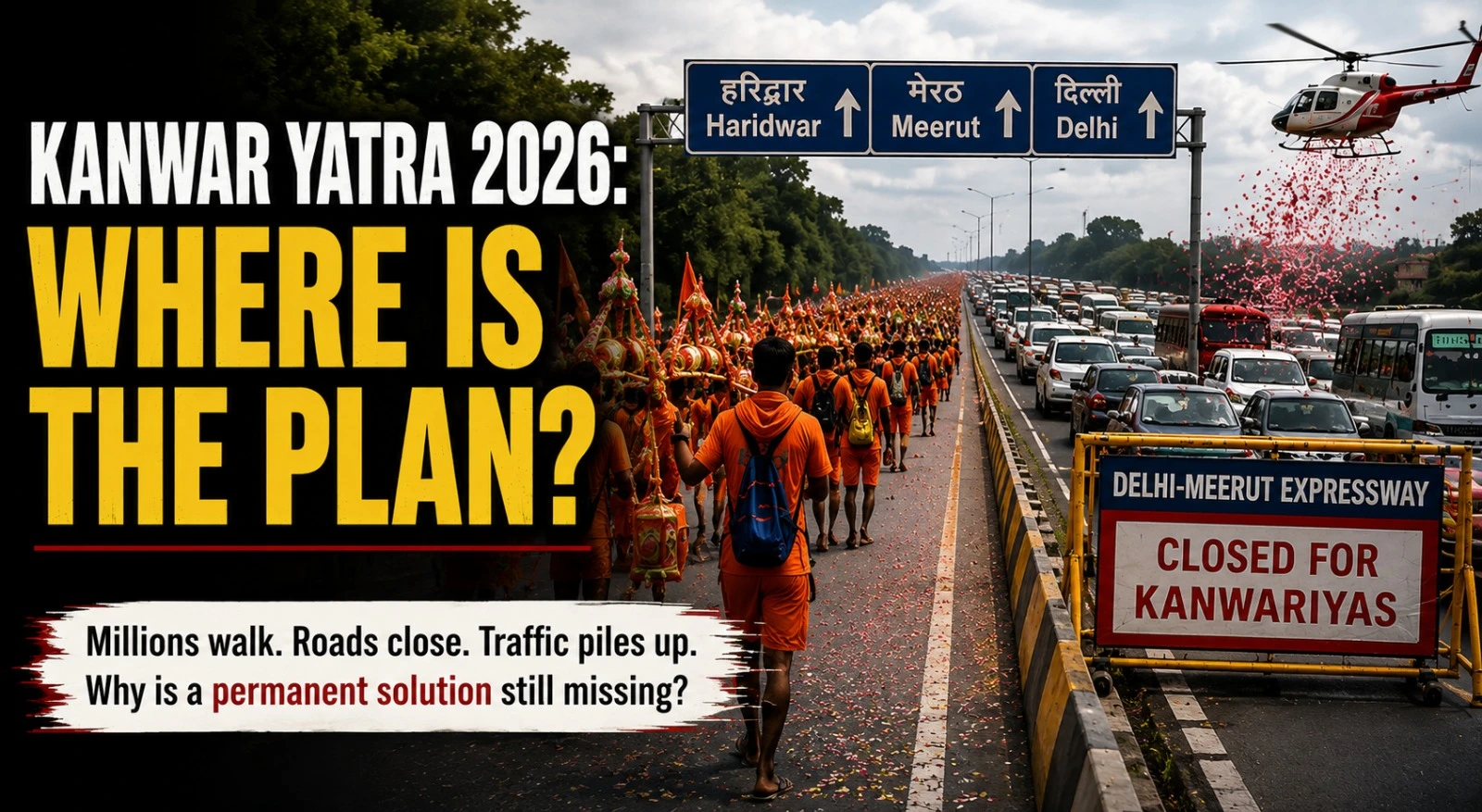
From helicopter flower showers to major road closures and traffic chaos, the 2026 Kanwar Yatra has revived a larger question: has the administration focused more on symbolism than long-term infrastructure?
The annual Kanwar Yatra is one of North India's largest religious gatherings, bringing millions of devotees onto roads across Uttarakhand, Uttar Pradesh, Delhi and the National Capital Region. Yet the 2026 pilgrimage has once again exposed a familiar problem: how to accommodate a massive, predictable religious movement without putting pilgrims, commuters and local residents at risk. The Editorial Team of Behind The Headlines reports that the controversy this year is not about the religious significance of the yatra, but about whether governments have done enough to create a permanent system for managing it.
The immediate flashpoint has been traffic. The Delhi-Meerut Expressway was reserved for Kanwariyas, disrupting the movement of ordinary vehicles between Delhi, Ghaziabad and Meerut. Traffic spilled onto NH-9 and other connecting roads, with commuters reporting lengthy delays. At the same time, governments highlighted security arrangements, CCTV networks, drones, police deployment and helicopter-based flower showers for pilgrims.
The underlying argument, however, is about planning. The Kanwar Yatra takes place every year during Shravan, meaning authorities know well in advance when large numbers of pilgrims will arrive, which routes they are likely to use and where traffic pressure will build. The question being raised is whether temporary diversions, school holidays, police deployments and symbolic gestures are enough—or whether the government should create dedicated infrastructure for the pilgrimage.
What is the Kanwar Yatra?
The Kanwar Yatra is an annual pilgrimage during the Hindu month of Shravan in which devotees, known as Kanwariyas, travel to sacred sites such as Haridwar to collect Ganga water and carry it back to their local Shiva temples.
Many devotees undertake the journey on foot, often travelling long distances along highways.
That creates a logistical challenge.
A normal national highway is designed primarily for vehicular traffic. During the Kanwar season, sections of these roads can effectively become large pedestrian corridors, with camps, Kanwar vehicles, food stalls and thousands of pilgrims sharing or crossing routes used by regular traffic.
The scale of the movement makes traffic management a major administrative issue.
What happened in 2026?
Authorities introduced extensive arrangements for this year's pilgrimage.
Delhi Traffic Police issued advisories warning commuters about congestion and diversions and recommended avoiding several major roads during periods of heavy Kanwariya movement.
In the Delhi-NCR region, the disruption became particularly visible after the Delhi-Meerut Expressway was closed to regular traffic while being used by Kanwariyas.
Why is the government being criticised?
The criticism is not that the government should stop the Kanwar Yatra.
It is that a predictable annual event should have a predictable infrastructure solution.
The India Today opinion piece argues that governments have had years to understand the scale and requirements of the pilgrimage but have continued to rely heavily on temporary arrangements.
Those include:
Road diversions
Police deployment
Temporary camps
Traffic advisories
School closures
CCTV cameras
Drones
Helicopter surveillance
Flower showers
These measures can help manage an individual year's pilgrimage.
But they do not necessarily solve the underlying infrastructure problem.
What about the helicopter flower showers?
Helicopter-based flower showers became one of the most visible images of the 2026 Kanwar Yatra.
Uttar Pradesh Chief Minister Yogi Adityanath also welcomed Kanwariyas in Meerut as flowers were showered over pilgrims from a helicopter.
Supporters see such gestures as a public expression of respect towards devotees.
Critics, however, argue that the symbolism should not substitute for basic infrastructure.
That is the central argument of the India Today satire: flower petals falling from the sky may create a memorable image, but they do little to solve the practical problems faced by pilgrims walking alongside heavy traffic.
In other words:
A helicopter can shower flowers in minutes. A dedicated pedestrian corridor could protect pilgrims for years.
What would a permanent solution look like?
A long-term solution could involve creating dedicated pedestrian corridors or protected Kanwar routes along the busiest stretches.
Such corridors could include:
Separate walking paths
Proper lighting
Drinking-water facilities
Medical stations
Emergency access lanes
Rest areas
Sanitation facilities
Controlled entry and exit points
Dedicated parking for Kanwar vehicles
Clear separation from regular traffic
The idea would not necessarily require constructing an entirely new road everywhere.
Existing government land, service roads and highway-side infrastructure could potentially be integrated into a planned pilgrimage network where feasible.
The objective would be simple:
Pilgrims should not have to compete with trucks, buses and cars for the same road space.
But hasn't the government already made major arrangements? Yes.
And this is where the story needs balance.
Authorities did not ignore the pilgrimage.
Delhi Traffic Police issued detailed advisories, while police forces were deployed across affected areas. In Noida, thousands of CCTV cameras, drones and police personnel were used as part of the security and crowd-management operation. Additional women police personnel were also deployed for the safety of women Kanwariyas.
The problem, therefore, is not simply “no preparation.”
It is the difference between annual emergency-style management and permanent infrastructure planning.
A government can deploy thousands of personnel every year.
But if the same roads have to be closed and the same traffic diversions imposed every Shravan, the question naturally arises: can the system be designed better?
Why does this affect ordinary commuters?
The Kanwar Yatra passes through some of the busiest parts of the Delhi-NCR transport network.
When major roads are closed or restricted, traffic does not disappear.
It moves elsewhere.
That creates a chain reaction.
A road closure can push vehicles onto another road. That road becomes congested, slowing traffic on connecting routes. Emergency vehicles can also face delays.
During the 2026 yatra, traffic congestion was reported across parts of Ghaziabad, Noida and Delhi, with NH-9 experiencing significant pressure while the Delhi-Meerut Expressway was reserved for Kanwariyas.
This creates a difficult balancing act for authorities:
Protect the pilgrims without making the surrounding road network dysfunctional.
What about the safety of Kanwariyas themselves?
This may actually be the strongest argument for dedicated infrastructure.
A pilgrim walking beside fast-moving traffic is vulnerable regardless of how much police presence exists.
The India Today opinion piece also highlights incidents of vandalism and clashes involving some Kanwariyas during this year's pilgrimage. It cites more than 170 people being booked for hooliganism in Uttar Pradesh during the first five days and refers to incidents involving vehicles and a school van.
These incidents should not be used to characterise millions of pilgrims.
Most Kanwariyas complete their pilgrimage peacefully.
But when even a small number of confrontations occur in crowded areas, the absence of physical separation between pedestrians and vehicles can make the situation more dangerous.
Does the government also have responsibility for enforcing rules? Yes.
A pilgrimage does not suspend ordinary law.
Noise limits, traffic regulations, road-safety rules and criminal laws continue to apply.
The India Today opinion piece argues that authorities have sometimes been reluctant to enforce rules during the yatra, particularly around loud music and behaviour on the roads.
That creates another challenge.
Respecting religious practice and enforcing the law are not mutually exclusive.
A well-designed system should allow devotees to undertake their religious journey while ensuring that violence, dangerous driving, excessive noise or obstruction of emergency services is dealt with in the same way as it would be during any other large public gathering.
Has this happened only under the current government? No.
That is another important part of the debate.
The India Today opinion piece itself acknowledges that the Kanwar Yatra has historically created challenges under different political administrations.
The current criticism is therefore not necessarily about which political party created the problem.
It is about why the problem has not been permanently solved despite years of experience.
Governments change.
The pilgrimage does not.
What is the larger lesson?
India has become increasingly capable of managing enormous public gatherings.
The country routinely manages religious festivals, elections, sporting events and other mass movements involving millions of people.
The Kanwar Yatra should therefore be viewed through the same infrastructure lens.
Instead of treating it as a temporary disruption that arrives every Shravan, governments could treat it as a predictable annual mobility event.
That would mean planning months in advance, identifying permanent routes, improving medical and sanitation infrastructure and developing traffic-management systems that can be activated every year with minimal disruption.
The real question
The debate around the 2026 Kanwar Yatra should not be reduced to pilgrims versus commuters.
That framing misses the real issue.
Pilgrims have a right to undertake their religious journey.
Commuters have a right to safe and reasonably predictable movement.
The administration has a responsibility to make both possible.
Helicopter flower showers may be visually impressive. CCTV cameras and drones may improve surveillance. Police deployment may help prevent incidents.
But the more fundamental question remains:
If authorities know exactly when millions of pilgrims will arrive every year, why is the country still improvising the road around them?
The Kanwar Yatra will return next Shravan.
The real test for governments is whether the same traffic diversions, same road closures and same infrastructure problems return with it.