

Now Reading: Will GST Relief Be Modi’s Trump Card Ahead of Bihar Elections?
-
01
Will GST Relief Be Modi’s Trump Card Ahead of Bihar Elections?

Will GST Relief Be Modi’s Trump Card Ahead of Bihar Elections?

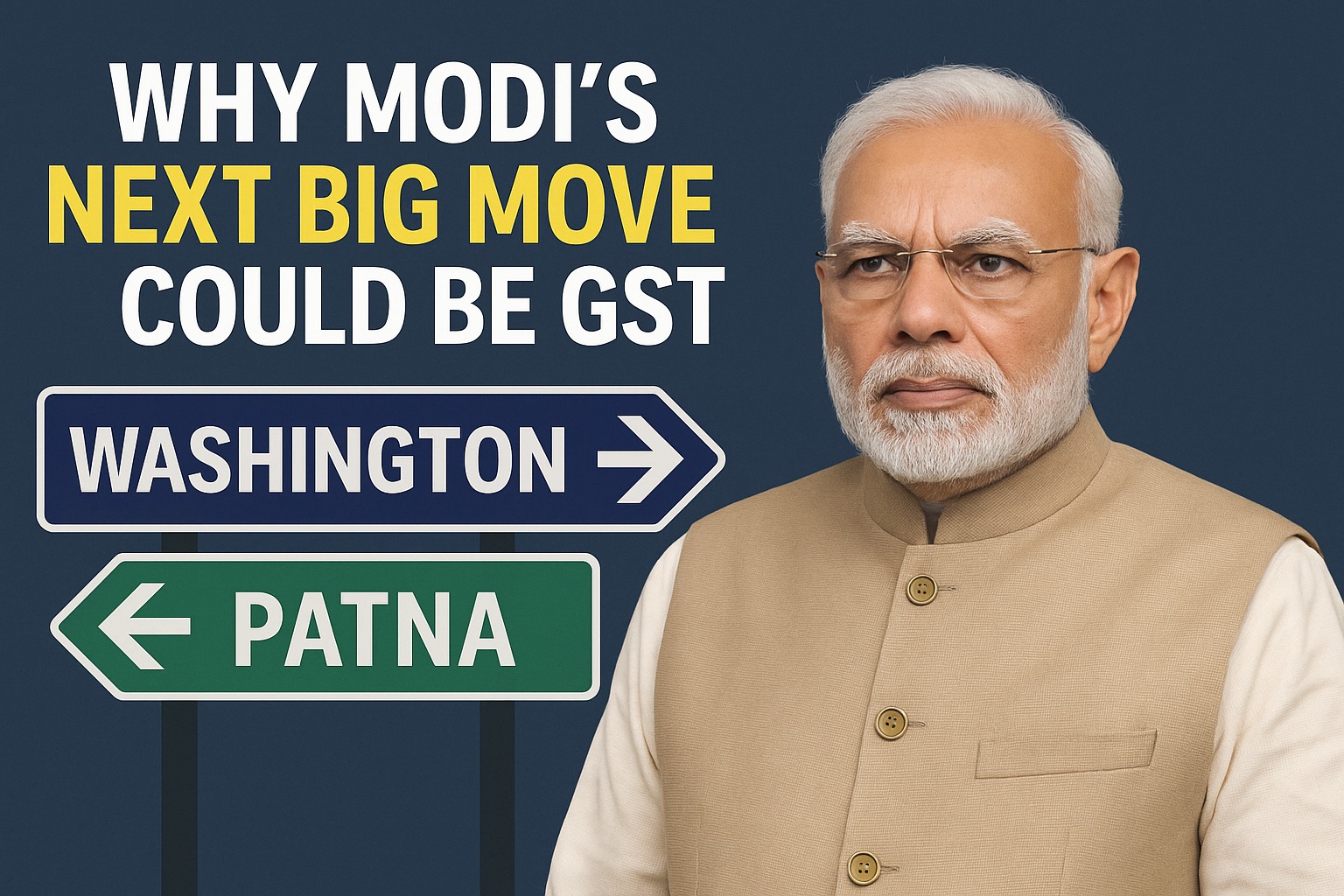
The debate around India’s Goods and Services Tax (GST) has once again gained momentum, with renewed calls for a possible reduction in tax slabs. At a time when global economic challenges are colliding with domestic political pressures, the discussion over GST reforms has become more than just an economic issue—it is increasingly being viewed as a political strategy that could shape the coming months for Prime Minister Narendra Modi and his government.
The Global Context: US Tariffs and India’s Response
The United States’ fresh wave of tariffs on Indian exports has added new pressure to India’s trade dynamics. These tariffs, targeted at specific sectors including steel, aluminum, textiles, and select agricultural products, are seen as a move to protect American industries in an election year. For India, however, they present a challenge to export competitiveness at a time when global demand is already sluggish.
Officials in New Delhi have hinted that any retaliatory measures will be carefully considered to avoid escalation. Yet, industry voices have made it clear that Indian exporters will require relief closer to home—through measures such as GST rationalization—to remain competitive.
Domestic Imperative: Bihar Elections and Voter Sentiment
On the home front, the Modi government is preparing for the crucial Bihar Assembly elections. Bihar, a politically sensitive state with a mix of rural, semi-urban, and urban voters, has traditionally responded strongly to economic promises. Rising prices of essential commodities, combined with limited job opportunities, have made GST a key issue in the state’s electoral conversation.
Small traders and middle-class families alike have expressed concerns about the burden of higher GST slabs, particularly in essential categories such as daily-use goods and household items. Any move to simplify or reduce the GST structure would not only provide financial relief but also directly appeal to these voting blocs, strengthening the BJP-led NDA’s campaign message.
The Political Signal: Modi’s Image as a Reformer
Prime Minister Modi’s political image has long been tied to his ability to deliver big, reform-oriented moves—from demonetization to the rollout of GST itself. Supporters believe that a GST reduction or rationalization would reinforce his image as a leader who listens to public concerns and adapts policies to ground realities.
Critics, however, argue that GST reduction now could be seen as a politically motivated decision rather than a long-term structural reform. Still, in electoral politics, perception often outweighs technicalities. With Bihar polls ahead, such a measure could showcase Modi’s government as pro-people and responsive during challenging times.
Industry and Expert Reactions
Economists suggest that reducing GST from the current multiple slabs toward fewer, lower categories could ease compliance and boost consumer demand. Retail and manufacturing sectors, particularly small and medium enterprises (SMEs), would be immediate beneficiaries. At the same time, industry associations have warned that such a move must be balanced against fiscal realities, as states depend heavily on GST collections for revenue.
Some experts argue that India’s current fiscal deficit leaves little room for large-scale cuts, but a carefully calibrated reduction—particularly in the 12% and 18% slabs—could provide both economic stimulus and political mileage.
Looking Ahead: A Dual Challenge for the Modi Government
The Modi government finds itself at the intersection of two challenges: an external trade battle with the US and an internal electoral test in Bihar. While tariff disputes with Washington may require long-term diplomatic engagement, the GST issue provides an immediate lever for Modi to boost both the economy and his political narrative.
By considering GST reduction, the government could cushion Indian exporters against tariff shocks, provide relief to domestic consumers, and frame the decision as a commitment to economic justice and growth. The timing, just before the Bihar elections, would naturally add weight to its political impact.
Editorial Conclusion
After examining both domestic and global factors, the Editorial Team of Jan Jagran Darpan concludes that a GST reduction, if announced, could serve as both an economic buffer and a political masterstroke. For Prime Minister Modi, it represents an opportunity to reaffirm his image as a reformer and protector of common citizens’ interests, while simultaneously countering international economic pressures and preparing for the battle of Bihar.
Related Posts



Stay Informed With the Latest & Most Important News
Previous Post
Next Post
Advertisement





Advertisement
