
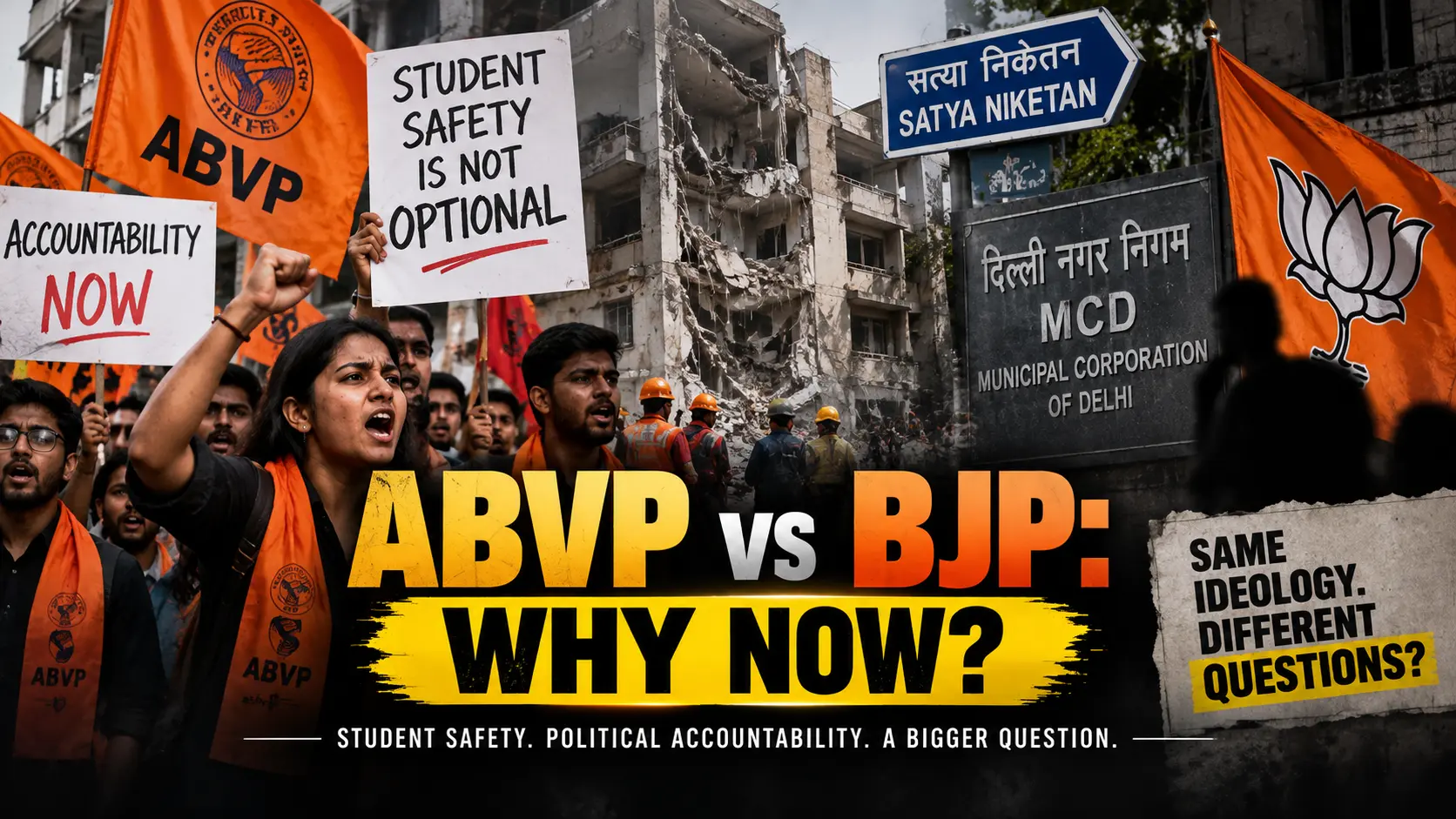
The protests after the Satya Niketan building collapse raise questions about student politics, accountability and the changing relationship between the ABVP and the BJP.
The Akhil Bharatiya Vidyarthi Parishad has intensified protests against the BJP-controlled Municipal Corporation of Delhi after the deadly collapse of a paying-guest building in Satya Niketan.
The Editorial Team of Behind The Headlines reports that the demonstrations have drawn attention to an unusual political situation: a student organisation associated with the wider Sangh Parivar publicly challenging an institution governed by the BJP. The protests have also revived questions about whether the ABVP is asserting independence or attempting to rebuild its credibility among students.
Satya Niketan tragedy becomes a student issue
The collapse of a five-storey building used as a boys’ paying-guest accommodation in Delhi’s Satya Niketan killed several people, including students. The incident exposed concerns surrounding unsafe private accommodation, overcrowding, building approvals and weak enforcement of safety rules.
In the aftermath, the ABVP demanded accountability from the MCD and called for safety audits of paying-guest accommodations and hostels. The organisation also sought action against senior civic officials, including the MCD commissioner.
The issue has gained wider importance because thousands of Delhi University students depend on private hostels and paying-guest facilities due to a shortage of affordable institutional accommodation.
Why is the ABVP protesting against the BJP-controlled MCD?
The ABVP is affiliated with the Rashtriya Swayamsevak Sangh, but it is not formally the student wing of the BJP. This distinction has historically allowed the organisation to maintain a degree of institutional autonomy.
The ABVP was established before the BJP became a major political force. Over the years, it has protested against university administrations, government departments and local authorities—including those controlled by the BJP.
However, such protests are usually directed at a particular policy, administrative failure or individual official rather than the entire ruling party. This is different from the organisation’s protests against non-BJP governments, which have more often included broader political and ideological demands.
A long history of internal dissent
The ABVP’s confrontation with BJP-led institutions is not entirely new.
In previous years, the organisation has protested against BJP governments and government-appointed authorities over issues such as unemployment, education policy, university administration, law and order, and alleged failures involving student welfare.
In some cases, protests have resulted in police action and clashes. Yet the organisation has generally maintained its larger ideological alignment with the Sangh Parivar.
This creates a complex relationship: the ABVP can challenge a BJP-controlled body on a specific issue while continuing to support the broader political and ideological framework associated with the party.
What changed after 2014?
The relationship between the ABVP and the BJP became closer after Narendra Modi came to power in 2014.
The BJP’s political dominance, its focus on major ideological issues and the movement of ABVP members into electoral politics strengthened the connection between the two organisations. The ABVP also benefited from greater institutional visibility and political influence.
But this closeness created a possible disadvantage. When a student organisation is seen as closely aligned with the government, it can find it harder to convince students that it is an independent voice on issues such as education, housing, fees, examinations and safety.
The Satya Niketan protests may therefore represent an attempt to draw a distinction between the ABVP and the administration—even when the administration is controlled by the same political ecosystem.
The post-NEET credibility question
The ABVP’s recent activism also needs to be viewed against the backdrop of student dissatisfaction over education and examination-related issues.
The organisation faced criticism after large-scale anger over the NEET controversy, with questions being raised about whether it had adequately represented students’ concerns. The episode reportedly prompted internal reflection over the perception that the ABVP had become too closely identified with the government.
Since then, the organisation has increased its focus on student-centred issues, including accommodation, safety and university administration.
The Satya Niketan protests fit into this broader effort to demonstrate that the ABVP can oppose administrative failures—even when the governing authority is politically aligned with it.
Is this genuine opposition or controlled dissent?
There are two competing interpretations of the protests.
One view is that the ABVP is exercising genuine organisational independence. Student safety is a politically sensitive issue, and failing to respond could damage its standing on university campuses. Publicly challenging the MCD may therefore be a way of representing students’ anger.
The other interpretation is that the protests are limited and carefully framed. The demands focus largely on civic officials, audits and administrative accountability rather than directly targeting the BJP’s political leadership. Such a strategy allows the organisation to express dissatisfaction without challenging the broader ruling structure.
Both explanations may contain some truth. The ABVP has its own organisational interests, but it also operates within a wider ideological and political network.
Why the issue matters beyond the ABVP
The larger question is not simply why one student group is protesting against a BJP-controlled civic body. It is whether political organisations can retain credibility when they are closely connected to power.
The Satya Niketan tragedy has highlighted the vulnerability of students living in unregulated or poorly monitored accommodation. Safety audits, building approvals, fire clearances and occupancy limits are administrative responsibilities that cannot be reduced to political slogans.
For the ABVP, the challenge is to ensure that its campaign produces concrete improvements rather than remaining limited to demonstrations. For the MCD and the Delhi government, the test is whether officials accept responsibility and enforce safety standards consistently.
Conclusion
The ABVP’s protests after the Satya Niketan building collapse reveal the complicated relationship between student politics and political power.
The organisation remains ideologically close to the Sangh Parivar, yet it is also attempting to show that it can question failures within BJP-controlled institutions. Whether this becomes meaningful student representation or remains a limited form of internal dissent will depend on what happens next.
The immediate priority, however, is clear: students need safe accommodation, transparent inspections and accountable civic administration—not merely political assurances.