
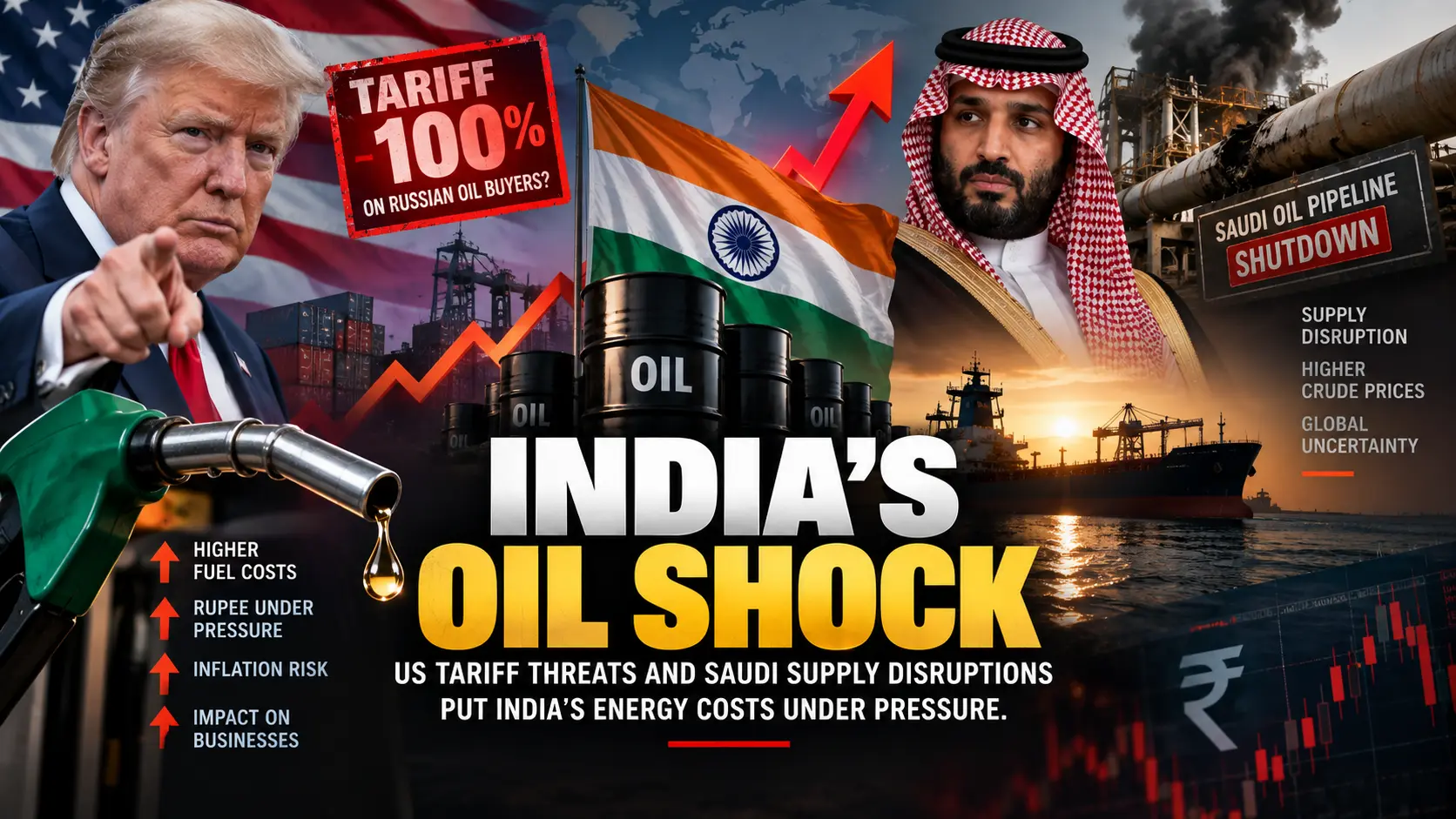
India is facing pressure from two directions at once: a possible US tariff escalation over Russian oil and rising crude costs after Saudi Arabia’s key pipeline shutdown.
India’s energy security is coming under renewed pressure as a proposed US measure could allow tariffs of up to 100% on countries buying Russian oil, while a major Saudi pipeline shutdown has tightened global crude supplies.
The Editorial Team of Behind The Headlines reports that the two developments are separate, but together they could make crude imports more expensive for India, increase pressure on the rupee and complicate the government’s effort to keep fuel prices and inflation under control.
What is happening with the US tariff threat?
The US House of Representatives has advanced legislation that could give President Donald Trump the power to impose tariffs of up to 100% on countries purchasing Russian oil and gas.
A House amendment specifically names India among countries that could become subject to such measures. The legislation still needs to go through the remaining US legislative process before any such tariff could actually be imposed.
The issue matters because Russia has become an important source of crude for Indian refiners. Preliminary data showed India imported around 1.42 million barrels per day of Russian crude during the first 14 days of September, although that was down from an August average of about 2.1 million barrels per day.
A 100% tariff, if eventually imposed, would therefore have consequences far beyond the direct cost of Russian crude. It could affect India's exports to the US and make the broader India-US trade relationship more difficult.
Why is the Saudi pipeline shutdown important?
Saudi Arabia's 1,200-km East-West pipeline is designed to transport crude from the kingdom's oil-producing east to the Red Sea port of Yanbu, allowing Saudi Arabia to bypass the Strait of Hormuz.
The pipeline was shut after attacks damaged infrastructure in the Riyadh and Madinah regions. It has been carrying roughly 4–5 million barrels of crude a day, equivalent to around 4–5% of global oil supply.
The timing is particularly important because oil flows through the Strait of Hormuz are already severely disrupted by the wider regional conflict.
The latest US assessment is that the pipeline could be restored within days, although other estimates have suggested a longer repair period. The uncertainty itself has contributed to higher oil prices.
India does not simply depend on Saudi oil
At first glance, the Saudi disruption may appear to be a direct supply problem for India. But the bigger risk is the global price effect.
India's direct Saudi crude purchases are only one part of its overall supply basket. Saudi crude imports averaged around 315,000 barrels per day in August, while India's total crude imports were around 4.7 million barrels per day.
If Saudi Arabia cannot move enough crude through alternative routes, however, refiners across Asia may compete for barrels from Russia, Iraq, Africa, Latin America and other producers.
That competition can increase both crude prices and shipping costs.
Russia becomes more important — and more complicated
This is where the US tariff issue and the Saudi pipeline problem intersect.
India could potentially increase purchases from Russia when Gulf supplies become more expensive. But Washington's proposed secondary tariff mechanism could make Russian crude significantly more complicated for Indian companies.
At the same time, Russian oil availability itself is under pressure. India's Russian crude imports are expected to be lower in September amid disruptions to Russian oil infrastructure and stronger competition from Chinese buyers. (
That leaves Indian refiners with fewer straightforward options.
What happens to petrol and diesel prices?
Higher international crude prices do not automatically mean an immediate increase in Indian petrol and diesel prices.
Indian fuel prices are influenced by international crude prices, refining costs, taxes, exchange rates and domestic pricing decisions.
But a prolonged increase in crude prices would increase the cost of India's imports and could eventually put pressure on domestic fuel prices.
The risk is broader than petrol and diesel. Expensive crude can raise costs for:
Aviation turbine fuel
LPG and other petroleum products
Petrochemicals
Plastics
Transport and logistics
Manufacturing
Agriculture and fertiliser supply chains
The government has already acknowledged that the West Asia crisis has implications for India through disruptions in petroleum supplies and higher international energy prices.
The rupee and inflation channel
India imports most of the crude oil it consumes. When crude becomes more expensive, the country's dollar demand for energy imports increases.
If the rupee weakens at the same time, imported crude becomes even more expensive in rupee terms.
That can create a chain reaction:
Higher crude prices → higher import bill → pressure on rupee → higher input costs → inflation pressure
India's August data already showed the impact of the energy shock: crude oil imports rose 25.8% year-on-year to $16.69 billion, while the Indian crude basket averaged $90.19 per barrel, up from $82.04 in July. The September average had climbed further by the middle of the month.
Can India find alternatives?
Yes, but replacing large volumes of crude quickly is not simple.
Indian refiners can increase purchases from sources such as Iraq, the United States, Africa and Latin America. Iraq has already emerged as an important alternative, with Indian imports of Iraqi crude rising sharply in the first half of September.
But alternative supplies can involve higher freight costs, different crude grades, insurance premiums and longer shipping distances.
Saudi Arabia can also reroute some crude through other export terminals, although doing so through the Strait of Hormuz carries its own security risks.
What should India watch next?
Three developments will determine how serious the economic impact becomes.
First, the Saudi pipeline repair timeline. A short disruption could largely remain a market shock. A prolonged outage could create a deeper physical supply problem.
Second, the US Russia-sanctions bill. The proposed 100% tariff is not yet an imposed tariff. Its final provisions and implementation will determine the actual impact on India.
Third, the direction of global crude prices. Brent crude has already moved above $100 a barrel amid the supply disruptions, with recent trading around the $107–109 range.
The bigger picture
India has spent years diversifying its crude suppliers and using its large refining capacity to manage changing global supply conditions. That provides some flexibility.
But the current situation is unusual because several risks are appearing simultaneously: disruption around the Strait of Hormuz, damage to Saudi Arabia's alternative export route, tighter Russian supplies and a potential US penalty on buyers of Russian energy.
For India, the immediate concern is therefore not that crude will suddenly disappear.
It is that the cost of finding the next barrel could become much higher.