
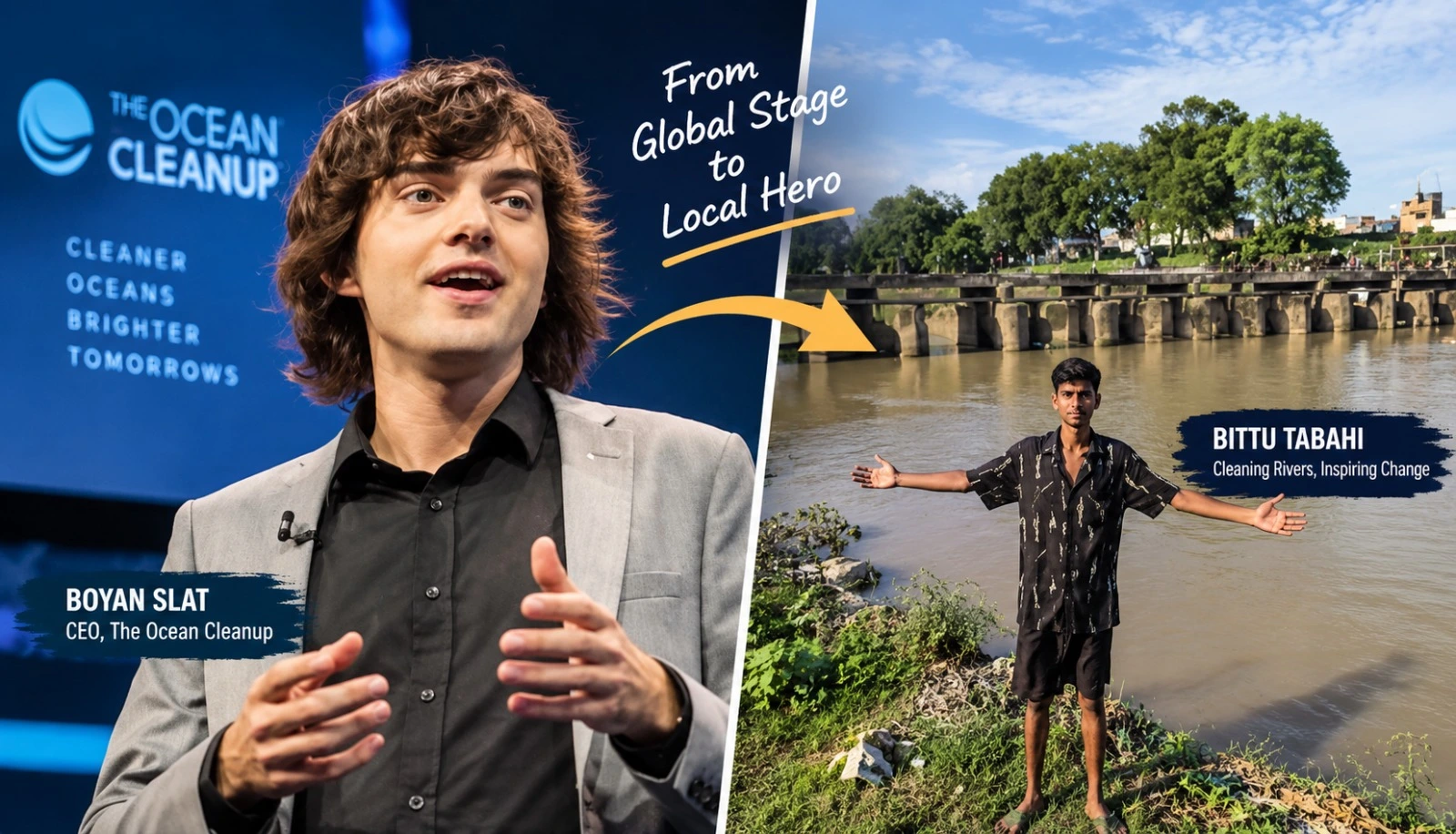
A 20-year-old from Madhya Pradesh spent months cleaning the garbage-filled Ajnar River largely on his own. His efforts have now earned international attention and an invitation to work with a global organisation fighting plastic pollution.
A young man from Madhya Pradesh has turned a personal mission to clean a polluted river into an opportunity that could take his environmental work to the international stage.
Surendra Singh Choudhry, popularly known online as ‘Bittu Tabahi’, has been cleaning the heavily polluted Ajnar River in Madhya Pradesh for months. Working largely by himself, he has been removing plastic, discarded waste and other debris from the river and surrounding areas.
What began as a local effort has now attracted global attention.
The Editorial Team of Behind The Headlines reports that Dutch environmentalist and The Ocean Cleanup founder and CEO Boyan Slat noticed posts about Choudhry’s work and responded with an invitation for him to join the organisation. Slat's short message — “Come work for us” — quickly went viral online.
Who is Bittu Tabahi?
Surendra Singh Choudhry is a young environmental enthusiast from Biaora in Madhya Pradesh’s Rajgarh district.
Rather than waiting for a large government programme or an organised campaign, he began working on the Ajnar River himself.
Images and videos shared online showed the condition of the river before and after his efforts, highlighting the amount of plastic and other waste that had accumulated in and around the waterway. Reports say he spent his own money on basic supplies and repeatedly returned to the river to continue the cleanup.
His social-media identity, Bittu Tabahi, soon became associated with the cleanup campaign.
From local cleanup to national attention
The scale of the effort eventually brought Choudhry considerable attention on social media.
His work also received recognition from people outside his immediate community, including industrialist Anand Mahindra, while videos documenting the cleanup helped the story spread much further.
The striking element of the campaign was its simplicity.
There was no large team visible in the initial effort. Instead, one young man repeatedly entering a polluted river and physically removing waste became the central image of the campaign.
That resonated with people because the story was not initially about a professional environmental organisation. It was about an individual deciding that a problem in his own neighbourhood could not simply be ignored.
How did Boyan Slat notice him?
The international breakthrough came after posts about Choudhry’s work circulated online.
Boyan Slat, whose organisation focuses on developing technologies and systems to remove plastic pollution from oceans and rivers, came across the story.
Slat responded by inviting Choudhry to work with his organisation.
The offer effectively transformed a local environmental initiative into a potential international career opportunity.
The exact terms of the potential employment and the next steps have not been publicly detailed.
Why is this story significant?
The Ajnar River story highlights a larger problem facing many Indian waterways: pollution is often visible long before effective cleanup systems reach the ground.
Plastic bottles, packaging material, household waste and other debris can accumulate in rivers, affecting water quality and the surrounding ecosystem.
Choudhry's campaign also raises another question — why should an individual have to take on a public environmental problem alone?
His work is inspiring, but it also underlines the need for sustained waste-management systems, public participation and effective local administration.
More than a job offer
For Choudhry, the international recognition could represent more than a career opportunity.
Working with an organisation focused specifically on river and ocean plastic pollution could allow him to learn professional cleanup techniques, understand large-scale environmental projects and potentially bring that knowledge back to India.
His story also demonstrates how social media can connect grassroots initiatives with people and organisations operating on a global scale.
A young man who started by cleaning one polluted river may now get the opportunity to work on the much larger global problem of plastic pollution.
The bigger message, however, remains local: environmental change does not always begin with a large institution.
Sometimes, it begins with one person deciding to act.