
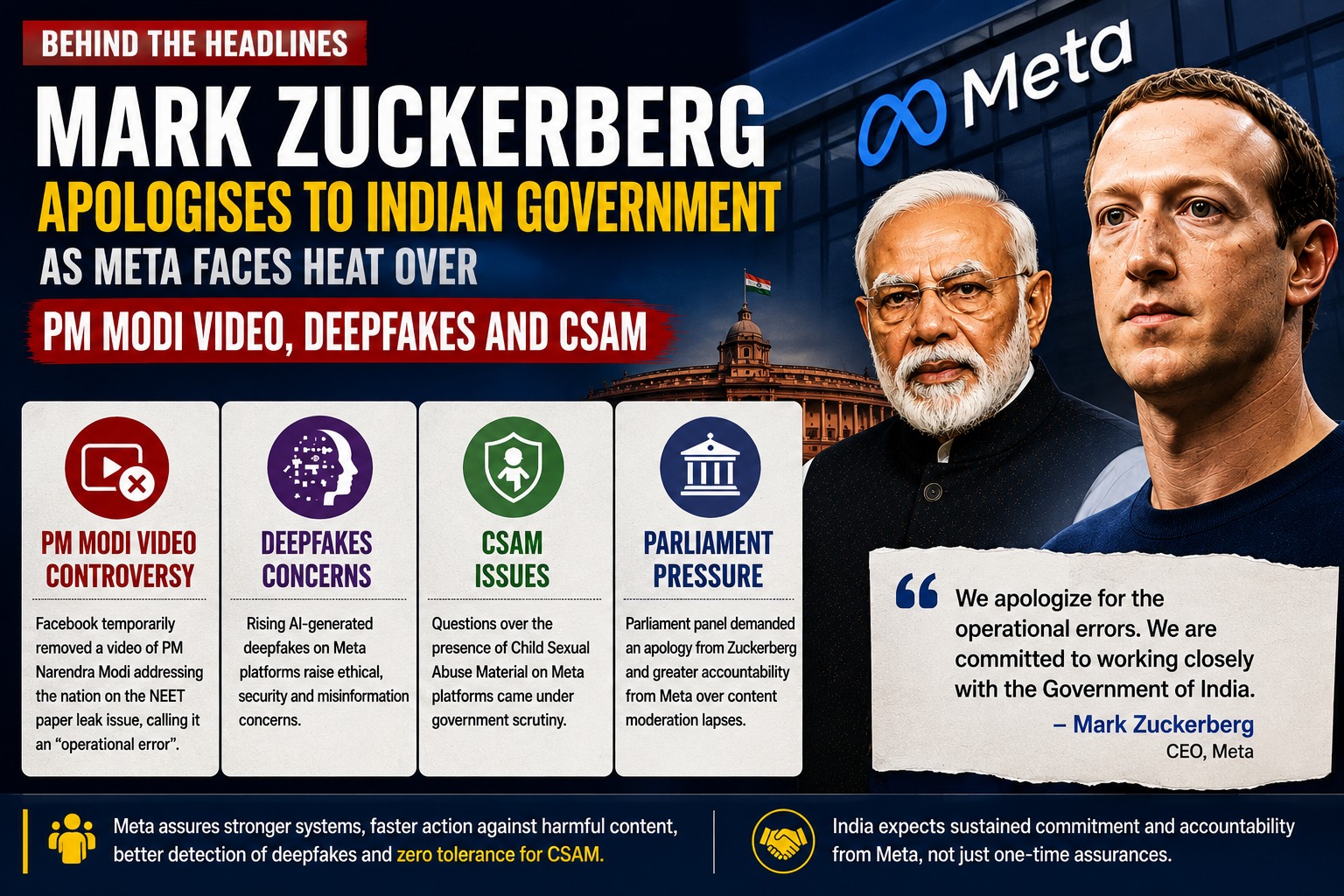
Meta CEO Mark Zuckerberg has apologised to the Indian government after the company came under intense scrutiny over multiple issues, including the temporary removal of Prime Minister Narendra Modi's Facebook video, the spread of deepfake content and concerns over Child Sexual Abuse Material (CSAM) on Meta's platforms.
The apology comes after a series of meetings between senior Meta executives and officials from the Ministry of Electronics and Information Technology (MeitY), along with growing pressure from a Parliamentary Standing Committee that had demanded accountability from the company.
Why Did Meta Apologise?
According to reports, Zuckerberg's apology covered three key issues that have put Meta under the government's scanner:
The brief removal of a Facebook video posted by Prime Minister Narendra Modi.
The presence of CSAM on Meta-owned platforms.
The increasing spread of AI-generated deepfake content and operational shortcomings in content moderation.
Meta reportedly acknowledged lapses and reaffirmed its commitment to improving its safety systems and compliance with Indian regulations.
The PM Modi Video Controversy
The controversy began after Facebook temporarily removed a video from Prime Minister Narendra Modi's official account in which he addressed the nation on the NEET paper leak issue.
Meta later restored the video, attributing the removal to a technical or operational error. However, the explanation did not satisfy the Indian government or members of Parliament, who questioned how content from the country's elected Prime Minister could be mistakenly taken down.
The incident prompted MeitY to summon Meta officials for an explanation and review the company's content moderation processes.
Parliament's Tough Stand
The Parliamentary Standing Committee on Communications and Information Technology, chaired by BJP MP Nishikant Dubey, had earlier demanded a personal apology from Mark Zuckerberg.
Committee members warned that failure to adequately address the issue could lead to recommendations affecting Meta's "safe harbour" protections under India's Information Technology Act.
The committee also questioned Meta about:
The removal of the Prime Minister's video.
Algorithmic transparency.
Platform accountability.
Protection against harmful online content.
Deepfakes and CSAM Under the Spotlight
The PM's video was only one part of the government's concerns.
Officials also questioned Meta over:
AI-generated deepfake videos.
Child Sexual Abuse Material (CSAM).
The effectiveness of Meta's detection systems.
The speed with which illegal content is removed.
According to reports, Meta reiterated its zero-tolerance policy towards CSAM and said it is strengthening automated detection tools and human review systems to identify and remove such material more effectively.
What Did Zuckerberg Say?
Media reports quoting government sources said Zuckerberg apologised for the operational lapses and acknowledged concerns regarding content moderation.
Meta also assured Indian authorities that it would:
Improve moderation systems.
Strengthen safeguards against deepfakes.
Enhance the detection and removal of CSAM.
Prevent similar errors involving high-profile public accounts.
Why This Matters
India is Meta's largest market by user base, making its relationship with the Indian government strategically important.
The episode reflects increasing expectations from regulators that global technology companies should:
Protect users from harmful content.
Act quickly against illegal material.
Ensure greater transparency in content moderation.
Avoid erroneous takedowns of verified public-interest content.
The discussions also come as India tightens digital platform regulations, including stricter timelines for removing unlawful content and greater accountability for intermediaries.
What Happens Next?
While Zuckerberg's reported apology appears to have eased immediate tensions, discussions between Meta and Indian authorities are expected to continue on broader issues such as AI-generated misinformation, deepfakes, child safety, and compliance with India's evolving digital regulations.
The government has indicated that it expects sustained improvements rather than one-time assurances, signalling that content moderation by large technology platforms will remain under close scrutiny.