
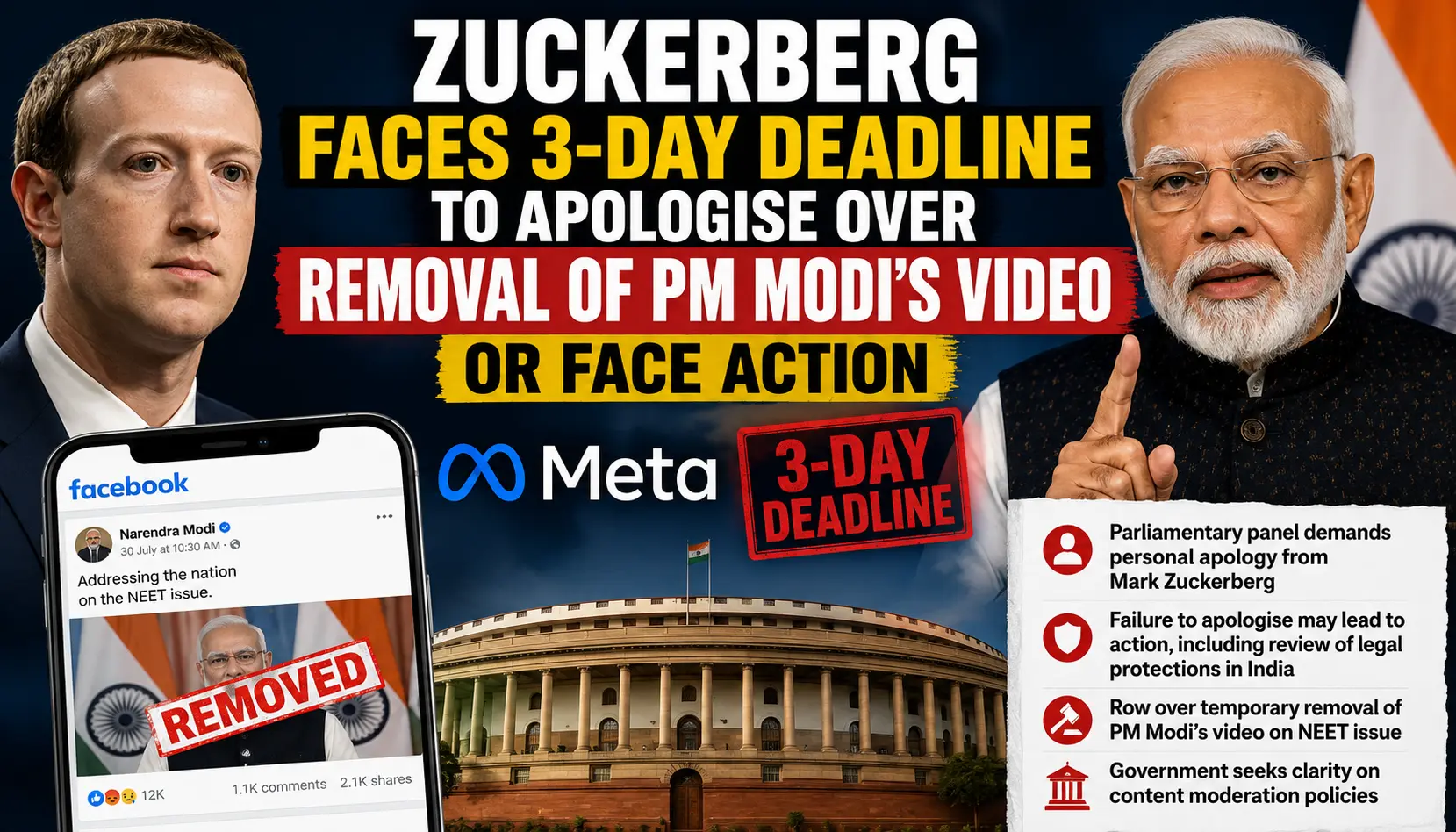
A controversy involving Meta's temporary removal of a Facebook video posted by Prime Minister Narendra Modi has escalated into a broader debate over content moderation, platform accountability and the relationship between global technology companies and sovereign governments.
India's Parliamentary Standing Committee on Communications and Information Technology has asked Meta CEO Mark Zuckerberg to issue a personal apology within three days, warning that failure to do so could prompt recommendations affecting the company's legal protections in India.
What Triggered the Controversy?
The issue began after Facebook briefly restricted or removed a video uploaded from Prime Minister Narendra Modi's official account in which he addressed the country on the NEET examination paper leak controversy.
The content was later restored by Meta, which described the incident as an inadvertent error or technical glitch. The company also expressed regret and initiated an internal review of its moderation processes for high-profile accounts.
However, the explanation did not satisfy several lawmakers or government officials, who argued that content from the elected Prime Minister should not have been removed without a compelling and transparent reason.
Why Is Parliament Demanding an Apology?
The Parliamentary Standing Committee, chaired by BJP MP Nishikant Dubey, has taken a strong position on the issue.
The committee has demanded:
A personal apology from Meta CEO Mark Zuckerberg.
An explanation of why the Prime Minister's verified account was affected.
Details of Meta's content moderation systems for high-profile public officials.
Assurance that similar incidents will not recur.
According to reports, the committee has warned that if Zuckerberg fails to respond within three days, it may recommend action that could affect Meta's legal protections under Indian law.
What Is 'Safe Harbour' and Why Is It Important?
A key issue in the dispute is safe harbour protection under Section 79 of the Information Technology Act.
Safe harbour protects online intermediaries such as Facebook, Instagram and WhatsApp from being held legally responsible for user-generated content, provided they comply with Indian laws and due diligence requirements.
Some members of the parliamentary committee have suggested that Meta's protection should be reconsidered if the company fails to adequately explain or address the incident. However, any change to Meta's legal status would require action under India's legal and regulatory framework rather than occurring automatically.
Government's Response
The Ministry of Electronics and Information Technology (MeitY) summoned Meta executives following the incident.
MeitY Secretary S. Krishnan said Meta had "no business" removing authorised content from the Prime Minister's official account and described the company's initial explanation as inadequate. Government officials also sought clarification on Meta's moderation processes and safeguards for verified accounts.
Meta subsequently agreed to meet government officials and discuss its internal policies and moderation procedures.
What Has Meta Said?
Meta has stated that the restriction resulted from a technical error rather than a deliberate policy decision.
The company restored the video shortly after identifying the issue, expressed regret and introduced additional review protocols for high-profile or VIP accounts to reduce the risk of similar incidents.
As of now, there has been no public confirmation that Mark Zuckerberg has personally responded to the parliamentary committee's demand.
Why Does This Matter?
The dispute extends beyond a single post.
It raises broader questions about:
How global technology platforms moderate political content.
Whether automated moderation systems can mistakenly affect verified public officials.
The accountability of multinational technology companies operating in India.
The balance between platform autonomy and government oversight.
India is Meta's largest market by user base, making the relationship between the government and the company particularly significant.
What Happens Next?
The immediate focus is on whether Meta and its CEO respond to the parliamentary committee's demand within the stated deadline.
Separately, government agencies continue discussions with Meta regarding content moderation practices, safeguards for verified accounts and compliance with India's evolving digital regulations. The outcome could influence future interactions between technology platforms and regulators, although any changes to legal protections would need to follow established statutory processes.