
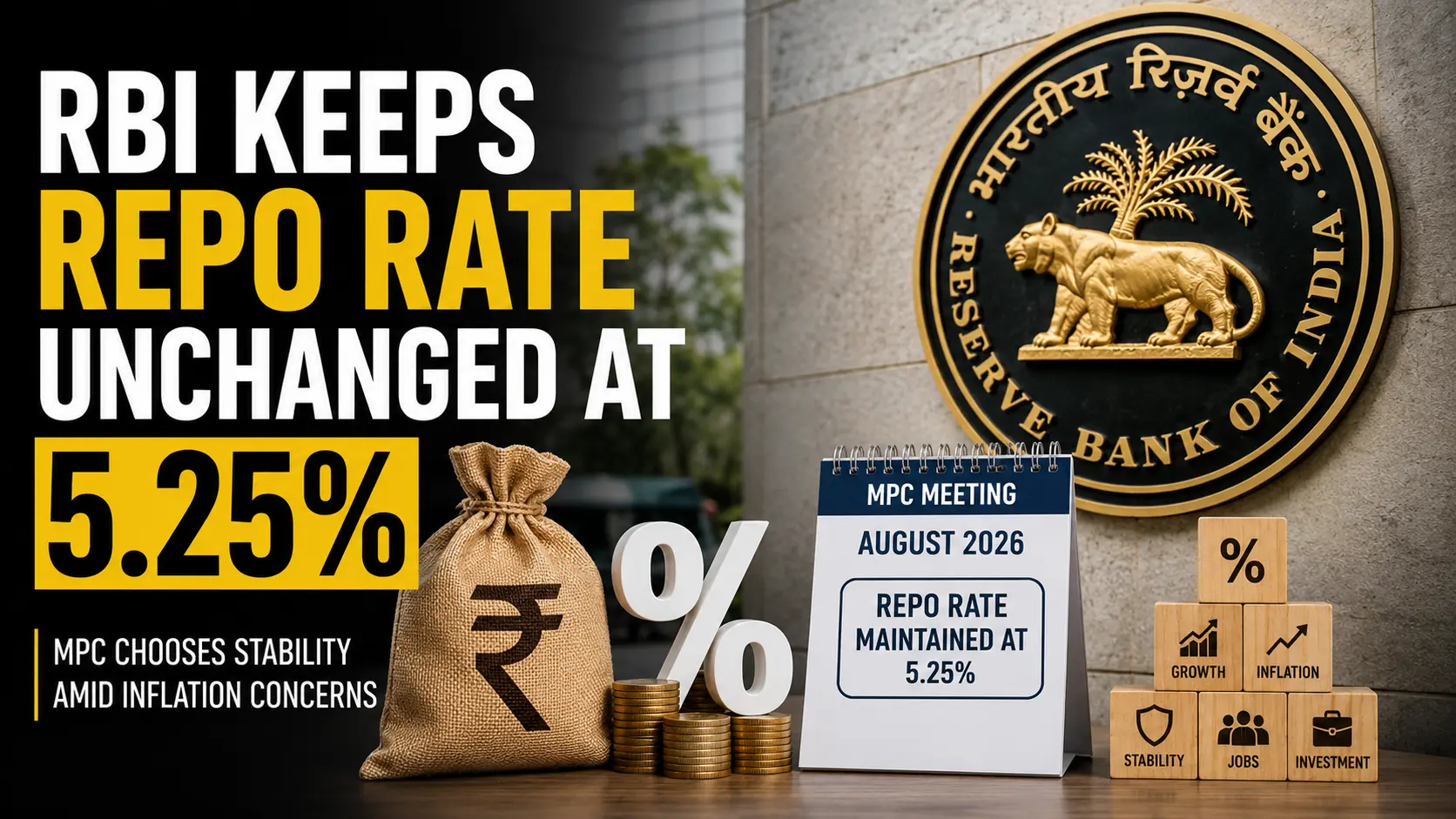
The Reserve Bank of India (RBI) has decided to keep the repo rate unchanged at 5.25%, choosing stability over another rate cut as it navigates a challenging global economic environment. The decision, announced after the Monetary Policy Committee's (MPC) August 2026 meeting, was widely expected by economists and financial markets.
For borrowers, homebuyers and businesses, the decision means there is no immediate change in borrowing costs. For the RBI, it reflects a cautious approach as it balances inflation risks with the need to support economic growth.
What Is the Repo Rate?
The repo rate is the interest rate at which commercial banks borrow short-term funds from the RBI. It serves as the central bank's primary monetary policy tool.
When the RBI lowers the repo rate, borrowing generally becomes cheaper, encouraging spending and investment. When it raises the rate, loans become costlier, helping contain inflation. By keeping the rate unchanged, the RBI is signalling that it believes current economic conditions do not warrant either a cut or a hike.
Why Did the RBI Hold Rates?
RBI Governor Sanjay Malhotra said the Indian economy remains resilient, but several global uncertainties continue to pose risks. These include geopolitical tensions, fluctuations in crude oil prices, volatile financial markets and inflationary pressures. The MPC therefore opted for a "wait and watch" approach while continuing with its data-driven policy framework.
The central bank also indicated that it will continue to monitor incoming economic data before making any future changes to interest rates.
Inflation Still a Key Concern
Although retail inflation has eased from previous highs, the RBI believes risks remain. Rising global commodity prices, food inflation and weather-related uncertainties could keep inflation elevated in the coming months.
At the same time, domestic demand has remained healthy, allowing the RBI to prioritise price stability without significantly affecting economic activity. The central bank has revised its inflation outlook higher while remaining optimistic about India's growth prospects.
What Does This Mean for Borrowers?
For existing borrowers with loans linked to the repo rate or external benchmark lending rates, EMIs are unlikely to change immediately.
Banks are also expected to maintain current lending rates unless market conditions shift significantly.
For those planning to take a home, vehicle or business loan, borrowing costs are expected to remain broadly stable in the near term.
Impact on Fixed Deposits
The decision also means fixed deposit (FD) rates are unlikely to witness major changes immediately.
Banks typically adjust deposit rates when there is a sustained shift in monetary policy. Since the RBI has maintained the status quo, depositors should not expect significant changes in returns in the short term.
How Did Markets React?
Financial markets had largely priced in the RBI's decision, resulting in a relatively muted immediate reaction.
Investors are now expected to focus on the RBI's commentary regarding inflation, growth projections and future policy direction rather than the rate decision itself.
What Should Consumers Expect?
For ordinary consumers, the immediate impact is one of continuity.
Home loan EMIs are likely to remain unchanged.
Car and personal loan interest rates are expected to stay stable.
Fixed deposit rates are unlikely to change significantly.
Businesses can continue planning investments without a sudden increase in borrowing costs.
The RBI's message is clear: while India's economy remains on a strong footing, global developments require caution rather than aggressive policy moves.
What's Next?
Future monetary policy decisions will largely depend on how inflation evolves, the trajectory of global crude oil prices, weather-related food inflation and broader international economic conditions.
If inflation remains under control and growth slows meaningfully, the RBI could consider easing rates in future meetings. Conversely, a sustained rise in inflation could prompt tighter monetary policy.
For now, the central bank has chosen stability—giving households, businesses and financial markets a predictable interest rate environment while it closely watches developments at home and abroad.