
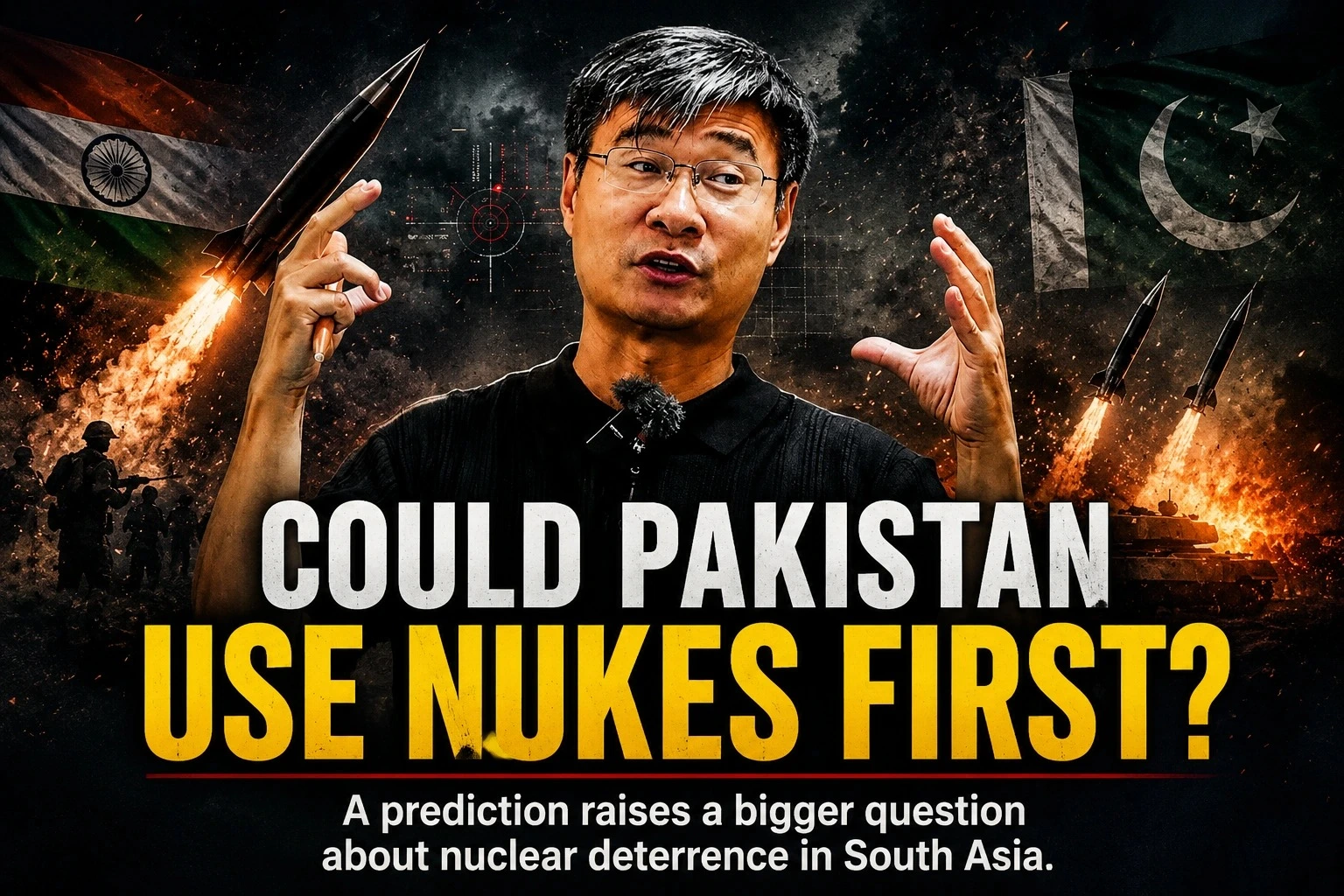
A geopolitical commentator has suggested that Pakistan could be the country most likely to use nuclear weapons first in a future India-Pakistan conflict. But his argument is a prediction, not evidence of an imminent nuclear attack.
A recent discussion about the possibility of nuclear weapons being used in a future conflict has drawn attention after Chinese-born Canadian geopolitical commentator Jiang Xueqin said Pakistan could be the most likely country to cross the nuclear threshold first. Speaking on YouTuber Raj Shamani's podcast, Jiang said that if nuclear weapons were ever used in a future conflict, he would place India or Pakistan among the most likely possibilities, with Pakistan his stronger concern.
The Editorial Team of Behind The Headlines reports that the comments should be understood carefully. Jiang did not predict that Pakistan is about to launch a nuclear strike, nor did he claim to possess intelligence indicating that such an attack is being planned. In fact, he said he personally believes there is almost no chance that nuclear weapons will be used in his lifetime because of the longstanding global taboo surrounding their use. His concern is about what could happen if a conventional India-Pakistan conflict escalates to a point where Pakistan's leadership believes the country's survival is at stake.
What exactly did Jiang say?
Jiang was asked about the possibility of nuclear weapons being used in a future conflict during a roughly two-hour conversation with Raj Shamani.
His answer was striking.
He said that if he had to identify the country most likely to use nuclear weapons first, he would choose India or Pakistan, possibly Pakistan.
But his reasoning was not that Pakistan wants a nuclear war.
Instead, he focused on the strategic imbalance between the two countries.
India has a larger conventional military and economic base, while Pakistan has historically relied heavily on nuclear weapons as a counterweight to India's conventional superiority.
Jiang's argument is that if a future conventional conflict becomes an existential threat to Pakistan, its leadership could potentially face pressure to consider nuclear weapons as a last-resort option.
That is a scenario analysis, not a forecast of an impending nuclear attack.
Why is Pakistan at the centre of the argument?
The India-Pakistan nuclear relationship is unusual because the two countries have very different strategic positions.
India maintains a declared No First Use nuclear doctrine, although Indian officials and strategic experts have debated aspects of the policy over the years. Pakistan, meanwhile, has not adopted a No First Use policy.
India's nuclear doctrine has traditionally emphasised retaliation after a nuclear attack.
Pakistan's approach has been more deliberately ambiguous.
The reason is straightforward: Pakistan has a smaller conventional military capability than India and therefore views nuclear weapons as an important way to deter a large-scale conventional attack.
This creates what strategists describe as asymmetric deterrence.
Pakistan's nuclear arsenal is not simply about matching India's weapons.
It is also about preventing India from using its conventional military superiority without facing the possibility of nuclear escalation.
What does 'first use' actually mean?
This distinction is important.
A country using nuclear weapons first does not necessarily mean it has launched an unprovoked nuclear attack.
In a military crisis, a country could theoretically decide to use nuclear weapons after suffering a major conventional attack if its leadership believes the state's survival is threatened.
This is the scenario that concerns Jiang.
His argument is essentially that Pakistan's nuclear doctrine leaves more room for such an escalation because Islamabad has not made a formal No First Use commitment.
However, the existence of such a doctrine does not mean Pakistan has decided to use nuclear weapons first in any future conflict.
Nuclear decision-making is highly classified, and the circumstances under which a state would actually cross the nuclear threshold cannot be predicted with certainty.
How many nuclear weapons do India and Pakistan have?
Both countries possess significant nuclear arsenals.
SIPRI's 2025 assessment estimated that India had approximately 180 nuclear warheads, while Pakistan had about 170. Both countries continued developing new nuclear-capable delivery systems.
SIPRI's latest 2026 assessment says both India and Pakistan continued modernising their nuclear forces in 2025. It also says Pakistan continued developing new delivery systems and accumulating fissile material, suggesting its arsenal could expand over the coming decade.
The numbers themselves, however, do not tell the entire story.
What matters in a crisis is not simply how many warheads a country possesses, but how its leadership views nuclear weapons, how command-and-control systems function, what delivery systems remain available and how decision-makers interpret an unfolding military situation.
Why is command and control so important?
This is at the heart of Jiang's concern.
Nuclear weapons are not like conventional missiles that can simply be fired whenever a military commander decides.
They are controlled through highly sensitive political and military command structures.
The biggest danger in a nuclear crisis is therefore not only deliberate decision-making.
It is miscalculation.
A rapidly escalating conventional conflict could create enormous pressure on military leaders. If one side believes its nuclear forces are about to be destroyed, it could face a “use them or lose them” calculation.
That is one reason nuclear strategists worry about short-range nuclear weapons, missile deployments and compressed decision-making timelines.
The less time leaders have to assess whether an attack is real, the greater the risk of an irreversible mistake.
What role does Asim Munir play in this discussion?
Jiang's comments have also been linked to previous remarks attributed to Pakistan's Army Chief, Field Marshal Asim Munir.
In August 2025, reports emerged that Munir had made highly aggressive remarks during a private dinner in Tampa, Florida, including a statement that Pakistan was a nuclear nation and would take “half the world down” if it believed it was going down.
India criticised the reported remarks as nuclear sabre-rattling, while Pakistan disputed the most alarming version of what was reported and said the comments had been distorted. The remarks were not independently verified in full.
This is important context, but it should not be presented as proof that Pakistan intends to use nuclear weapons.
Political and military rhetoric can be designed to strengthen deterrence.
In nuclear strategy, threatening retaliation can itself be intended to prevent war.
The problem is that aggressive rhetoric can also increase the risk of miscalculation and escalation, particularly during a real military crisis.
Does Pakistan actually want to use nuclear weapons?
There is no evidence from Jiang's comments that Pakistan is currently planning to use nuclear weapons.
In fact, Pakistan's publicly stated position is that its nuclear arsenal is intended primarily as a deterrent.
The basic strategic calculation is:
If Pakistan can convince India that a major conventional attack could eventually trigger nuclear escalation, India may be deterred from launching such an attack in the first place.
This is the logic behind nuclear deterrence.
The problem arises when deterrence fails.
If both sides believe the other will eventually back down, a conventional conflict can begin under the assumption that it can be controlled.
History shows that this assumption can be dangerous.
Why does India matter so much in this calculation?
India and Pakistan have fought several wars and military confrontations since independence.
Their nuclear weapons were developed against the backdrop of that rivalry.
A future crisis could begin with a conventional incident—such as a terrorist attack, border clash or military strike—and then escalate through retaliation.
The danger is not necessarily that either side begins the conflict intending to use nuclear weapons.
The greater danger is that each round of retaliation reduces the space for de-escalation.
That is why the nuclear dimension remains a major concern even when the initial conflict is entirely conventional.
SIPRI's 2026 assessment noted that the brief India-Pakistan armed conflict in May 2025 challenged assumptions about nuclear deterrence. It said both sides took steps to avoid escalation, despite attacks on military infrastructure likely to have nuclear-related roles.
So, could Pakistan really use nuclear weapons first?
It is possible in a theoretical sense, but there is no basis to say that such a decision is imminent.
Jiang's argument rests on several assumptions:
A future India-Pakistan conflict becomes severe.
Pakistan's conventional military position deteriorates significantly.
Pakistani leaders perceive an existential threat.
Conventional options appear insufficient.
Nuclear deterrence shifts into nuclear use.
Every one of those steps is uncertain.
That is why his statement should be treated as a strategic warning or scenario, rather than a prediction that Pakistan will actually launch a nuclear weapon.
Why is the prediction still important?
Because it highlights a genuine problem in South Asian security.
India and Pakistan are not simply two nuclear-armed countries.
They are neighbours with a history of military conflict, unresolved disputes and very short geographic distances between major population centres.
That makes escalation particularly dangerous.
A nuclear exchange would not remain confined to military targets.
Its humanitarian, environmental and economic consequences could extend across the region and potentially beyond it.
SIPRI has warned more broadly that the risks associated with nuclear weapons are increasing as states modernise their arsenals, while weakened arms-control mechanisms and geopolitical tensions create greater opportunities for miscalculation.
What about Jiang calling himself a 'professor'?
There is another important detail in the story.
Jiang is frequently described publicly as “Professor Jiang”, but India Today reports that he acknowledged in a March interview with US journalist Mehdi Hasan that he is not actually a professor and that other people began using the title.
That matters when evaluating his nuclear prediction.
His views may be interesting and widely discussed, but they should not automatically be treated as an official intelligence assessment, military forecast or expert consensus.
The credibility of a prediction ultimately depends on the evidence supporting it.
What is the bigger takeaway?
The most important point is not whether Jiang is right.
It is that South Asia remains one of the world's most sensitive nuclear flashpoints.
India's declared No First Use posture and Pakistan's more ambiguous nuclear doctrine create different strategic calculations. Both countries are also modernising their nuclear delivery systems.
That does not mean nuclear war is inevitable. Quite the opposite.
The purpose of nuclear deterrence is precisely to prevent nuclear weapons from being used.
But deterrence depends on rational decision-making, reliable communication and functioning command-and-control systems.
The danger begins when leaders misread each other's intentions or believe that escalation can be controlled.
So, is Pakistan preparing to use nuclear weapons first?
There is no evidence presented in this story to establish that.
What the debate does show is why every India-Pakistan military crisis carries an unusually high level of risk.
Jiang's prediction may remain only a prediction.
But the underlying question is real:
If a future conventional war threatens either country's survival, can nuclear deterrence prevent escalation—or could it become the reason escalation happens?
That is the question South Asia cannot afford to answer through another war.