

Now Reading: Bihar Seat Talks Heat Up: NDA and INDIA Blocs Battle for Bigger Poll Share
-
01
Bihar Seat Talks Heat Up: NDA and INDIA Blocs Battle for Bigger Poll Share

Bihar Seat Talks Heat Up: NDA and INDIA Blocs Battle for Bigger Poll Share

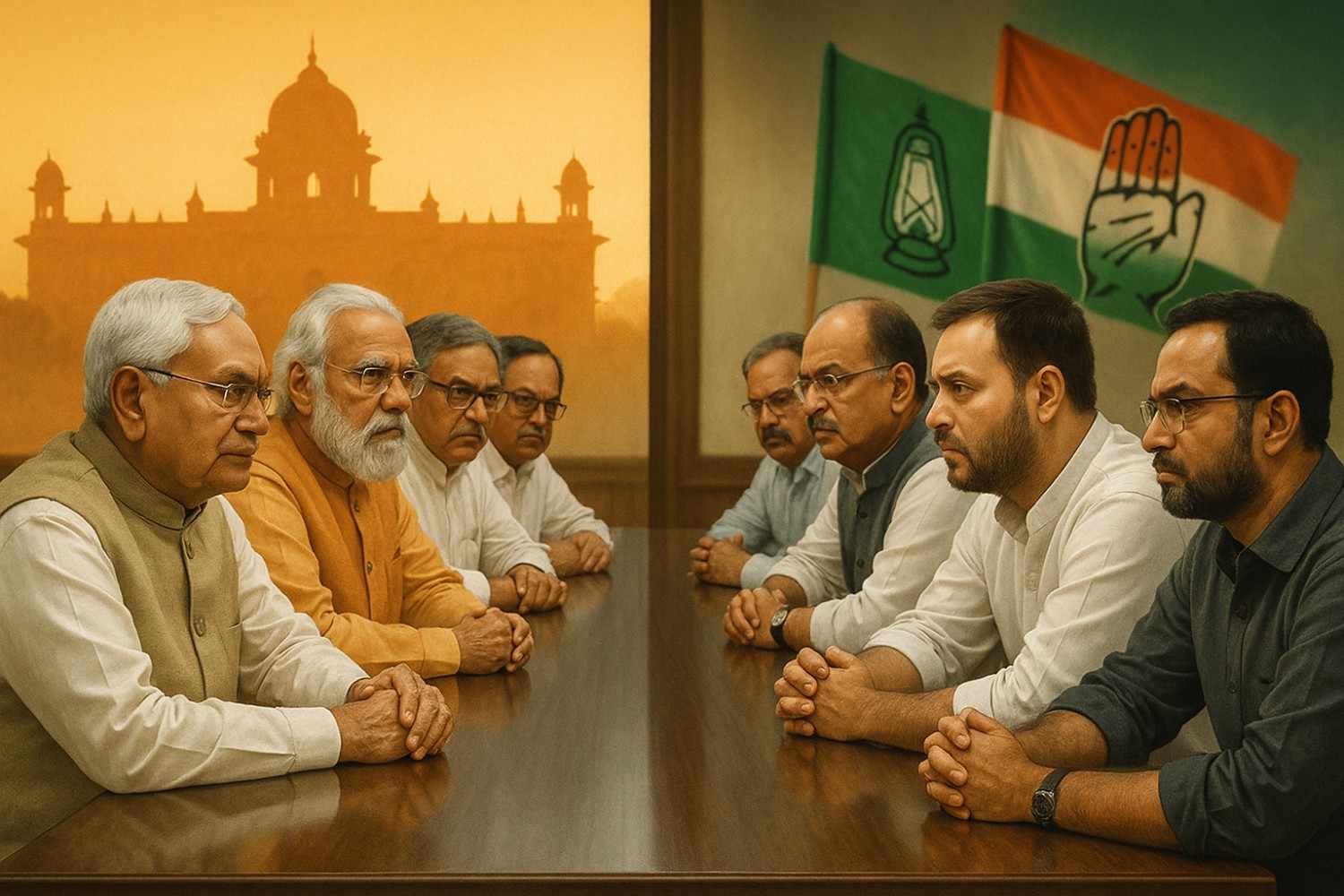
With the Bihar Assembly Elections 2025 drawing closer, political negotiations across the state have reached a breaking point. Both the ruling NDA alliance and the opposition INDIA bloc are locked in intense seat-sharing discussions, each partner pushing for a larger slice of the electoral pie.
What began as a routine negotiation has turned into a power test — where every seat is a symbol of relevance, and every claim carries the weight of future leadership. As the political temperature in Patna rises, this tug-of-war has become the clearest reflection of the shifting alliances, ambitions, and insecurities defining Bihar’s current political landscape.
The Editorial Team of Behind The Headlines breaks down the numbers, the demands, the strategy behind the scenes, and what this high-stakes negotiation means for the road ahead.
NDA Bloc: Pressure Mounts Within
The National Democratic Alliance (NDA), led by the Bharatiya Janata Party (BJP), is facing internal pressure from its key allies — primarily the Janata Dal (United) and smaller partners like the Lok Janshakti Party (Ram Vilas).
JD(U) leaders, led by Chief Minister Nitish Kumar, are reportedly seeking a share of seats equal to or slightly higher than the BJP, arguing that their organizational base and governance record justify parity. Meanwhile, the BJP camp insists that the party’s national reach and voter pull give it the right to contest a larger number of seats.
The Rashtriya Lok Samata Party (RLSP) and HAM-Secular are also demanding fair representation, citing their regional presence in specific constituencies. With all allies pressing their cases, the NDA faces a delicate balancing act — one that could decide whether the alliance remains cohesive or begins to splinter before voting day.
(Read our earlier report — “How Nitish Kumar Is Positioning Himself Ahead of the Bihar Polls”)
INDIA Bloc: Opposition’s Seat Puzzle
On the opposition side, the INDIA alliance, comprising the Rashtriya Janata Dal (RJD), Congress, Left parties, and smaller regional outfits, is struggling with similar internal frictions.
The RJD, led by Tejashwi Yadav, wants to contest the majority of seats, positioning itself as the central pillar of the anti-NDA front. The Congress has demanded a respectable number of constituencies, arguing its national appeal and past performances justify a bigger share than it received in 2020.
Meanwhile, Left parties — particularly the CPI(ML) — are negotiating to retain influence in districts where they performed well in the previous polls. The balancing act within the INDIA bloc is proving equally difficult, as leaders attempt to project unity while privately negotiating hard bargains.
(Also read — “Tejashwi’s Balancing Act: Can RJD Keep INDIA Bloc United?”)
The Numbers Game: Strategic Math Behind the Negotiations
Seat-sharing talks in Bihar are less about numbers and more about symbolic dominance. Both alliances understand that the distribution of seats reflects hierarchy — who leads, who follows, and who gets to claim moral authority in the coalition.
NDA Side
- BJP reportedly aims to contest more than 120 seats.
- JD(U) seeks parity with BJP or a near-equal number.
- Smaller allies together demand 30+ constituencies, mainly in caste-specific strongholds.
INDIA Side
- RJD is targeting 140+ seats, positioning itself as the natural anchor.
- Congress is pushing for around 70 seats, much higher than its last allocation.
- Left parties demand around 25–30 seats, citing their grassroots connect.
Behind the scenes, negotiators are weighing caste arithmetic, winnability, and past performance in each constituency. For both blocs, even minor seat adjustments could swing the momentum.
Analysis: Bihar’s New Political Reality
These negotiations expose more than mere electoral ambition — they underline Bihar’s changing political power balance.
Nitish Kumar’s shifting alliances over the years have reshaped traditional loyalties. The BJP, confident of its national standing, is asserting itself more openly in state politics. The RJD, under Tejashwi, is aggressively targeting first-time voters, aiming to consolidate its Yadav–Muslim–Dalit base while projecting a more development-oriented image.
What’s emerging is a fragmented political map, where ideological lines blur and survival instincts dominate. Both alliances know that every seat counts — not just for 2025, but for their standing in the 2029 Lok Sabha race as well.
(Related feature — “From Patna to Parliament: Bihar’s Role in Shaping National Politics”)
Reactions from Ground and Leadership
Party spokespersons have maintained optimism in public, but insiders describe the atmosphere as “tense yet calculative.” Leaders are holding backdoor talks while publicly downplaying the disagreements.
Grassroots workers, however, have expressed growing frustration, fearing that prolonged delays in seat announcements may demotivate cadres and confuse local voters.
Political analysts believe the outcome of these seat talks could directly influence alliances in other Hindi heartland states preparing for polls in 2026 and beyond.
The Bigger Picture: Stakes Beyond Bihar
Beyond the numbers, the Bihar seat-sharing battle represents a larger national trend — the increasing difficulty of maintaining multi-party coalitions in an age of personality-driven politics.
Both the NDA and INDIA alliances are aware that the perception of disunity could hurt them electorally. Therefore, while negotiations appear heated, leaders are likely to settle differences behind closed doors, presenting a united front once the campaign begins.
However, the final seat distribution will speak volumes about each alliance’s internal dynamics — and who truly calls the shots in Bihar politics today.
Conclusion
As the clock ticks down to election season, Bihar has once again become India’s political theater. The high-decibel seat-sharing talks between NDA and INDIA aren’t merely about power — they’re about prestige, positioning, and political survival.
When the final list emerges, it will not only shape Bihar’s immediate future but also set the tone for national politics heading into the second half of the decade.
The Editorial Team of Behind The Headlines will continue to monitor every twist in the negotiations and their impact on Bihar’s evolving political landscape.
Internal Backlinks
- How Nitish Kumar Is Positioning Himself Ahead of the Bihar Polls
- Tejashwi’s Balancing Act: Can RJD Keep INDIA Bloc United?
- From Patna to Parliament: Bihar’s Role in Shaping National Politics
Related Posts



Stay Informed With the Latest & Most Important News
Previous Post
Next Post


Advertisement





Advertisement
