
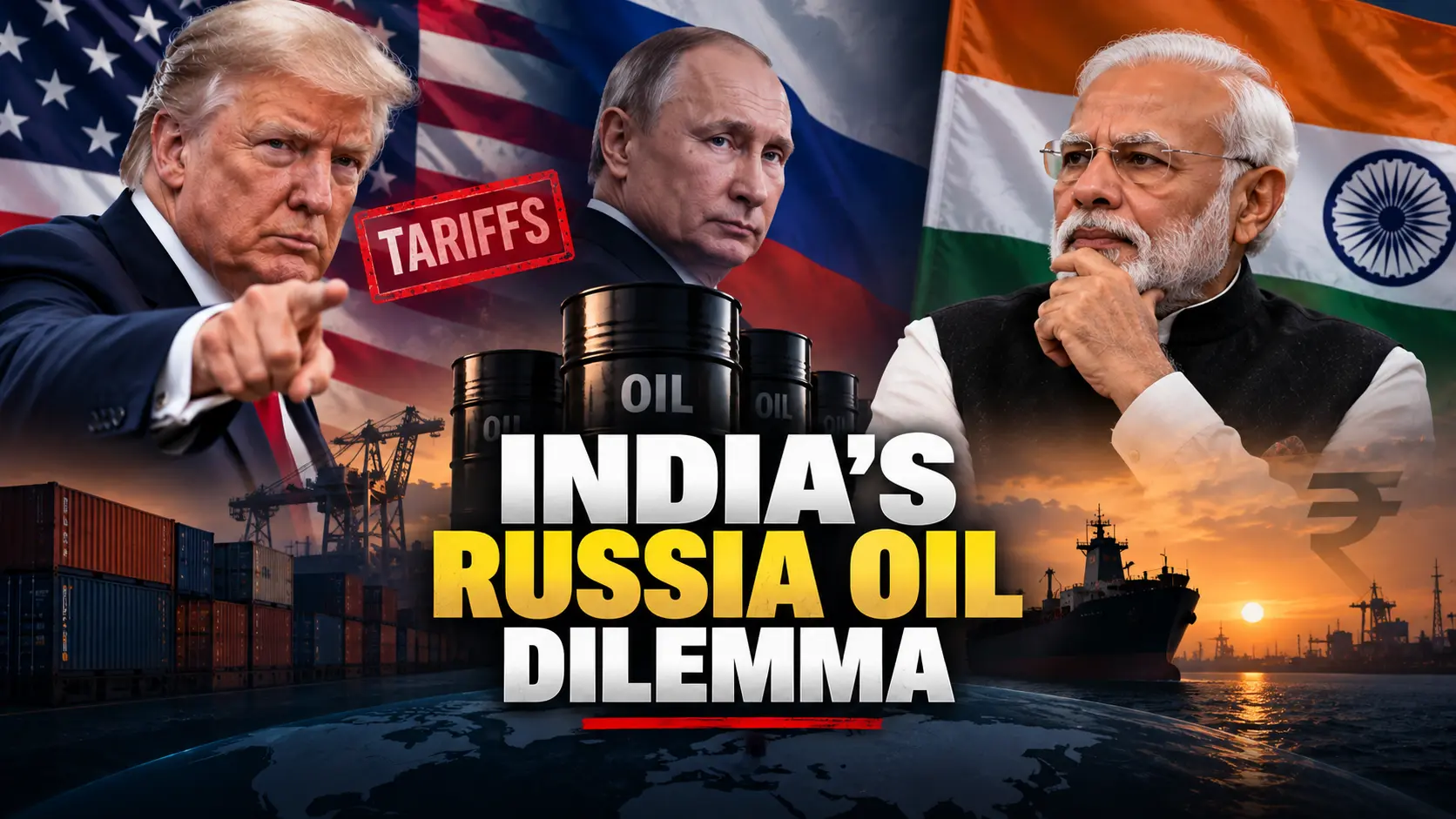
The US has cleared a new sanctions law that could give Washington a powerful tariff tool against countries buying Russian energy, putting India’s oil strategy and trade relationship with the US under fresh pressure.
The US House of Representatives has passed legislation allowing steep tariffs on countries that continue buying Russian oil and gas, with India among the major economies exposed to the measure.
The Editorial Team of Behind The Headlines reports that the legislation does not automatically impose a 100% tariff on Indian goods. Instead, it gives the US president authority to decide whether and how such tariffs are applied, making the next phase of implementation critical for India.
What has the US passed?
The legislation, called the Lindsey O. Graham Sanctioning Russia and Iran Act of 2026, was passed by the US House on September 16 by 262 votes to 159, after clearing the Senate in August.
The bill targets Russia's energy and financial sectors and seeks to increase economic pressure on Moscow over the Ukraine war. It also gives the US president authority to impose tariffs of up to 100% on countries that are major buyers of Russian oil and gas.
The legislation now moves to President Donald Trump for his consideration and signature.
The important point for India is that 100% is a maximum authorised tariff, not an automatic tariff that starts immediately. The US administration would still have to determine how the provisions are used, which countries and products are targeted, and whether exemptions or other arrangements apply.
Why is India exposed?
Russia has become India's largest source of crude oil since the Ukraine war.
Indian refiners increased purchases of Russian crude after Western sanctions reduced Moscow's access to several traditional markets. Discounted Russian barrels became commercially attractive for Indian refiners and helped diversify India's crude supply.
According to recent industry estimates, Russian crude accounted for about 45% of India's oil imports in August, with purchases around 2.08 million barrels per day. In July, other estimates put Russia's share above 50%.
That makes India particularly vulnerable to any US measure aimed at major Russian-energy buyers.
But the issue is not simply about Russia.
India imports more than 88% of its crude oil requirements, meaning the availability and price of international crude directly affect its economy.
India says energy security remains the priority
New Delhi has responded by reiterating that energy security remains a central consideration.
The government has said India will continue to source energy from diversified suppliers according to market conditions and will take necessary steps to protect its trade and economic interests.
India has also told US interlocutors about the potential consequences of the legislation for bilateral relations and international energy markets.
The argument is straightforward: abruptly removing a major source of crude from India's supply chain could increase costs at a time when global energy markets are already under pressure.
Why simply replacing Russian oil is difficult
India can buy more crude from countries such as Saudi Arabia, Iraq, the UAE, the US, Brazil and other producers.
But replacing Russian supplies on a large scale is not an overnight process.
Different crude grades require different refinery configurations. Alternative suppliers may also involve higher freight, insurance and procurement costs.
The timing is particularly significant because the wider West Asia conflict has already disrupted energy flows and pushed crude prices higher.
Recent analysis suggests Russian crude remains one of the most practical large-scale sources available to Indian refiners under current market conditions.
The US trade relationship adds another layer
The sanctions legislation comes while India and the US are also working through their broader trade relationship.
That creates an additional economic dimension.
Washington now has another potential instrument that could influence India's trade calculations. If tariffs are eventually imposed, Indian exports to the US could face higher costs, potentially affecting sectors that depend heavily on the American market.
At the same time, India has an incentive to keep negotiations focused on trade and avoid allowing the energy dispute to spill into the entire bilateral economic relationship.
The eventual outcome will depend heavily on how the Trump administration uses the powers provided by Congress.
Could India stop buying Russian oil?
A complete and immediate shift away from Russian crude would be difficult.
India could reduce its dependence gradually by increasing purchases from other suppliers, but doing so could raise its overall import bill if alternative crude is more expensive.
There is also a broader geopolitical calculation. India has maintained close relations with Russia for decades, particularly in defence, energy and strategic cooperation.
At the same time, the US has become an increasingly important economic and strategic partner for India.
The sanctions bill therefore puts New Delhi in a situation where energy security, trade interests and foreign-policy priorities intersect.
What happens if Trump imposes the tariff?
The impact would depend on several factors.
1. The tariff rate
A maximum authority of 100% does not mean a 100% tariff will necessarily be imposed. A lower rate would have a different economic impact.
2. Which products are covered
The effect would be much larger if the measure covered a broad range of Indian exports rather than a limited set of products.
3. Exemptions and waivers
The legislation gives the US administration room to make implementation decisions. Exemptions or waivers could significantly change India's exposure.
4. India's response
New Delhi could negotiate with Washington, adjust its crude procurement strategy, diversify suppliers further or combine several measures.
The oil-price problem
There is another reason Washington may have to consider implementation carefully.
Removing significant quantities of Russian crude from the global market could tighten supply and push international oil prices higher.
That would not only affect India. Countries across Asia and Europe could face higher energy costs.
For India, expensive crude can increase the import bill, put pressure on the rupee and raise costs across transportation, manufacturing, aviation and petrochemicals.
Therefore, the question is not simply whether India can buy less Russian oil.
It is also what happens to global oil prices if millions of barrels of Russian crude become harder to sell.
What India needs to watch next
Three developments will now be particularly important.
First, whether President Trump signs the legislation and how his administration interprets its tariff provisions.
Second, whether Washington uses the new powers against India or seeks negotiations and exemptions.
Third, how quickly India can diversify its crude basket without substantially increasing its energy costs.
The legislation has therefore created a new source of uncertainty, but its final economic impact is not yet known.
The bigger picture
India's challenge is to protect energy security while managing an increasingly complicated relationship with both Russia and the United States.
Russian crude has become an important part of India's energy strategy because of its availability and pricing. The US, meanwhile, remains an important market and strategic partner.
The new US legislation does not force India to immediately abandon Russian oil. But it gives Washington a new mechanism to exert economic pressure on countries that continue buying Russian energy.
For India, the coming weeks will therefore be less about choosing one supplier overnight and more about negotiating space to keep its energy options open while limiting the impact on trade and the wider economy.